
By GRANT SCHULTE
The Associated Press
LINCOLN, Neb. —
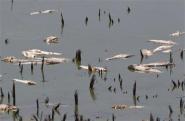
Thousands of fish are dying in the Midwest as the hot, dry summer dries up rivers and causes water temperatures to climb in some spots to nearly 100 degrees.
About 40,000 shovelnose sturgeon were killed in Iowa last week as water temperatures reached 97 degrees. Nebraska fishery officials said they’ve seen thousands of dead sturgeon, catfish, carp, and other species in the Lower Platte River, including the endangered pallid sturgeon.
And biologists in Illinois said the hot weather has killed tens of thousands of large- and smallmouth bass and channel catfish and is threatening the population of the greater redhorse fish, a state-endangered species.
So many fish died in one Illinois lake that the carcasses clogged an intake screen near a power plant, lowering water levels to the point that the station had to shut down one of its generators.
“It’s something I’ve never seen in my career, and I’ve been here for more than 17 years,” said Mark Flammang, a fisheries biologist with the Iowa Department of Natural Resources. “I think what we’re mainly dealing with here are the extremely low flows and this unparalleled heat.”
The fish are victims of one of the driest and warmest summers in history.
The federal U.S. Drought Monitor shows nearly two-thirds of the lower 48 states are experiencing some form of drought, and the Department of Agriculture has declared more than half of the nation’s counties – nearly 1,600 in 32 states – as natural disaster areas. More than 3,000 heat records were broken over the last month.
Iowa DNR officials said the sturgeon found dead in the Des Moines River were worth nearly $10 million, a high value based in part on their highly sought eggs, which are used for caviar. The fish are valued at more than $110 a pound.
Gavin Gibbons, a spokesman for the National Fisheries Institute, said the sturgeon kills don’t appear to have reduced the supply enough to hurt regional caviar suppliers.
Flammang said weekend rain improved some of Iowa’s rivers and lakes, but temperatures were rising again and straining a sturgeon population that develops health problems when water temperatures climb into the 80s.
“Those fish have been in these rivers for thousands of thousands of years, and they’re accustomed to all sorts of weather conditions,” he said. “But sometimes, you have conditions occur that are outside their realm of tolerance.”
In Illinois, heat and lack of rain has dried up a large swath of Aux Sable Creek, the state’s largest habitat for the endangered greater redhorse, a large bottom-feeding fish, said Dan Stephenson, a biologist with the Illinois Department of Natural Resources.
“We’re talking hundreds of thousands (killed), maybe millions by now,” Stephenson said. “If you’re only talking about game fish, it’s probably in the thousands. But for all fish, it’s probably in the millions if you look statewide.”
Stephenson said fish kills happen most summers in small private ponds and streams, but the hot weather this year has made the situation much worse.
“This year has been really, really bad – disproportionately bad, compared to our other years,” he said.
Stephenson said a large number of dead fish were sucked into an intake screen near Powerton Lake in central Illinois, lowering water levels and forcing a temporary shutdown at a nearby power plant. A spokesman for Edison International, which runs the coal-fired plant, said workers shut down one of its two generators for several hours two weeks ago because of extreme heat and low water levels at the lake, which is used for cooling.
In Nebraska, a stretch of the Platte River from Kearney in the central part of the state to Columbus in the east has gone dry and killed a “significant number” of sturgeon, catfish and minnows, said fisheries program manager Daryl Bauer. Bauer said the warm, shallow water has also killed an unknown number of endangered pallid sturgeon.
“It’s a lot of miles of river, and a lot of fish,” Bauer said. “Most of those fish are barely identifiable. In this heat, they decay really fast.”
Bauer said a single dry year usually isn’t enough to hurt the fish population. But he worries dry conditions in Nebraska could continue, repeating a stretch in the mid-2000s that weakened fish populations.
Kansas also has seen declining water levels that pulled younger, smaller game fish away from the vegetation-rich shore lines and forced them to cluster, making them easier targets for predators, said fisheries chief Doug Nygren of the Department of Wildlife, Parks and Tourism.
Nygren said he expects a drop in adult walleye populations in the state’s shallower, wind-swept lakes in southern Kansas. But he said other species, such as large-mouth bass, can tolerate the heat and may multiply faster without competition from walleye.
“These last two years are the hottest we’ve ever seen,” Nygren said. “That really can play a role in changing populations, shifting it in favor of some species over others. The walleye won’t benefit from these high-water temperatures, but other species that are more tolerant may take advantage of their declining population.”
Geno Adams, a fisheries program administrator in South Dakota, said there have been reports of isolated fish kills in its manmade lakes on the Missouri River and others in the eastern part of the state. But it’s unclear how much of a role the heat played in the deaths.
One large batch of carp at Lewis and Clark Lake in the state’s southeast corner had lesions, a sign they were suffering from a bacterial infection. Adams said the fish are more prone to sickness with low water levels and extreme heat. But he added that other fish habitat have seen a record number this year thanks to the 2011 floods.
“When we’re in a drought, there’s a struggle for water and it’s going in all different directions,” Adams said. “Keeping it in the reservoir for recreational fisheries is not at the top of the priority list.”
