
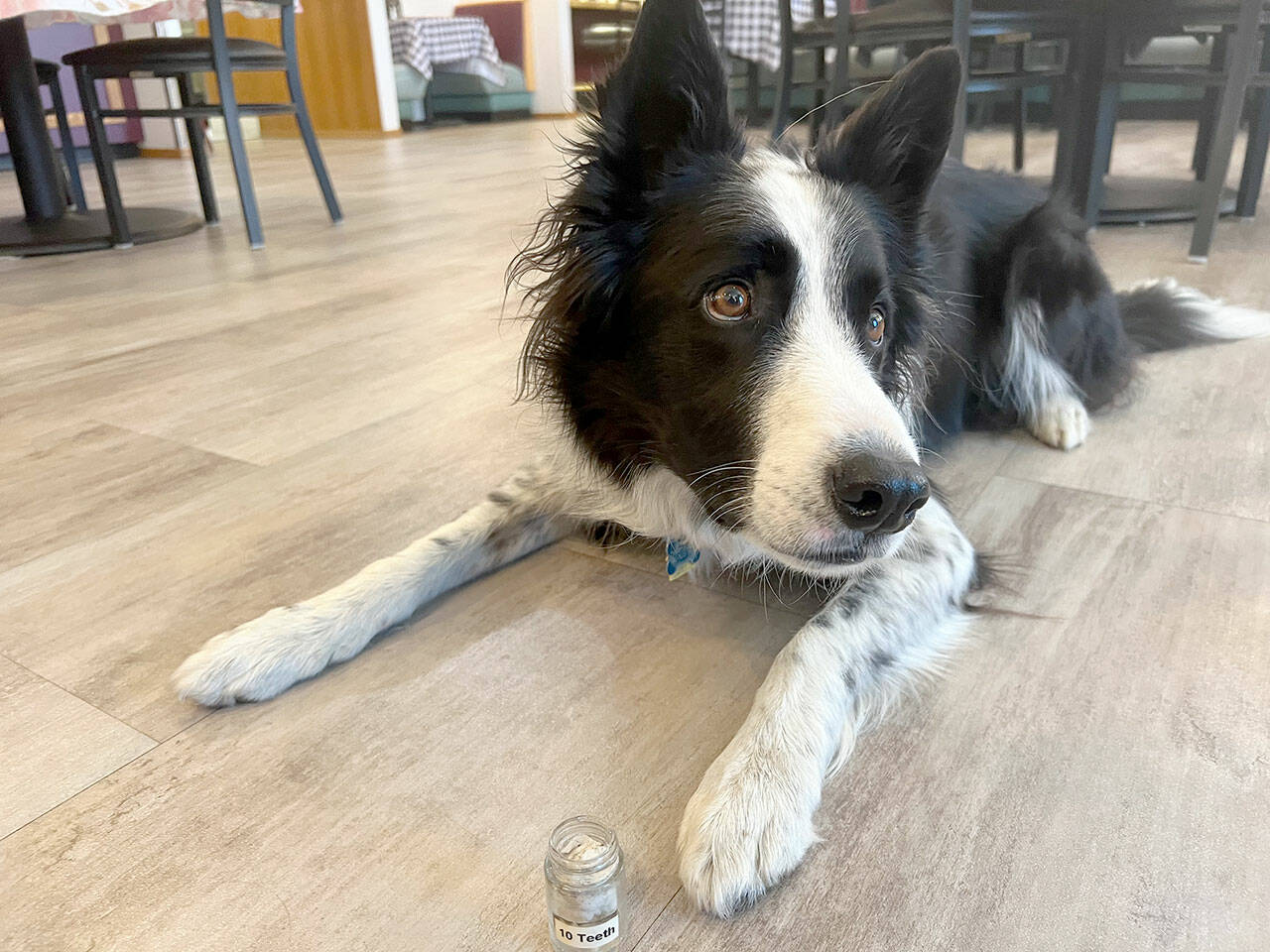
PORT ANGELES — A typical search and rescue dog can be trained to find over 500 scents, but the dogs trained at the Canine Forensics Foundation in Sequim tp find ancient remains have to look for only three.
“Search and Rescue dogs, they have 502 scents they have to look for,” said Cindy Arnold, project manager at Canine Forensics Foundation, or K9FF. “You think of a decomposing body and all of the different stages it goes through. We have a much easier thing to do.”
Those three scents: bones, teeth and ‘cremains’ or cremated remains.
“Dogs can smell 10,000 times better than a human,” said K9FF President Lynne Angeloro, speaking to a meeting of the Port Angeles Nor’Wester Rotary at Joshua’s Restaurant Friday.
“Their nose and the structure of their nose — they have 300 million scent receptors in that nose,” Angeloro said.
A trained dog can find human remains that are hundreds if not thousands of years old, Angeloro said, buried up to nine feet deep or even underwater.
Angeloro has run the K9FF in Sequim since 2019, but she’s worked with dogs in historical human remains detection — or HHRD — for several years, working all over the world to find long-buried bones, teeth and other remains.
Most of her clients are Native American tribes, many of whom know generally where people are buried but not the exact location. Angeloro said she works yearly with the Spokane Tribe of Indians and the Confederated Tribes of the Colville Reservation, searching for remains along river banks.
Angeloro also has been hired to find the remains at the sites of former boarding schools where Native American children were forcibly taken from their families and forced to assimilate into Western culture.
“In 1900, 20,000 children were in the boarding schools,” Angeloro said. “By 1925, there were over 60,000 kids, many of them never returned to their parents.”
“Nobody knows where they are. What they’re finding is some unmarked cemeteries.”
In 2022, the Department of the Interior released the first volume of an investigation into Native American boarding schools which found that hundreds of children died while in the custody of the 408 schools across the nation and its territories.
Training for the dogs starts as young as possible, and while different breeds can be trained to do HHRD, most of K9FF’s dogs are Border Collies.
“It has to be a dog with a longer nose,” Arnold said. “A Pug wouldn’t work; anything with the squished noses, they just don’t have the same smelling power.”
Arnold also said working breeds are best. Sometimes an area will be searched and dogs won’t pick anything up, but the client expects the search to continue.
“A non-working dog will have a tendency to say ‘I’m not going to do it anymore’ where a working breed will say ‘OK, I can keep going,’” Arnold said.
Areas are searched in a grid pattern and nowadays the work is aided by a GPS device in the dog’s collar —sometimes just a cell phone — which sends real-time information back to someone in the field with a laptop.
Areas are searched multiple times by different dog-and-handler teams. As one team searches, flags are set down where dogs “alert” to a scent —either by sitting or laying down — and the GPS coordinates are taken down.
Teams don’t watch each other work, and the flags are removed before the next team moves in so they can search without bias. If multiple teams are all alerting in the same place, you know you’ve got something, Angeloro said.
Before she founded K9FF, Angeloro worked for another canine forensics company that was hired by the National Geographic Society to fly out to a remote atoll in the South Pacific to search for the remains of famed aviatrix Amelia Earheart, who famously disappeared in 1937 while trying to circumnavigate the globe.
In 2017 and again in 2019, Angeloro and the National Geographic team — which included oceanographer Bob Ballard, who discovered the wrecks of the Titanic and the Lusitania — were flown to the Kiribati atoll of Nikumaroro, 1,000 miles north of Fiji.
The results of the search were inconclusive, neither the wreck of Earhart’s plane or her remains were discovered, but Angeloro thinks there’s something there.
“It’s been drilled into me, and I drill into all the handlers that we train, always trust your dog,” Angeloro said. “The dogs have no bias.”
Angeloro said on both trips the four dogs went to the same spot, leading her to believe that someone is buried there. She hopes National Geographic will make another trip to the atoll.
“They dug, but it’s a coral island and it’s really hard to dig very deep,” Angeloro said.
_______
Reporter Peter Segall can be reached at peter.segall@peninsuladailynews.com.
