
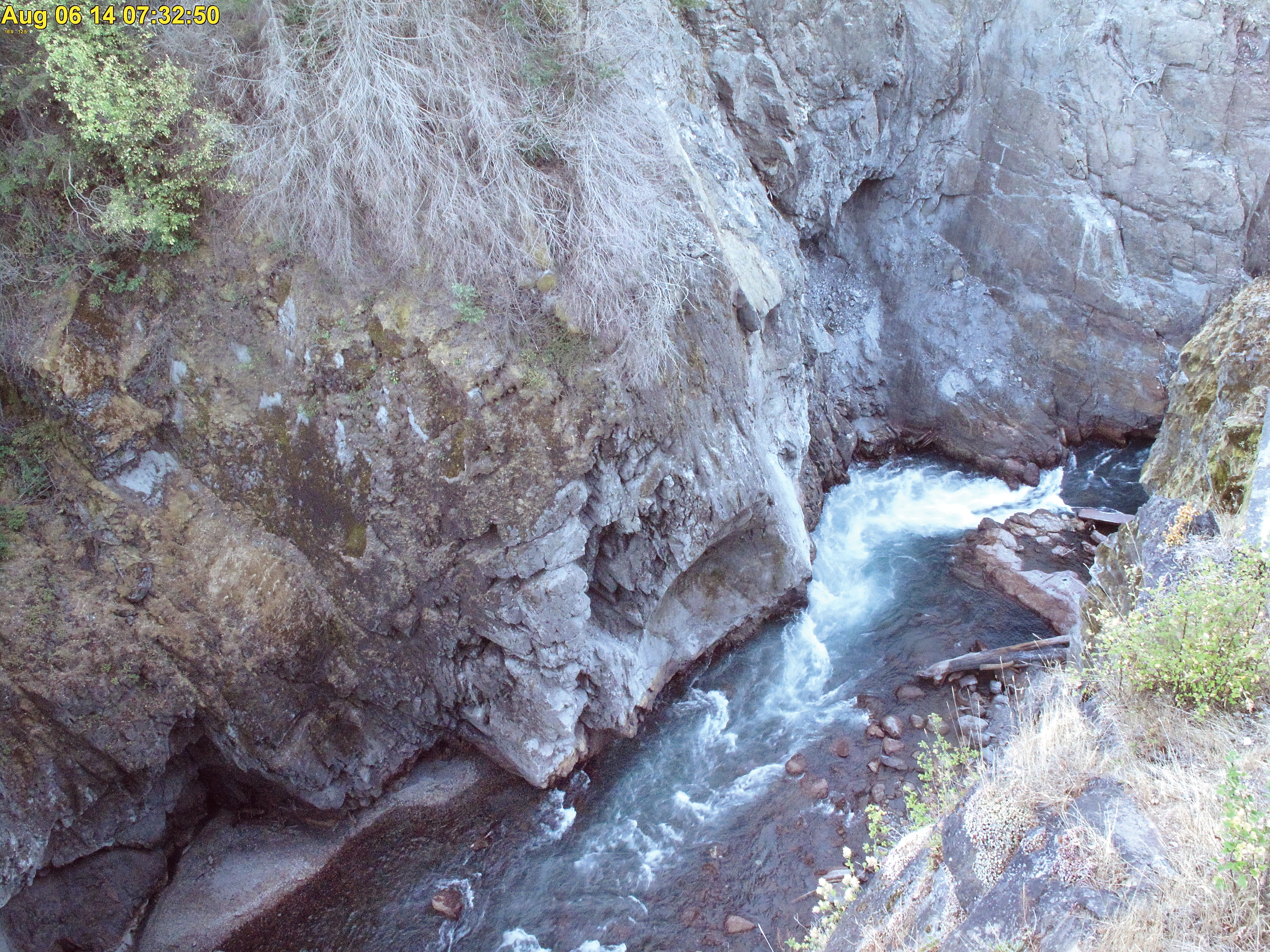
OLYMPIC NATIONAL PARK — The Elwha River is finally beginning to cooperate with efforts to remove the last bit of dam blocking it.
The volume of flow has lowered enough to allow crews with National Park Service contractor Barnard Construction Co. Inc. to restart work — perhaps as early as next week — to take down the final remnant of Glines Canyon Dam 8 miles from the mouth of the Elwha River.
High river flows had prevented access to the once-towering structure’s remaining 30 feet for all of July.
The smaller Elwha Dam downstream was removed in March 2012.
Aaron Jenkins, Elwha River dam-removal project superintendent for Barnard, said this week that crews have begun moving equipment back up to the dam site.
They are expected to begin drilling holes in the dam remnant for the final batch of demolition blasts next week.
“We hope to be ready [for the next blasts] sometime around the end of the month,” Jenkins said, adding that two or three blasts likely will be needed to bring down the rest of the dam.
Glines Canyon Dam, which once towered 210 feet tall, is being removed as part of the larger $325 million project to restore the Elwha River to its wild state, including its fish runs.
The project also removed the older Elwha Dam, built more than 100 years ago.
Both the Elwha and Glines Canyon dams, originally built to provide electricity to Port Angeles and other areas of the Olympic Peninsula, were constructed without fish ladders and so blocked salmon migration.
Demolition explosions last tore chunks from the Glines Canyon concrete edifice in March, Jenkins said.
A “fish window,” a time in which demolition is not allowed to protect spawning fish in the river, ran for all of May and June, said Barb Maynes, park spokeswoman.
River flows topped 1,000 cubic feet per second, or cfs, for most of July, according to U.S. Geological Survey monitoring data, and began decreasing to around 500 cfs in the final week of the month.
Jenkins estimated work crews need consistent flows of about 850 cfs or less to expose the last portion of Glines Canyon Dam enough to drill holes for the demolition explosives.
Maynes said the Park Service has secured a waiver from the U.S. Army Corps of Engineers to allow dam-removal work to take place between Aug. 1 and Sept. 15, which would normally be another fish window.
Maynes said the Park Service consulted with other state and federal agencies, including the Lower Elwha Klallam tribe, the state Department of Fish and Wildlife and the U.S. Fish and Wildlife Service, and concluded that finishing dam removal by this fall would have less negative impact overall on fish than waiting.
“All parties favored the waiver,” Maynes said.
“Not working during the fish window would likely extend the duration of the project, and that would extend the negative effects of the sediment loads for another year.”
The complete removal of the Elwha River dam and the ongoing demolition of its larger upstream cousin have released millions of cubic yards of sediment into the Elwha River and the Strait of Juan de Fuca.
The material was locked behind the dams in the bottoms of the lakes that once bore the names Aldwell and Mills.
“Where we are in the process and where were are with flows, it’s not expected [the blasts] will result in huge pulses of sediment release like we had last year, for example, when blasts were done when there was still water in the [lake],” Maynes said.
Once the final blasts remove the remainder of Glines Canyon Dam, Maynes said, weeks of work will like remain to remove the dam rubble from the bottom of the river.
A crane equipped with a clamshell bucket will then be used to remove the debris, she said, adding that the rubble from the blasts earlier this year is still sitting on the river bed.
“They did remove some last fall, but there’s quite a bit left, so that will need to be done after the final blast is completed,” Maynes said.
The debris will be trucked to a rock pit in Clallam County, where it will be ground up for eventual recycling as road surface, she said.
________
Reporter Jeremy Schwartz can be reached at 360-452-2345, ext. 5074, or at jschwartz@peninsuladailynews.com.
