
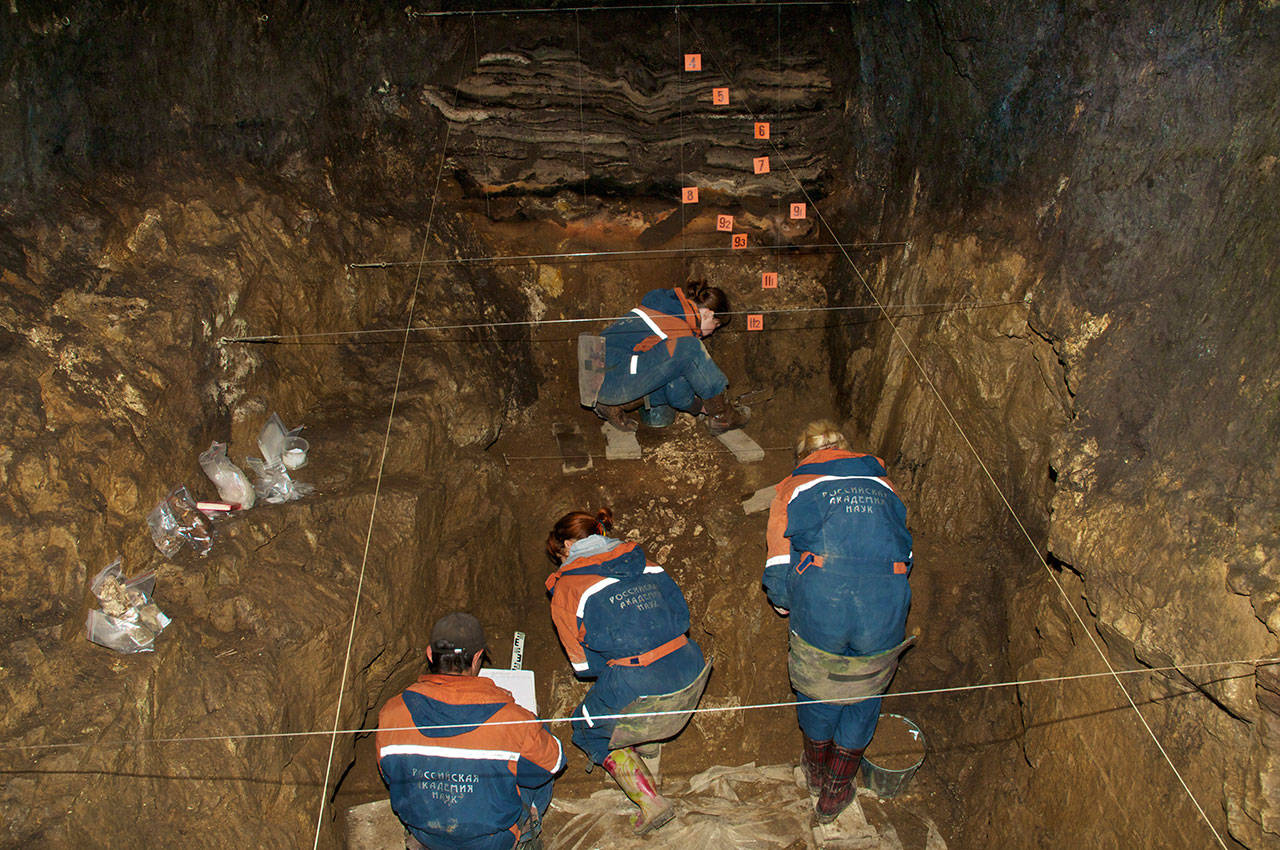
In this 2011 photo provided by Bence Viola of the University of Toronto, researchers excavate a cave for Denisovan fossils in the Altai Krai area of Russia. On Wednesday, Aug. 22, 2018, scientists reported in the journal Nature that they have found the remains of an ancient female whose mother was a Neanderthal and whose father belonged to another extinct group of human relatives known as Denisovans. (Bence Viola/Department of Anthropology - University of Toronto/Max Planck Institute for Evolutionary Anthropology via AP)

In this 2011 photo provided by Bence Viola of the University of Toronto, researchers excavate a cave for Denisovan fossils in the Altai Krai area of Russia. On Wednesday, Aug. 22, 2018, scientists reported in the journal Nature that they have found the remains of an ancient female whose mother was a Neanderthal and whose father belonged to another extinct group of human relatives known as Denisovans. (Bence Viola/Department of Anthropology - University of Toronto/Max Planck Institute for Evolutionary Anthropology via AP)

Fossil shows mixture of humankind’s early cousins

  • By Frank Jordans The Associated Press
  • Sunday, August 26, 2018 11:59am
  • News

By Frank Jordans

The Associated Press

BERLIN — Scientists said they’ve found the remains of a prehistoric female whose mother was a Neanderthal and whose father belonged to another extinct group of human relatives known as Denisovans.

The 90,000-year-old bone fragment found in southern Siberia marks the first time a direct offspring of these two groups has been discovered, according to a study published Wednesday in the journal Nature.

Both groups disappeared by about 40,000 years ago. Neanderthals lived in Europe and Asia, while fossils of Denisovans are known only from the cave where the fragment was found.

Past genetic studies have shown interbreeding between the two groups, as well as with our own species, which left a trace in the DNA of today’s people. But the new study is the first to identify a first-generation child with Neanderthal and Denisovan parents.

“It’s fascinating to find direct evidence of this mixing going on,” said Svante Paabo, one of the study’s lead authors.

Paabo said he was surprised by the discovery, given how relatively few remains of our evolutionary relatives have been found around the world.

The cave near Mongolia where the bone was found contains some remains attributed to Neanderthals as well as Denisovans. But finding an actual offspring of the two groups — which are more different from each other than any two present-day human groups — seemed like a rare stroke of luck, Paabo said.

“The fact that we stumbled across this makes you wonder if the mixing wasn’t quite frequent,” said Paabo, a geneticist at Max Planck Institute for Evolutionary Anthropology in Leipzig, Germany.

The finding doesn’t reveal how often such mating occurred and where, said Ron Pinhasi, a physical anthropologist at the University of Vienna who wasn’t involved in the study.

“Had it happened frequently, we would not have such divergence between the Denisovans and Neanderthal genomes,” he said.

The newly discovered DNA could be interpreted in different ways, said Anders Eriksson, evolutionary population geneticist at King’s College London who wasn’t involved in the study.

“I think they convincingly showed that genetically this individual falls halfway between the Neanderthal and Denisovan fossils found in the same cave,” he said. “But I’m less convinced that it is necessarily a first-generation offspring of a union between Neanderthal and Denisovan.”

The fossil could instead have come from a population with roughly an equal mix of Neanderthal and Denisovan ancestry, he said. It will take analysis of more fossils to find out, he said.

The researchers said the small bone fragment likely came from the arm or leg of a female who was at least 13 years old at the time of death.

Comparison with other ancient DNA showed that the genes she inherited from her mother were more closely related to Neanderthals who lived later in Europe than to other Neanderthal remains found in the cave, suggesting a wave of westward migration.

Together with previously discovered remains of a Homo sapiens that had a Neanderthal ancestor four to six generations earlier, Paabo said the latest find supports the theory that the now-extinct ancient lineages may have been absorbed through interbreeding with modern humans, rather than wiped out through warfare as is widely believed.

More in News

Two dead after tree falls in Olympic National Forest

Two women died after a tree fell in Olympic National… Continue reading

Sue Long, left, Vicki Bennett and Frank Handler, all from Port Townsend, volunteer at the Martin Luther King Day of Service beach restoration on Monday at Fort Worden State Park. The activity took place on Knapp Circle near the Point Wilson Lighthouse. Sixty-four volunteers participated in the removal of non-native beach grasses. (Steve Mullensky/for Peninsula Daily News)
Work party

Sue Long, left, Vicki Bennett and Frank Handler, all from Port Townsend,… Continue reading

Portion of bridge to be replaced

Tribe: Wooden truss at railroad park deteriorating

Kingsya Omega, left, and Ben Wilson settle into a hand-holding exercise. (Aliko Weste)
Process undermines ‘Black brute’ narrative

Port Townsend company’s second film shot in Hawaii

Jefferson PUD to replace water main in Coyle

Jefferson PUD commissioners awarded a $1.3 million construction contract… Continue reading

Scott Mauk.
Chimacum superintendent receives national award

Chimacum School District Superintendent Scott Mauk has received the National… Continue reading

Hood Canal Coordinating Council meeting canceled

The annual meeting of the Hood Canal Coordinating Council, scheduled… Continue reading

Bruce Murray, left, and Ralph Parsons hang a cloth exhibition in the rotunda of the old Clallam County Courthouse on Friday in Port Angeles. The North Olympic History Center exhibit tells the story of the post office past and present across Clallam County. The display will be open until early February, when it will be relocated to the Sequim City Hall followed by stops on the West End. The project was made possible due to a grant from the Clallam County Heritage Advisory Board. (Dave Logan/for Peninsula Daily News)
Post office past and present

Bruce Murray, left, and Ralph Parsons hang a cloth exhibition in the… Continue reading

This agave grew from the size of a baseball in the 1990s to the height of Isobel Johnston’s roof in 2020. She saw it bloom in 2023. Following her death last year, Clallam County Fire District 3 commissioners, who purchased the property on Fifth Avenue in 2015, agreed to sell it to support the building of a new Carlsborg fire station. (Matthew Nash/Olympic Peninsula News Group file)
Fire district to sell property known for its Sequim agave plant

Sale proceeds may support new Carlsborg station project

As part of Olympic Theatre Arts’ energy renovation upgrade project, new lighting has been installed, including on the Elaine and Robert Caldwell Main Stage that allows for new and improved effects. (Olympic Theatre Arts)
Olympic Theatre Arts remodels its building

New roof, LED lights, HVAC throughout

Weekly flight operations scheduled

Field carrier landing practice operations will be conducted for aircraft… Continue reading