
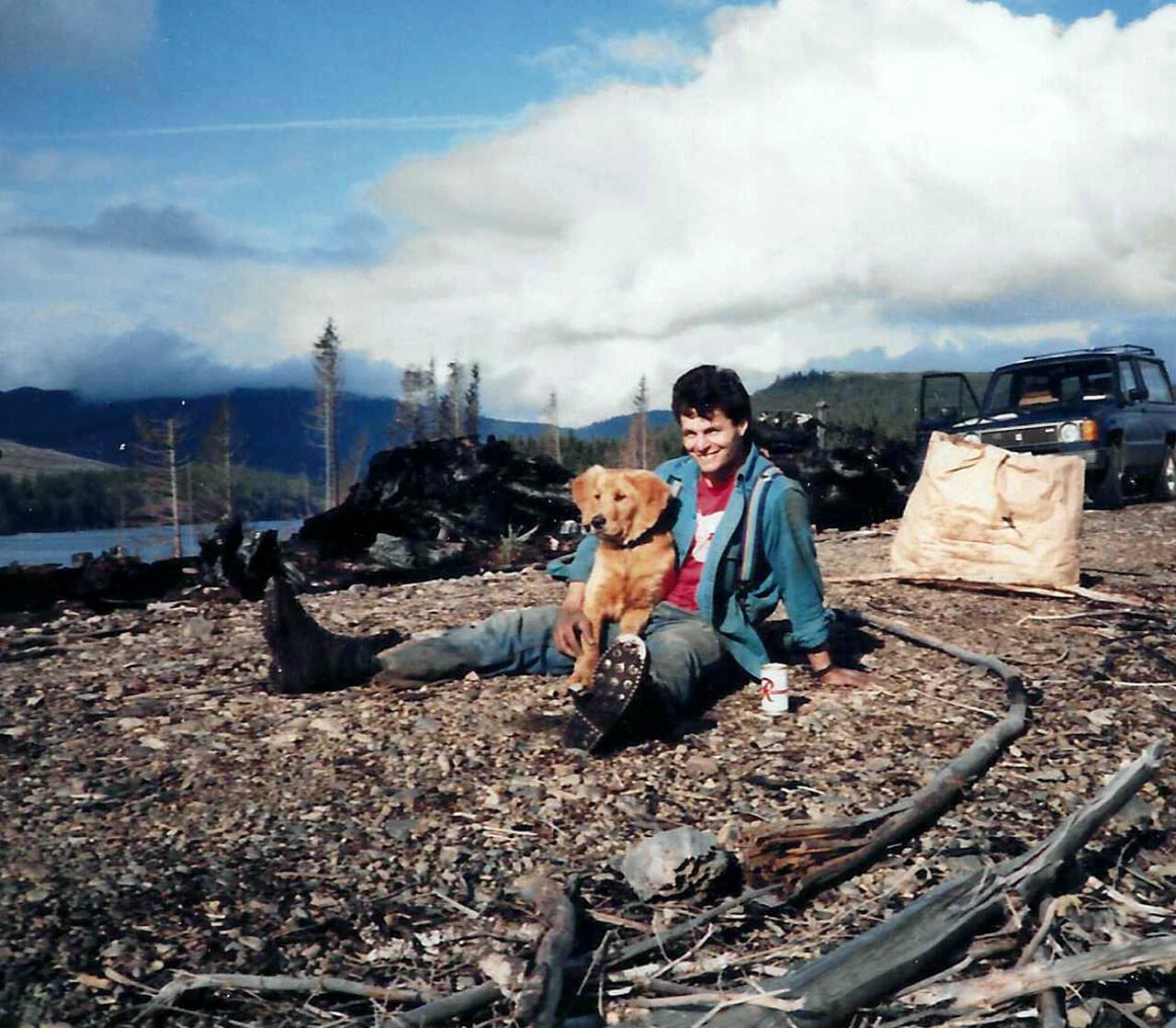
PORT ANGELES — The first indication Tom Swanson had that something was amiss on the West End came on the morning of Sept. 25, 1985, as he drove west on U.S. Highway 101 to visit the site of a recent Milwaukee Land Company slash burn.
“I remember getting this sinking feeling in my stomach as I could see the underside of the alder leaves that were still on the trees,” said Swanson, who was a forester with the company at the time.
“The wind is at my back, so if the leaves are turned and I can see the underside of them, this means east winds. This is not good.”
Swanson’s instincts were correct.
East winds driven by a high-pressure system over the interior of British Columbia and funneled through the Strait of Juan de Fuca produce the dry, low-humidity conditions that those who live in the sparsely populated area of Clallam County know from experience can create the ideal conditions for fire.
An east wind blowing up to 50 mph that day 40 years ago re-ignited the remnants of a slash fire on a recently logged area southeast of Lake Pleasant, leading to a blaze that involved 1,300 firefighters and torched more than 550 acres.
The Lake Pleasant — or “Pistol Grip” — fire was actually a collection of blazes that flared across private, state and federal lands over the next few days and blanketed the North Olympic Peninsula with smoke from just west of Port Angeles to the coast.
At 105 acres, the Lake Pleasant fire wasn’t even the largest or most persistent. A 130-acre fire that broke out on U.S. Forest Service land 8 miles southeast of Lake Quinault proved particularly difficult to extinguish due to steep terrain that hindered trail construction to the site.
“There were multiple slash burns that day, but Lake Pleasant was the one we were worried about because there were homes, a mill and a store” on the north side of Highway 101, said Jeff McGinley, who worked for the state Department of Natural Resources at the time and now owns Pacific Forest Management in Forks. (No structures ended up burning.)
There also was concern the wind would blow embers to the south into a nearby clearcut.
Firefighters from around Washington, Oregon and California were called to fight and contain the blazes. They were joined by crews from the Department of Natural Resources, the Beaver Fire Department, the Bureau of Indian Affairs, U.S. Army personnel and locals.
Swanson remembers Dan Christensen, a section manager with DNR, using a two-radio to call for help: “He’s saying, ‘I need every helicopter and fire crew you can spare because this thing is getting out of hand in a hurry.’”
Beaver shake and shingle mill owner Rene Davis and his crew were commandeered to pull down old snags that were in the fire’s path.
“The wind was kind of wild that day,” said Davis, now 84. “It wasn’t gigantic, but it was sure fast, and it could have been a lot worse.”
With seasonal fire crews made of up college students already back in class, DNR was challenged to find help in a hurry.
“We put anybody we could get together, even office staff, into fire trucks,” McGinley said. “We actually set up a fire truck in the middle of Highway 101 to lay out hose and pump water.”
By the next day, a large part of the fire was significantly under control, McGinley said.
The blaze was throwing off so many sparks, Swanson recalled, that even the tops of old pilings in Lake Pleasant were catching on fire.
Controlled burns to get rid of brush, stumps, branches and other debris left behind by logging operations, to remove wildfire fuel and to improve the site for replanting, are less frequent today, Swanson said, but they were standard practice 40 years ago.
“In the ’60s, ’70s, and ’80s, it was very common to burn slash under permit, starting in about July and going all the way through August,” Swanson said. “It was the rare burn slash that didn’t have an escape, but they were attended by on-site crews.”
Problems arise when embers believed to be extinguished — like those at the Lake Pleasant site — are rekindled.
“A hot, dry wind will just accelerate that process like you wouldn’t believe,” Swanson said.
In the weeks that led up to the fire, Swanson and other Milwaukee Land Company employees were at the site every day conducting mop-up operations.
“We thought we had it out, and then the winds came up and away it went,” he said.
You would have to look hard to find a sign the Lake Pleasant fire ever occurred. The area was replanted, and natural regeneration quickly reestablished the wooded landscape.
“You’d never even known it was burnt,” Davis said.
________
Reporter Paula Hunt can be reached by email at paula.hunt@peninsuladailynews.com
Forks fire
More than a generation before the Lake Pleasant fire, a similar hot, dry wind from the east ignited a blaze that tore through almost 32,668 acres in the Olympic National Forest near the north fork of the Calawah River.
The Forks fire — also known as the Port Angeles and Western Railway fire — that began on Sept. 20, 1951, torched more than a half-billion board feet of timber as it raced across an area about 20 miles long and 2 1/2 miles wide, forcing the evacuation of the town and destroying 32 homes, businesses and farm buildings.
