
FORKS — It’s just an ordinary black-and-white soccer ball, but the tales it could tell after traveling more than 9,000 miles, first by sea and then by air, would make Wilson the volleyball from the 2000 film “Cast Away” seem like a landlubber.
The first 4,424 miles were by sea after the massive March 2011 earthquake and tsunami hit Japan.
The second journey was by air, as the ball was carried back to its home by John Anderson of Forks, a collector of flotsam and a beachcomber extraordinaire.
The soccer ball was with other soccer equipment in a coach’s van near Otsuchi, Japan, when the 2011 earthquake and tsunami hit Japan.
The coach lost his life that day.
“When we returned the soccer ball . . . they got a little emotional,” Anderson said.
The small town of Otsuchi in Iwate Prefecture in northeastern Japan was one of the hardest hit, with some 10 percent of the population dead or missing after the 8.9-magnitude quake and resultant tsunami.
The soccer ball was swept out to sea and was carried over the Pacific to the beaches of Northwest Washington.
There, it was found by members of the Ikkatsu Project, formed by kayakers in Tacoma in 2012 to survey remote beaches for marine debris.
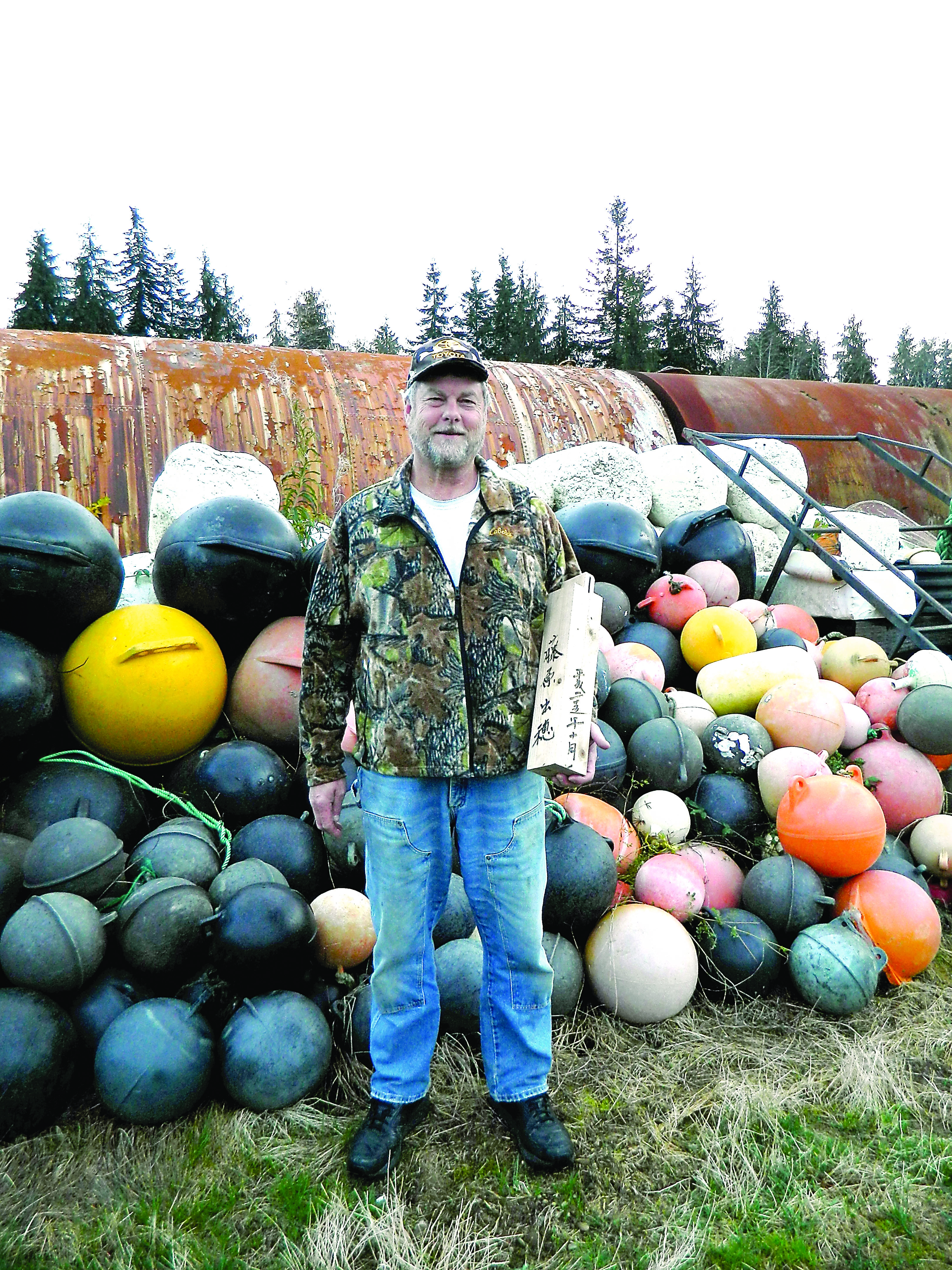
They gave the ball to Anderson, who added it to his Beachcombing Museum in Forks, a collection gathered over more than 40 years of walking area beaches.
Anderson placed the ball in a protected area he set aside for his smaller and more personal finds washed ashore after the Japanese tsunami.
Toronto filmmakers John Choi and Nicolina Lanni came upon Anderson in an Internet search for seasoned beachcombers.
Anderson has gained national attention for his vast collection of beach treasures, so the pair contacted him to see whether he’d be interested in participating in their movie, “Lost and Found,” a documentary about the stories attached to personal items washed out to sea with the tsunami.
In agreeing to be part of the film, Anderson got a ticket to another country that has provided many of the interesting objects he’s collected.
After an 11-hour flight to meet the film crew and return articles he’d recovered that had personal identification, Anderson touched down in Tokyo — 4,779 miles from Seattle to Tokyo — with the soccer ball and a few other items from the disaster.
“The toughest part is going to be returning things to people [when the owners] aren’t alive,” Anderson said before leaving at the end of October.
During his 10 days abroad, he found out how hard it was.
With several lucky breaks and through the assistance of an interpreter, he was able to return the soccer ball to coaches who had worked with the deceased coach.
He was grateful that children were practicing with the coaches at the time, saying they provided a distraction before the sadness became overwhelming.
This was not the only difficult point in the trip. The crew followed many clues that led to dead ends.
“We kept getting excited, and then the letdown would be emotional,” Anderson said.
“It was a roller coaster.”
A hard hat and float Anderson had hoped to return were going to require more sleuthing than he had time to spend overseas, he said.
The personal identifications on each did not lead directly to any living individuals he could readily locate.
Anderson was struck by the immensity of the loss the Japanese people have gone through.
Everywhere he visited, townspeople had created shrines to cope with the loss.
Each tribute was an impromptu collection honoring the people and places that were lost in the largest earthquake and tsunami to hit Japan since record-keeping began in 1900.
Anderson described his trip as “incredible.”
Among the highlights were watching the removal of the last portion of a ship that had settled 4 miles inland at Kesennuma, Japan.
It was here he also saw machines pick up the flattened remainder of a car from under the ship and uniformed men pick up hand rakes to look for human remains.
He saw owners return to destroyed homes to plant gardens in the foundations after the Japanese government declared areas closest to the sea a greenbelt and required the citizenry to relocate to higher ground.
Anderson appreciated seeing items in everyday use that were identical to what he has found on local beaches.
Such things as survey markers and beverage crates seem special when they have drifted across the sea, he said.
Anderson also served as an ambassador for the city of Forks.
He brought a letter from Forks Mayor Bryon Monohon to officials of the city of Ishinomaki, which also was hard-hit, proposing the cities enter into a sister-city relationship.
“Please accept the visit of Mister John Anderson with our sorrows for your losses and the knowledge that we honor and respect your successful future,” the letter said.
It will be some time before the mayor and council of Ishinomaki will be able to make a decision, Anderson said.
“Their old City Hall was destroyed, so now the city is being run from donated space in the top story of a supermarket,” he said.
“Lost and Found” aims to reunite items discovered by beachcombers and others who feel compelled to return them to their rightful owners, then film the stories, Choi says on the website, www.lostandfoundthefilm.ca.
The film is in the production phase, with filmmakers hoping to release the film on the third anniversary of the disaster.
The film crew currently is looking for transcribers at “Lost and Found the Film” on Facebook.
Anderson said another trip to Japan may be in his future.
“I found another ball with writing on it just the other day,” Anderson said.
________
Zorina Barker is a freelance writer and photographer living in the Sol Duc Valley.
