
By Andrew Selsky
The Associated Press
SISTERS, Ore. — Lightning started a forest fire one August afternoon near this Oregon tourist town, and it was spreading fast.
Residents in outlying areas evacuated as flames marched toward their homes.
Just a few months earlier, the U.S. Forest Service and a group of locals representing environmental, logging and recreational interests arranged to thin part of the overgrown forest, creating a buffer zone around Sisters.
Workers removed trees and brush with machines, then came through on foot to ignite prescribed burns.
That effort saved homes, and perhaps the community of 2,500 on the eastern slopes of the Cascade Range, by slowing the fire’s progress and allowing firefighters to corral it.
Devastating fires
Scrutiny of the condition of the American West’s forests, and of policies that curtailed logging and suppressed wildfires, has intensified amid a devastating wildfire season that has burned a combined area bigger than Maryland and caused widespread destruction in California’s wine country.
Until the advent of aggressive fire suppression at the turn of the last century, forests were historically shaped by low-intensity blazes, with the flames clearing underbrush but not killing tall trees.
Forests across the West are now so overgrown they’ve been called powder kegs.
The work by the Deschutes Collaborative Forest Project in central Oregon, where towns and subdivisions sit in a green ocean of Ponderosa and lodgepole pines, shows the potential of forest thinning.
And it shows how loggers and environmentalists — normally bitter enemies — can join forces.
But it also highlights the challenges of replicating the forest thinning across the West, where a lack of timber workers and money are among the obstacles.
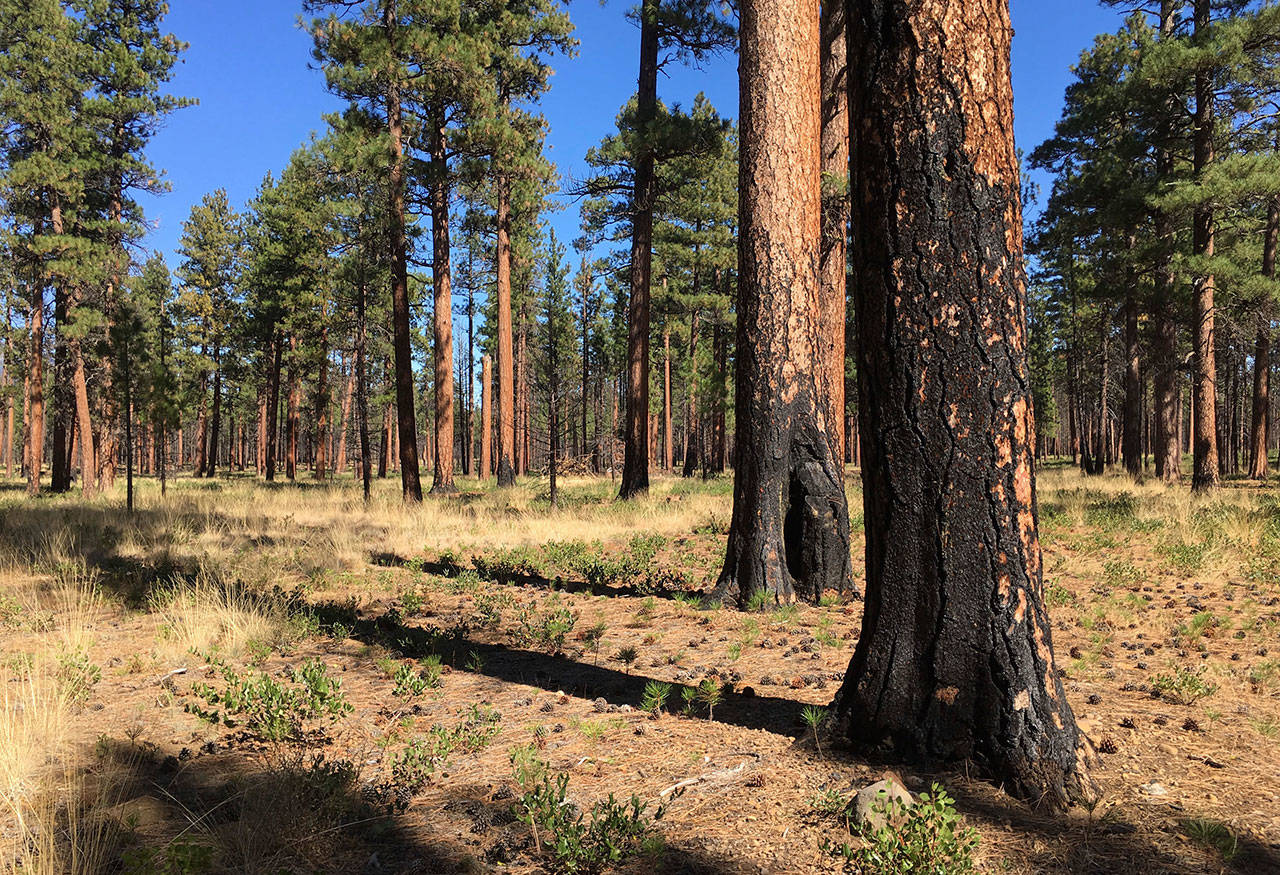
On a recent morning, Forest Service fire manager James Osborne drove into a section of the Deschutes National Forest outside Sisters that was thinned in May.
Blackened trunks
Widely spaced Ponderosas were blackened to twice the height of a person. But higher up, the bark retained its normal orangey color.
Needle clusters shone vibrant green in the sunshine.
Four deer trotted through dappled sunlight.
This part of the forest looked healthy, not despite of, but due to, the prescribed burn.
“Ponderosa pines are used to low-intensity fires,” Osborne said.
“Every five to 15 years, a fire would come through. We’re trying to take it back to low-intensity fires.”
California’s situation is different because its wildfires have generally ignited in chaparral — brush that naturally grows densely packed, said Andrew Latimer, plant expert at the University of California-Davis.
The temperate coniferous forests that burn in large wildfires elsewhere are historically less dense.
Returning those forests to their natural state is the goal of groups such as the Deschutes Collaborative, one of 23 projects in the Collaborative Forest Landscape Restoration program created in 2009 by Congress.
Overcoming suspicions and stereotypes was one of the Oregon group’s first hurdles.
Deschutes Collaborative member Marilyn Miller, an environmentalist, and former member Chuck Burley, who then worked for an Oregon sawmill, used to call each other names, Miller recalled during a recent tour of Deschutes Collaborative projects.
But they got to know each other in Bend, home to more microbreweries per capita than anywhere else in America.
“I hate to say this, but beer really is a good conversation starter,” Miller said.
“We would sit and talk. We learned we’re real humans with real concerns, and what we care about isn’t that far apart.”
Burley, who’s now employed with the Forest Service, said the Deschutes Collaborative made recommendations on where and how much to thin, and the Forest Service almost always adopted them.
“They had a consensus, a starting point,” Burley said in a phone interview.
Oregon Gov. Kate Brown, a Democrat, applauds collaborative efforts, including the Good Neighbor Authority under which states can organize restoration of federal lands.
Under the programs, a mill removes the timber after agreeing to buy it at a certain rate. The proceeds stay local, helping finance more restoration.
“No. 1, it allows us to put Oregonians back to work in the woods, so there are good jobs,” Brown said. “No. 2, it provides product for the local milling infrastructure. And No. 3, it creates healthier forests. Do I think we need more efforts like this? Absolutely.”
Such groups understand some management is required to keep public lands healthy, said Amy Tinderholt, a Deschutes National Forest ranger.
But replicating the work across the sprawling reaches of the West poses several challenges.
“We really don’t have the capacity in most places to do the work at anything like the scale needed,” said John Bailey, an Oregon State University professor of silviculture and fire management.
There are no longer enough timber outlets such as mills and plants, he said.
And things such as equipment, trucks, drivers and infrastructure will take time and resources to ramp back up.
Also, smoke from controlled burns can surpass legal limits, though it’s much less than smoke from out-of-control wildfires.
Some wilderness areas and habitats for endangered species could be off-limits.
Another challenge is money.
“All of those funds will take you only so far across the landscape, and we’ve got pretty large landscapes,” Tinderholt said.
Restored areas also would have to be thinned again after some years, unless fires are allowed to burn the vegetation that grows back.
In Oregon, many locals are proud of the Deschutes Collaborative’s work, and want to see more done in the state and other parts of the West.
“As it unfolded, the community has really come behind it. It’s amazing,” said Kevin Larkin, a senior Deschutes Forest ranger.
“Scaling up, that’s our hope.”
