
By OSKAR GARCIA
The Associated Press
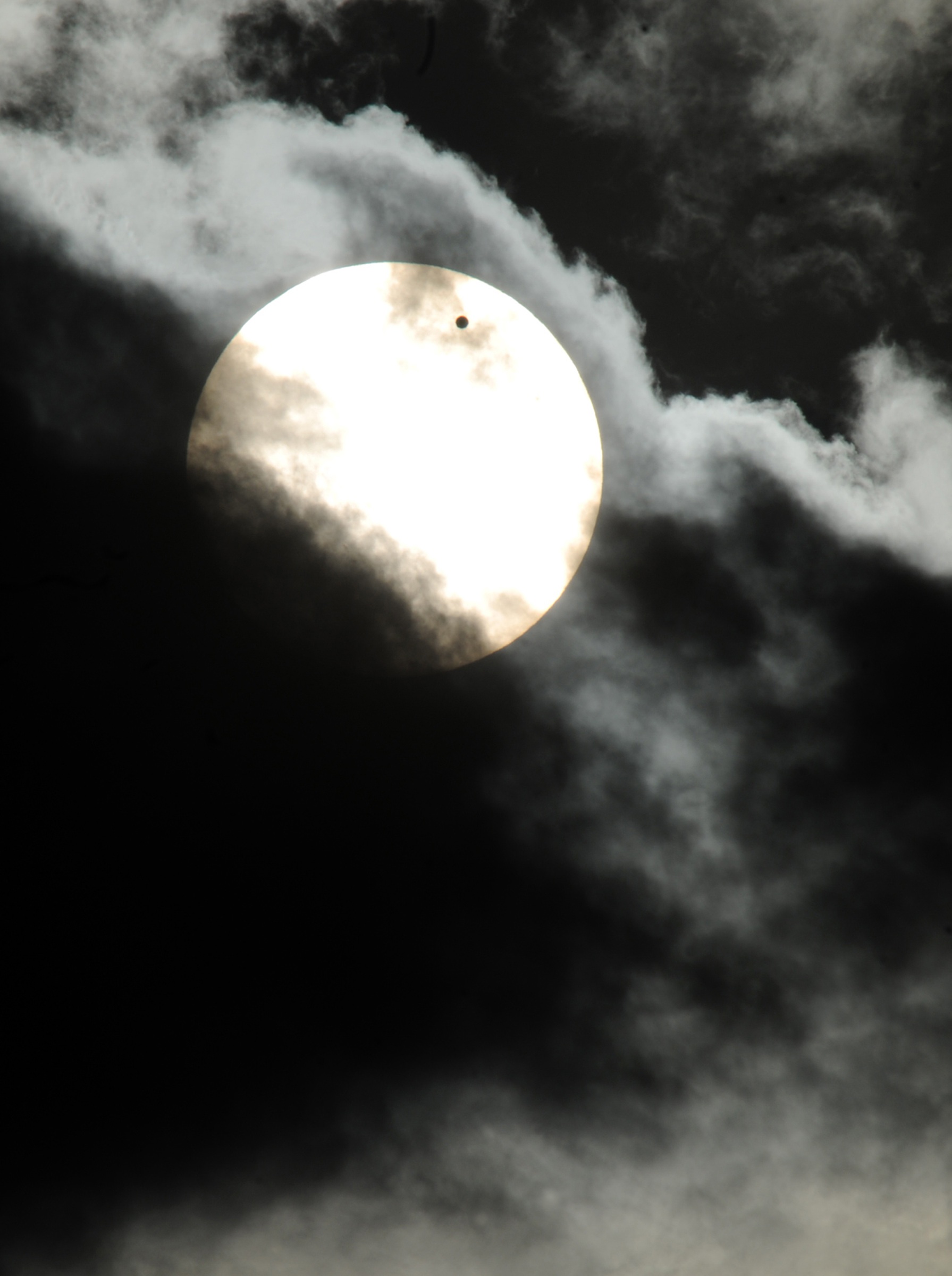
HONOLULU — Filtering the sun’s light to a miniscule fraction of its true power allowed sky-gazers over the world to watch a silhouetted Venus travel across Earth’s closest star on Tuesday, an extremely rare spectacle that served as a reminder of how tiny our planet really is.
After all, the next transit is 105 years away — likely beyond all of our lifetimes but just another dinky speck in the timeline of the universe.
“I’m sad to see Venus go,” electrical engineer Andrew Cooper of the W.M. Keck Observatory told viewers watching a webcast of the transit’s final moments as seen from the nearly 14,000-foot summit of Mauna Kea volcano on Hawaii’s Big Island.
From Maui to Mumbai, Mexico to Norway, much of the world watched the 6-hour, 40-minute celestial showcase through special telescopes, live streams on the Internet or with the naked eye through cheap cardboard glasses.
“If you can see the mole on Cindy Crawford’s face, you can see Venus,” Van Webster, a member of the Los Angeles Astronomical Society, told anyone who stopped by his telescope for a peek on Mount Hollywood.
For astronomers, the transit wasn’t just a rare planetary spectacle. It was also one of those events they hoped would spark curiosity about the universe and our place in it.
Sul Ah Chim, a researcher at the Korea Astronomy and Space Science Institute in South Korea, said he hoped people see life from a larger perspective, and “not get caught up in their small, everyday problems.”
“When you think about it from the context of the universe, 105 years is a very short period of time and the Earth is only a small, pale blue spot,” he said.
The transit began just after 3 p.m. Pacific time in the United States.
What observers could see and for how long depended on their region’s exposure to the sun during that exact window of time, and the weather.
Those in most areas of North and Central America saw the start of the transit until sunset, while those in western Asia, the eastern half of Africa and most of Europe could catch the transit’s end once the sun came up.
Hawaii, Alaska, eastern Australia and eastern Asia including Japan, North and South Korea and eastern China get the whole show since the entire transit happens during daylight in those regions.
While astronomers used the latest technology to document the transit, American astronaut Don Pettit aboard the International Space Station was planning to take photos of the event and post them online.
Online streams with footage from telescopes around the world proved popular for NASA and other observatories. A NASA stream midway through the transit had nearly 2 million total views and was getting roughly 90,000 viewers at any given moment.
Meanwhile, terrestrial stargazers were warned to only look at the celestial event with a properly filtered telescope or cardboard eclipse glasses. If the sun is viewed directly, permanent eye damage could result.
Roy Gal, an assistant astronomer at the University of Hawaii, told those viewing the transit at Waikiki Beach on Oahu that the telescopes were filtered to block all but 1/100th of 1 percent of the sun’s light, plus all its infrared rays to keep the instruments from overheating.
“What we need to do is block out most of the light from the sun so that we don’t go blind and we don’t melt things,” Gal said in an interview.
In Los Angeles, throngs jammed Mount Hollywood where the Griffith Observatory rolled out the red carpet for Venus. The last time the city witnessed a Venus transit was 130 years ago in 1882. A 2004 transit was not visible from the western U.S.
Telescopes with special filters were set up next to the lawn and people took turns peering at the sun before and during the transit. Astronomers and volunteers lectured about the rarity of a Venus pass to anyone who would listen.
Minutes before Venus first touched the outer edge of the sun, Sousa’s “Transit Of Venus March” blared through. The crowd turned their attention skyward.
Jamie Jetton took the day off from work to bring her two nephews, 6 and 11, visiting from Arizona to the observatory. Sporting eclipse glasses, it took a little while before they spotted Venus.
“I’m still having fun. It’s an experience. It’s something we’ll talk about for the rest of our lives,” she said.
Bo Tan, a 32-year-old software engineer took a half day off from work and went with his co-workers to the observatory. He admitted he wasn’t an astronomy buff but could not miss this opportunity.
He pointed his eclipse glasses at the sun and steadied his Nikon camera behind it to snap pictures.
“It makes you feel like a small speck in the universe,” he said.
Clouds obscured the view in Tokyo, but students and other viewers under clearer skies in southern and western Japan were seen on TV using dark lenses to gaze at the sun. One child remarked that it looked as if the “sun had a mole on its face.”
In India, where astrology is so popular it influences decisions from when to get married to who should run for office – hundreds of enthusiasts from children to the elderly massed at New Delhi’s planetarium to see Venus cut a path across the Sun.
“Celestial events, especially rare ones like this, generate a lot of public interest,” said Rathnasree Nandivada, director of the planetarium. During the last Venus transit in 2004, more than 10,000 people visited the planetarium.
There was no disappointment, however, for those who watched the planetarium’s webcast of the celestial event from India’s Astronomical Observatory in the Himalayan region of Ladakh – the world’s highest observatory, at 14,800 feet (4,511 meters).
The low oxygen and air pressure along with minimal cloud cover over the station provide optimal conditions for sky viewing, according to Raghu Kalra, one of several volunteers for the Amateur Astronomers Association who provided the webcast feed from Ladakh.
In Mexico, at least 100 people lined up two hours early to view the event through telescopes or one of the 150 special viewing glasses on hand, officials said. Observation points were also set up at a dozen locations.
Venus, which is extremely hot, is one of Earth’s two neighbors and is so close in size to our planet that scientists at times call them near-twins. During the transit, it will appear as a small dot.
This will be the seventh transit visible since German astronomer Johannes Kepler first predicted the phenomenon in the 17th century. Because of the shape and speed of Venus’ orbit around the sun and its relationship to Earth’s annual trip, transits occur in pairs separated by more than a century.
It’s nowhere near as dramatic and awe-inspiring as a total solar eclipse, which sweeps a shadow across the Earth, but there will be six more of those this decade.
In Hawaii, hundreds of tourists and locals passed through an area of Waikiki Beach where the University of Hawaii set up eight telescopes and two large screens showing webcasts of the transit as seen from telescopes at volcanoes on other Hawaiian islands.
But minutes after Venus crossed into the sun’s path, clouds rolled overhead and blocked the direct view.
“It’s always the challenge of being in Hawaii – are you going to be able to see through the clouds,” said Greg Mansker, 49, of Pearl City, as he stood in line at a telescope.
The intermittent clouds didn’t stop people from looking up through filters, but it did drive some to crowd the screens instead.
Jenny Kim, 39, of Honolulu, said she told her 11-year-old son the planet’s crossing would be the only time he’d get to see the transit in person.
“I don’t know what the future will be, so I think this will be good for him,” Kim said as she snapped photos of the webcast with her smartphone.
Astronomers also hosted viewings at Pearl Harbor and Ko Olina. In Maui, 20 couples renewed their vows during a ceremony tied to the transit at the Hyatt Regency Maui, a spokeswoman said.
Some observers at the University of Alaska, Anchorage gathered on a campus rooftop, peering at Venus through special filtered glasses and telescopes.
“It’s not really spectacular when you’re looking at it,” Kellen Tyrrell, 13, said. “It’s just the fact that I’m here seeing it. It’s just so cool that I get to experience it.”
NASA planned a watch party at its Goddard Visitor Center in Maryland with solar telescopes, “Hubble-quality” images from its Solar Dynamics Observatory Mission and expert commentary and presentations.
Most people don’t tend to gaze at the sun for long periods of time because it’s painful and people instinctively look away. But there’s the temptation to stare at it during sky shows like solar eclipses or transits of Venus.
The eye has a lens and if you stare at the sun, it concentrates sunlight on the retina and can burn a hole through it. It’s similar to when you hold a magnifying glass under the blazing sun and light a piece of paper on fire.
It can take several hours for people to notice problems with their eyes but, by that time, the damage is done and, in some cases, irreversible.
During the 1970 solar eclipse visible from the eastern U.S., 145 burns of the retina were reported, according to the American Academy of Ophthalmology.
Experts from Hong Kong’s Space Museum and local astronomical groups were organizing a viewing Wednesday outside the museum’s building on the Kowloon waterfront overlooking the southern Chinese city’s famed Victoria Harbor.
On the East Coast of the United States, amateur astronomer Vince Sempronio was at a viewing hosted by Montgomery College in Takoma Park, Md., but clouds there – as in many other places – limited visibility of the spectacle. Many at the college viewing crowded around a laptop to watch the NASA webcast instead of the Venus move across the sun.
“I was here at the same spot eight years ago when we had the last transit and I was able to show people, using my telescope then. So I’m not too disappointed,” Sempronio said. “If modern science and medicine helps, maybe I’ll be around in a hundred and five years to see the next one. But I’m not crossing my fingers.”
