
OLYMPIC NATIONAL PARK — The weasel-like fisher, which was reintroduced onto the North Olympic Peninsula from 2008-10, appears to be getting around.
Photos and hair samples of fishers caught in survey areas across the Peninsula show the small mammals are breeding and expanding to new territory after 90 fishers from British Columbia were released into Olympic National Park.
Fishers, once native to the Peninsula, had disappeared from the state, wiped out by overhunting for their pelts, by the early 1900s.
In surveys beginning in 2013, researchers have found evidence of fishers at sites across the park and Olympic National Forest in both Clallam and Jefferson counties and into the northern portion of Grays Harbor County.
Neither Kurt Jenkins, a wildlife biologist with the U.S. Geological Survey, nor Betsy Howell, a wildlife biologist with Olympic National Forest, could estimate the number of fishers, a carnivorous mammal, on the Peninsula.
“What we do know is that they’re finding each other, they are reproducing, and young are surviving into adulthood, so those are all positive signs,” Howell said.
Jenkins said signs of reproduction and an expanding range “are both positive indicators that give us cause for optimism.”
Jenkins and Howell are among the researchers involved with the fisher reintroduction project that spans such agencies as the park, Olympic National Forest and the U.S. Fish and Wildlife Service as well as several state agencies and native tribes.
“It really is a conglomeration,” Jenkins said.
“It’s just an incredibly successful cooperative effort that has made this project possible.”
Radio collars were first used to track the movements of the original 90 “founder” fishers released on the Peninsula, Jenkins said.
As planned, over several years, the collars fell off or their batteries died.
157 sites
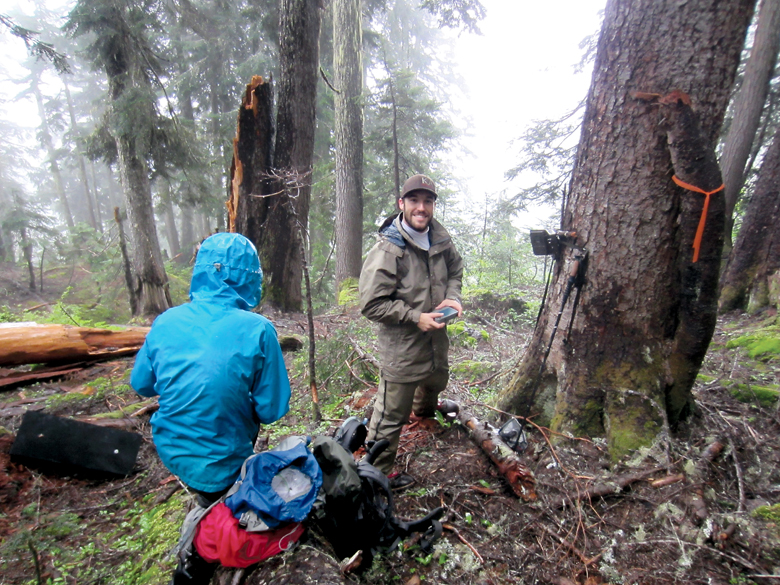
So to track the creatures, researchers are planning to equip 157 survey sites in the park, the forest and Grays Harbor County with trail cameras and small tubes designed to snag fur samples.
The sites, baited with chicken legs or thighs to attract the fishers, are designed to both collect photographic and DNA evidence from the animals, Jenkins said.
Data gleaned from radio-tracking fishers helped researchers decide where to set up survey sites.
They also chose areas of good fisher habitat, with large stretches of mature coniferous forest containing trees between 8 and 10 inches in diameter.
Crews working with the fisher reintroduction network surveyed 52 of the sites in 2013 and another 15 so far this year, Jenkins said.
The plan is to have all sites surveyed by 2016, using both volunteer and paid staff.
Results so far are promising.
In 2013, 10 individual fishers were seen in nine of the 52 survey areas, including five animals born on the Peninsula, Howell said.
Researchers are able to tell through DNA analysis of collected hair samples which animals are new because complete genetic profiles were created of the original 90 fishers, Jenkins said.
“We’re now piecing together who is still alive, who has had young,” he said.
“It’s kind of a big detective game, but we’re able to collect quite a lot of information.”
The animals are definitely spreading out, Jenkins said.
“We can say that we’re finding fishers using areas that weren’t being used by the original 90,” he said.
“In other words, there does seem to be some range expansion.”
The newest survey site has been set up in East Jefferson County.
Dead fisher in Ludlow
A dead fisher was found in December in Port Ludlow. It was in poor condition, Howell said.
Unlike some fishers found dead, this one had not been hit by a car.
Howell said the find was the first evidence that fishers had crossed both U.S. Highway 101 and state Highway 104 that far east into Jefferson County.
“With that evidence, it seemed more important to get some cameras out in this area, and the land trust, with their own properties [in Jefferson County], as well as access to other trust and easement lands, seemed a perfect partner,” Howell said in an email.
Land trust volunteers helped set up the first camera trap site June 12 in Jefferson County’s Tarboo Valley and were trained by park staff, said Carrie Clendaniel, a conservation assistant with the Jefferson Land Trust.
The area was privately owned property protected through a Jefferson Land Trust conservation easement, she said.
Training involved learning about fisher behavior, how to set up the camera and hair traps, and where the fishers most likely would be found, she said.
Clendaniel described going out to survey sites to squint to see images on the small cameras and not knowing what was actually recorded until viewing the photograph on a full-size computer screen.
It’s a thrill, she said. “It’s just the anticipation of what are we going to see.”
Volunteers sought
The land trust is looking for volunteers to help in another survey trip later this summer and possibly more in the next two years, Clendaniel said.
Those interested can email her at cclendaniel@saveland.org or phone 360-379-9501.
The state listed the species as endangered in 1998, and in 2004, the fisher was listed as a candidate for protection under the Endangered Species Act.
Jenkins and Howell said reports of dead fishers often come in from the general public.
Deaths were expected, Jenkins said. That is one reason that 90 were released in the first place.
Of 35 fishers that died during the first two years after their release, predation, such as by bobcats for example, was the primary cause, followed by being hit by vehicles.
Howell said fishers, like all animals native to the Peninsula, play an important role in the area’s ecosystem.
Fishers, which eat small mammals such as snowshoe hares, mountain beavers, squirrels and porcupines, help keep populations of prey animals in check and serve as food themselves for larger predators.
“It’s important to have them back,” Howell said.
Jenkins said this fisher reintroduction effort is part of a larger vision of seeing the animal return to more of its historic habitat, which once ranged from British Columbia into Western Washington and Oregon and south to the northern Sierra Nevada mountains in California.
Plans are being made now to reintroduce fishers into Mount Rainier and North Cascades national parks as early as 2015.
“For us, bringing back fishers to Washington will really be a major step to ensuring the long-term outlook of fishers on the West Coast,” Jenkins said.
________
Reporter Jeremy Schwartz can be reached at 360-452-2345, ext. 5074, or at jschwartz@peninsuladailynews.com.
