
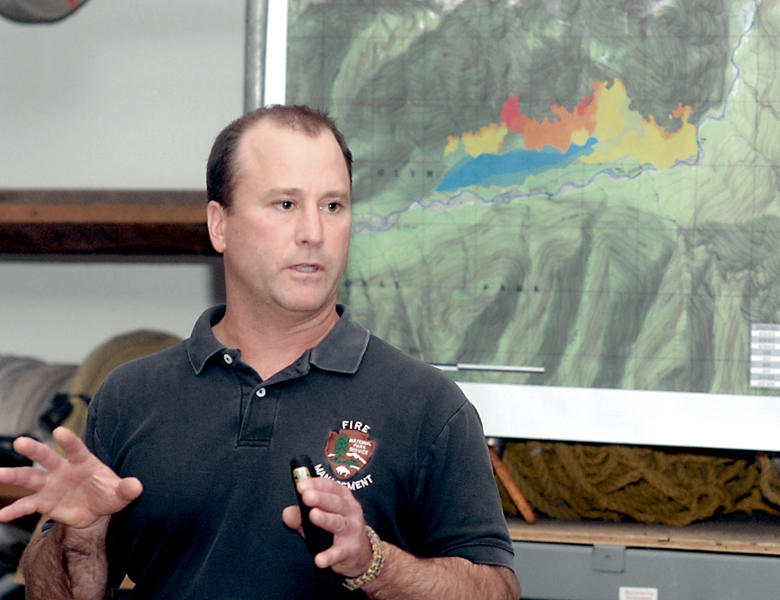
OLYMPIC NATIONAL PARK — The fire in the Queets River valley is growing slowly now, but it eventually could consume 6,000 to 9,000 acres if there is no break in the weather, fire officials said Tuesday.
The fire grew by only about 25 acres since Monday to 1,050 acres by Tuesday afternoon, but hot, dry conditions are right for it to grow explosively, said Bill Hannenberg, manager for the Pacific Northwest National Incident Management Organization, which is leading the firefight.
“The potential for this fire to become thousands of acres is real,” Hannenberg said at a briefing Tuesday afternoon at Olympic National Park headquarters in Port Angeles.
The blaze continues to move into wilderness areas and away from habitations, he said.
Attending the briefing were U.S. Rep. Derek Kilmer, who represents the 6th Congressional District, which includes the North Olympic Peninsula, as well as Clallam County Commissioners Jim McEntire and Bill Peach, Jefferson County Commissioners Kathleen Kler and David Sullivan, Forks Mayor Bryon Monohon and Rod Fleck, Forks city planner and attorney.
Hannenberg said that this weekend, additional firefighters will be added to the two fire crews trying to keep the fire from moving west into unconfined areas.
Fire crews have 11 members; 99 people, including those in helicopters and support personnel, were working on the blaze as of Tuesday.
Alert for new fires
Fire danger is growing.
The countywide burn ban will be upgraded to high fire danger today, Clallam County Fire Marshal Annette Warren announced Tuesday.
The upgrade prohibits all outdoor burning, including recreational fires. Cooking on propane or gas appliances is allowed.
Hannenberg said an interagency network of fire crews has been posted at strategic intervals around the Olympic Mountain range in preparation for new fires.
The fire began May 17 deep inside the park on the north side of the Queets River near Paradise Creek, 13 miles northeast of Quinault.
It smoldered in deep duff until June 14, when it burst to the surface, moved into the canopy of 170-foot old-growth trees and scorched 300 acres before it was discovered.
“It went on a 2-mile run parallel to the river,” said Todd Rankin, park fire management officer.
It has since grown by another mile to the east and from its initial elevation of 700 feet to hillsides at 3,200 feet, he said.
As of Tuesday, it was 21 percent contained on the south side at the Queets River and in the west at a hose line established by firefighters when they first arrived at the fire.
If the fire moves westward, it will move into areas where there are no natural barriers, such as rocky cliffs or the river, to stop it, Hannenberg said.
Currently, it continues to move up the steep hillsides, where firefighters cannot safely fight the fire, he said.
Ty Crowe, fire operations specialist, said conditions are extreme in the Queets River valley, with very steep hillsides where boulders and falling trees can roll or toboggan downhill, heavy undergrowth that in some places is so thick it takes a half-hour to walk 50 feet and huge old-growth trees that can drop branches and snags to the forest floor below.
Fire managers said water drops have been considered, but the narrow, steep terrain is dangerous for flight crews to fly into, and water and chemical drops are largely ineffective against the spread of fire in thick canopy.
________
Reporter Arwyn Rice can be reached at 360-452-2345, ext. 5070, or at arice@peninsuladailynews.com.
