
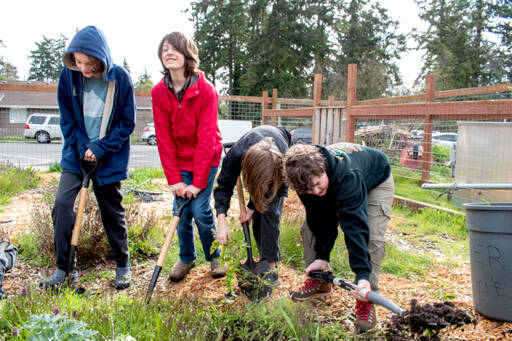
PORT TOWNSEND — At Salish Coast Elementary School in Port Townsend, a group of fifth-grade students is asked a math question: If a farmer wants to plant four seeds per foot in two 40-foot rows, how many seeds will the farmer need?
It’s the kind of math problem teachers often ask fifth-graders. At Salish Coast, though, it’s not theoretical: “Farmer Neil” asks the question, and the students plant the seeds.
“If you know you helped make the food, it always tastes better,” says 11-year-old Gus Griffin, who’s helping plant 320 bean seeds in one of Salish Coast’s three gardens. (That’s the answer to the math question, by the way.)
Salish Coast’s gardens are part of Port Townsend School District’s farm-to-school program, and “Farmer Neil” is what the kids call the school’s garden production manager, Neil Howe.
Howe tries to teach kids math, science and research skills through gardening. He also tries to foster their curiosity.
“Every time I find a grub out there, I try to link it back to science. ‘What is this? Does anybody know?’ I want them to pass it around. I want them to want to know what that is,” Howe said.
The school also gets beef, pork and grain from local farmers, which means it participates in all three elements of farm-to-school: school gardens, food education and local food procurement.
The specifics vary, but nearly every state has some kind of farm-to-school program.
Washington’s was established in 2008, and since then, farm-to-school has exploded in popularity. Last fall, the state Department of Agriculture received more than $8 million in farm-to-school funding requests from schools, more than twice the amount of funds available.
The state expanded the program in 2021 using federal COVID-19 funds. Based on how the budget is written, the agriculture department expects that, as federal funds run out, legislators will backfill the money with state dollars.
“The kids will eat [school meals] more when they own their own food,” said Shannon Gray, the Port Townsend district’s food services director.
“I’ll put the picture of the garden above anything that’s from the garden,” Gray said about the school’s cafeteria meals. “If they’re not eating it, [I’ll realize] ‘Oh, yeah, I forgot to put the picture up.’”
The rise of farm-to-school
At least half of Washington’s districts are participating in some type of farm-to-school food program, estimates Annette Slonim, WSDA’s farm-to-school lead.
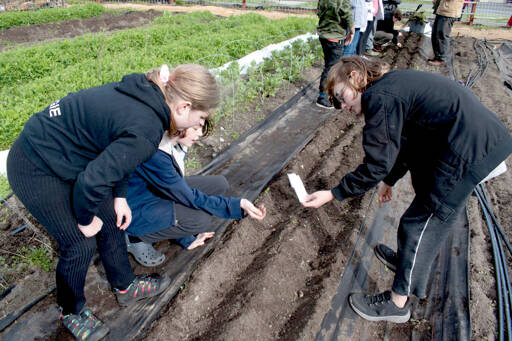
Salish Coast students plant beans on March 28. (Grace Deng/Washington State Standard)
More than half of the survey’s Washington respondents had been participating in farm-to-school programs for less than three years.
This year, USDA nutrition guidelines are expected to limit added sugar in school meals for the first time. But with farm-to-school, it can be easier to control sugar, sodium and other nutritional content.
Slonim said the pandemic also showed districts that local businesses are less susceptible to disruptions in the global food supply chain.
“[The pandemic] made visible how fragile some parts of the food supply chain are,” Slonim said.
Small businesses and communities benefit, too: Port Townsend, for example, purchased more than 1,000 pounds of pork over the last two school years from One Straw Ranch, a local farm owned by Charlotte Frederickson and her husband, Martin Frederickson. The pigs at One Straw Ranch also eat local feed and spend most of their time outside, unlike most factory farm pigs.
“We feel that having a connection to your food is important environmentally, socially, ethically — across the board,” Charlotte Frederickson said. “To be able to nurture that in the next generation of consumers who will soon be choosing where to buy their food … it makes us feel really good.”
Port Townsend’s program continues to expand. Howe and the students grew about 4,000 pounds of produce last year. This year, he’s hoping for 6,000 pounds — and the kids seem more than happy to help.
“It’s pretty groovy,” said Griffin, the 11-year-old student, looking at the garden.
Nutritional and educational benefits
Cassandra Hayes, nutrition services director at Colville School District, said she’s been surprised with how little some kids know about where their food comes from.
When the district first implemented farm-to-school, Hayes did a carrot showcase, featuring Washington carrots that still had the tops on them. Some of the kids told her they thought carrots came like peeled baby carrots.
Colville School District’s farm-to-school program has only been going on for two years. Two high school sweethearts who graduated from the district now produce the beef for schools there.
Hayes said there’s some trial and error that goes into figuring out what the kids will eat. For example, the high school students help make the ranch dressing from scratch at Colville, and some kids love it — but others “are like, I want my Hidden Valley back,” Hayes said.
But she said it’s worth it and the kids often like the local food better. Last year, Colville bought out its local carrot producer and had to return to its old producer, and the kids came up to Hayes to complain.
“They’re like, ‘What is this?’” Hayes said. “And they held up a carrot. I’m like, ‘That’s a carrot,’ and they’re like, ‘No, this is not those carrots that you gave us … they’re not as sweet.’”
“I’m like, ‘I’m sorry, I don’t know what to tell you, you guys ate them all,’” Hayes said. “And they’re like, ‘Well, tell them to go make some more!’”
________
Grace Deng writes for the Washington State Standard (https://washington statestandard.com), an independent, nonprofit news organization that produces original reporting on policy and politics.
