
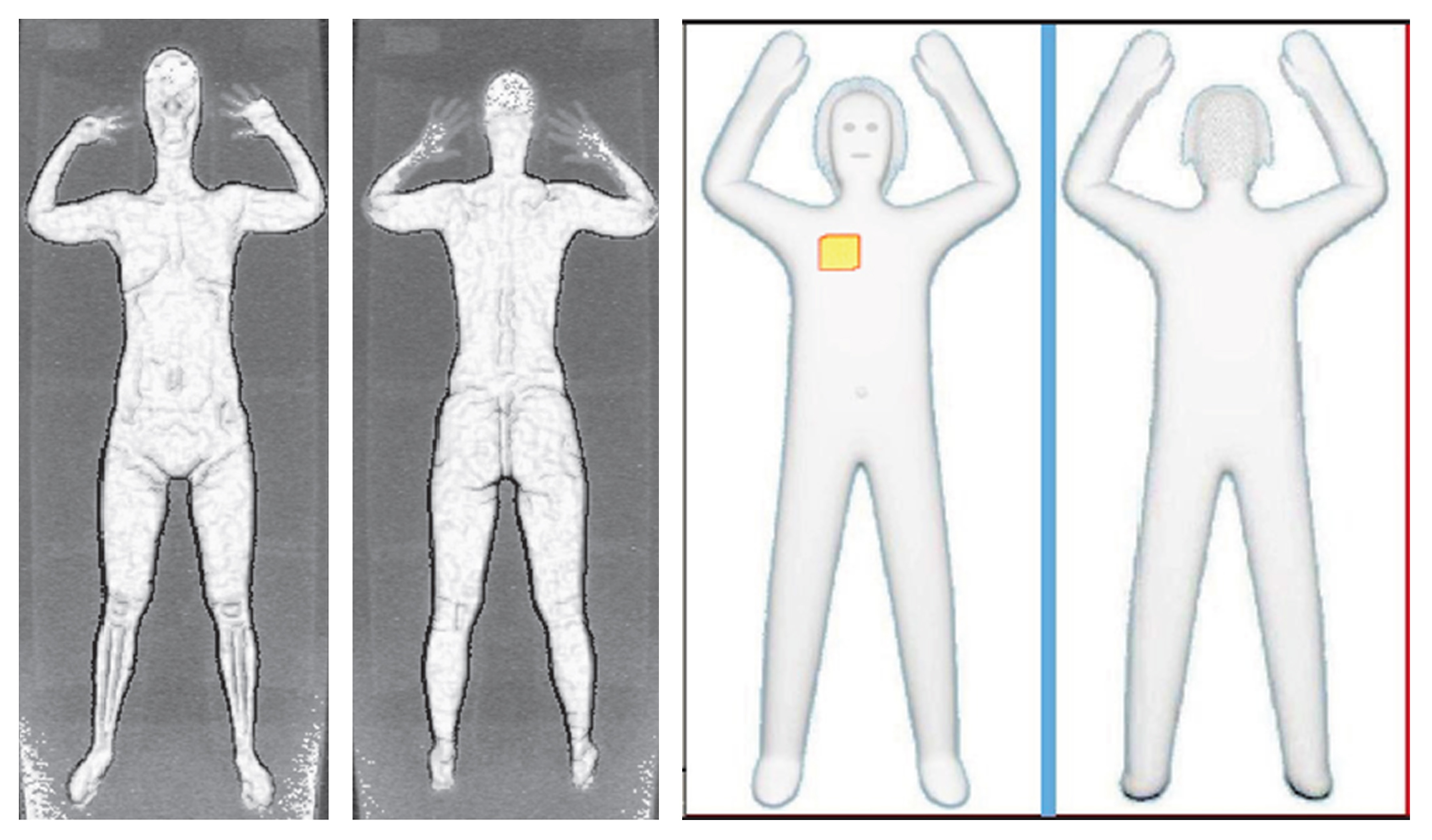
These two sets of images provided by the Transportation Security Administration are samples that show details of what TSA officers see on computer monitors when passengers pass through airport body scanners. At left are two images using backscatter advanced image X-ray technology from the huge scanners that were introduced in 2010 at O'Hare International Airport in Chicago and other airports. At right are images from new scanners using new millimeter wave technology that produces a cartoon-like outline rather than naked images of passengers produced by using X-rays.

These two sets of images provided by the Transportation Security Administration are samples that show details of what TSA officers see on computer monitors when passengers pass through airport body scanners. At left are two images using backscatter advanced image X-ray technology from the huge scanners that were introduced in 2010 at O'Hare International Airport in Chicago and other airports. At right are images from new scanners using new millimeter wave technology that produces a cartoon-like outline rather than naked images of passengers produced by using X-rays.

Farewell to ‘naked’ airport scanners (including 14 at Sea-Tac)

  • Peninsula Daily News news services
  • Saturday, January 19, 2013 6:01pm
  • News

Peninsula Daily News news services

WASHINGTON — Those airport scanners with their all-too revealing body images will soon be going away.

The Transportation Security Administration says the scanners that used a low-dose X-ray will be gone — by June — because the company that makes them can’t fix the privacy issues.

The decision will affect 14 machines in use at Seattle-Tacoma International Airport.

Other airport body scanners, which produce a generic outline instead of a naked image, are staying.

The government rapidly stepped up its use of body scanners after a man snuck explosives onto a flight bound for Detroit on Christmas day in 2009.

At first, both types of scanners showed travelers naked.

The idea was that security workers could spot both metallic objects like guns as well as non-metallic items such as plastic explosives.

The scanners also showed every other detail of the passenger’s body, too.

The TSA defended the scanners, saying the images couldn’t be stored and were seen only by a security worker who didn’t interact with the passenger.

But the scans still raised privacy concerns. Congress ordered that the scanners either produce a more generic image or be removed by June.

On Thursday Rapiscan, the maker of the X-ray, or backscatter, scanner, acknowledged that it wouldn’t be able to meet the June deadline.

The TSA said Friday that it ended its contract for the software with Rapiscan.

The agency’s statement also said the remaining scanners will move travelers through more quickly, meaning faster lanes at the airport.

Those scanners, made by L-3 Communications, used millimeter waves to make an image.

The company was able to come up with software that no longer produced a naked image of a traveler’s body.

Used in 30 airports

The TSA will remove all 174 backscatter scanners from Seattle and the 29 other airports they’re used in now.

Another 76 are in storage.

It has 669 of the millimeter wave machines it is keeping, plus options for 60 more, TSA spokesman David Castelveter said.

Not all of the machines will be replaced.

Castelveter said that some airports that now have backscatter scanners will go back to having metal detectors.

That’s what most airports used before scanners were introduced.

The Rapiscan scanners have been on their way out for months, in slow motion.

The government hadn’t bought any since 2011.

It quietly removed them from seven major airports in October, including New York’s LaGuardia and Kennedy airports, Chicago’s O’Hare, and

Los Angeles International.

The TSA moved a handful of the X-ray scanners to very small airports.

At the time, the agency said the switch was being made because millimeter-wave scanners moved passengers through faster.

Rapiscan parent company OSI Systems Inc. said it will help the TSA move the scanners to other government agencies. It hasn’t yet been decided where they will go, said Alan Edrick, OSI’s chief financial officer.

Scanners are often used in prisons or on military bases where privacy is not a concern.

“There’s quite a few agencies which will have a great deal of interest” in the scanners, Edrick said.

OSI is taking a one-time charge of $2.7 million to cover the money spent trying to develop software to blur the image, and to move the machines out of airports, Edrick said.

More in News

Port Townsend Main Street Program volunteers, from left, Amy Jordan, Gillian Amas and Sue Authur, and Main Street employees, Sasha Landes, on the ladder, and marketing director Eryn Smith, spend a rainy morning decorating the community Christmas tree at the Haller Fountain on Wednesday. The tree will be lit at 4 p.m. Saturday following Santa’s arrival by the Kiwanis choo choo train. (Steve Mullensky/for Peninsula Daily News)
Decoration preparation

Port Townsend Main Street Program volunteers, from left, Amy Jordan, Gillian Amas… Continue reading

Port Angeles approves balanced $200M budget

City investing in savings for capital projects

Olympic Medical Center Board President Ann Henninger, left, recognizes commissioner Jean Hordyk on Wednesday as she steps down after 30 years on the board. Hordyk, who was first elected in 1995, was honored during the meeting. (Paula Hunt/Peninsula Daily News)
OMC Commissioners to start recording meetings

Video, audio to be available online

Jefferson PUD plans to keep Sims Way project overhead

Cost significantly reduced in joint effort with port, city

Committee members sought for ‘For’ and ‘Against’ statements

The Clallam County commissioners are seeking county residents to… Continue reading

Christopher Thomsen, portraying Santa Claus, holds a corgi mix named Lizzie on Saturday at the Airport Garden Center in Port Angeles. All proceeds from the event were donated to the Peninsula Friends of Animals. (Dave Logan/for Peninsula Daily News)
Santa Paws

Christopher Thomsen, portraying Santa Claus, holds a corgi mix named Lizzie on… Continue reading

Peninsula lawmakers await budget

Gov. Ferguson to release supplemental plan this month

Clallam County looks to pass deficit budget

Agency sees about 7 percent rise over 2025 in expenditures

Officer testifies bullet lodged in car’s pillar

Witness says she heard gunfire at Port Angeles park

A copper rockfish caught as part of a state Department of Fish and Wildlife study in 2017. The distended eyes resulted from a pressure change as the fish was pulled up from a depth of 250 feet. (David B. Williams)
Author to highlight history of Puget Sound

Talk at PT Library to cover naming, battles, tribes

Vern Frykholm, who has made more than 500 appearances as George Washington since 2012, visits with Dave Spencer. Frykholm and 10 members of the New Dungeness Chapter, NSDAR, visited with about 30 veterans on Nov. 8, just ahead of Veterans Day. (New Dungeness Chapter DAR)
New Dungeness DAR visits veterans at senior facilities

Members of the New Dungeness Chapter, National Society Daughters of… Continue reading

Festival of Trees contest.
Contest: Vote for your favorite tree online

Olympic Medical Center Foundation’s Festival of Trees event goes through Dec. 25