
Peninsula Daily News news sources
TACOMA — Once the streamlined centerpiece of Washington’s ferry fleet, later abandoned to the icy weathers of Alaska, last still the victim of failed rescue efforts, the Kalakala later this month will be cut apart for scrap in a Tacoma graving yard.
It sits today as it has for 10 years on the western shore of the Hylebos Waterway, hosted by benefactor and Tacoma industrialist Karl Anderson.
It’s the end of a journey that took the unusual vessel to the Port Angeles-Victoria ferry route in the 1950s, and to Neah Bay for a year in 2004 as the Makah tribe had been told by its then-owner that jobs would be available for its rehabilitation.
When only dock damage from winds and rain — and no jobs — resulted, the Kalakala was evicted by the Makah.
Its Hylebos site was volunteered in Tacoma, and in 2004 it was towed to the city that will become its grave by month’s end.
Rust weeps all along the once-shining superstructure.
Rust carpets every deck in thick layers of rotted steel.
Paint peels from every wall as cold rain and wind blow in where windows once stood.
Launched in Oakland, Calif., as the Peralta in 1927, the San Francisco Bay Area ferry became stuck on the ways, reluctant to descend from its construction dock into the water.
Within a month of her christening, the Peralta struck a dock at San Francisco causing more than $35,000 in damage.
The Peralta burned to the waterline in 1933 and the hull was later purchased from insurance underwriters and towed north by Capt. Alexander Peabody, founder of Puget Sound Navigation Co.
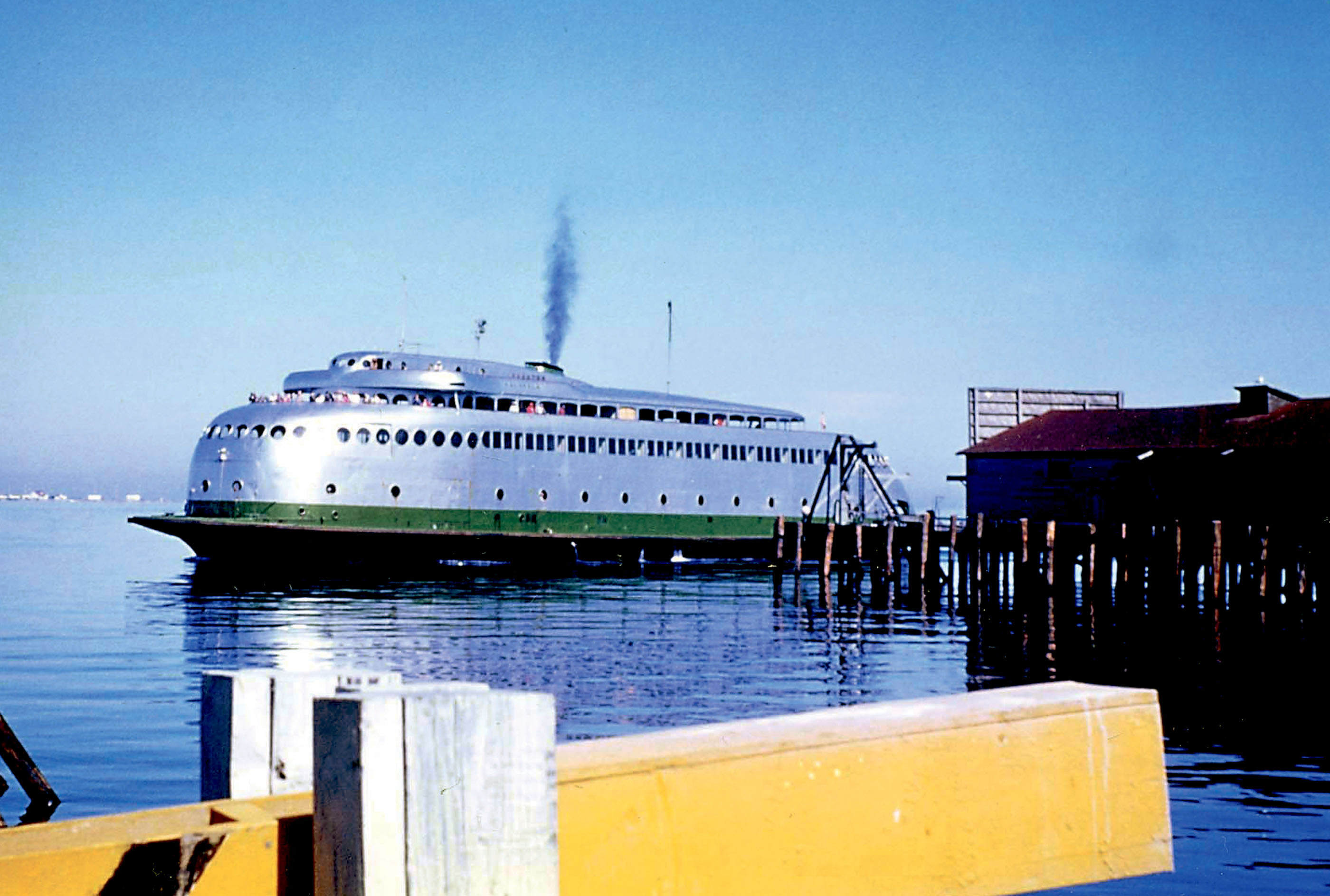
It was at the Lake Washington Shipyards in Kirkland where the Kalakala earned its iconic art deco design.
Inside the boat, fashionable bench seats and upholstered chairs could accommodate 2,000 passengers.
An open-air Palm Room opened onto a promenade deck, and there was a horseshoe-shaped lunch counter and separate lounges for women and men.
Where it made upwards of eight trips daily between Seattle and Bremerton serving wartime shipyard workers, she spent her evenings as a party boat with the nautically clad Flying Bird Orchestra playing from 8:30 p.m. to half past midnight.
“Flying bird” is the English translation of the Chinook jargon “Kalakala.”
Yes, it wobbled.
The 3,000-horsepower engine may not have been properly aligned, and the turbulent vibrations were such that coffee cups at the snack bar were served half-full so as not to spill.
There also was a problem with the placement of the wheelhouse, set so far back on the uppermost deck as to eliminate a view of the lower decks.
A ferry whose captain cannot see the bow is likely to suffer collisions with docks or other vessels, which the Kalakala did several times in its career.
Following a dispute with the state, Peabody in 1950 sold most of his fleet, including the Kalakala, to Washington State Ferries.
It was in that era that the Kalakala was reassigned to Port Angeles as the car ferry to Victoria.
But its flat bottom and navigational difficulties on the Strait of Juan de Fuca inspired construction of the MV Coho, which began service in 1959 and continues today.
The Kalakala sailed Puget Sound and the Strait for 32 years and welcomed an estimated 30 million passengers.
But even as it entertained visitors to the 1962 Seattle World’s Fair, proudly sailing Elliott Bay, the industry the Kalakala once led was changing.
By 1967 she could accommodate only 60 automobiles. Larger state ferries had entered service.
In 1967, the state sold the decommissioned ferry to American Freezerships and it was towed to Dutch Harbor, Alaska, to house a crab processing operation.
Two years later she was sold again, and in 1971 was towed to a site near Kodiak and run aground, thus to serve as a fish cannery.
The Kalakala died again when it was abandoned after the cannery operation failed.
Spurred by the efforts of a Seattle artist, the Kalakala was refloated in 1998 and towed home to Seattle where she was met by wellwishers afloat and onshore.
Enthusiasm soon waned, however, and the boat docked on Lake Union, where people complained that it was both an eyesore and a hazard.
She was so much of a hazard that the city of Seattle and the U.S. Coast Guard prohibited onboard fundraisers for safety reasons. Fans continued their attempt to raise funds, although no deep pockets were found.
In 2003, the Kalakala Foundation filed for bankruptcy.
Thurston County entrepreneur Steve Rodrigues acquired the hulk in bankruptcy, hoping at one point to moor it in Port Angeles as part of a fundraising scheme to restore the Kalakala as a convention attraction.
Although a foundation office temporarily appeared on Lincoln Street only blocks from where the Kalakala once took vehicles and passengers to Victoria decades earlier, the Kalakala drew more derision on Lake Union.
Hence the towing to Neah Bay in March 2004, with Rodrigues standing on the bridge on its westward voyage along the Strait of Juan de Fuca.
The Kalakala has been anchored in Neah Bay on state Department of Natural Resources tidelands and bedlands since early March after it was moved away from the Makah tribe’s pier when currents smashed it against the dock.
After the vessel caused an estimated $4,000 in damage to the Makah pier, the tribe filed a lawsuit against Rodrigues, intended to evict him from its leasehold in Neah Bay.
The DNR later joined the lawsuit in Clallam County Superior Court because the vessel was found to be moored over that agency’s tidelands and bedlands.
Rodrigues and the Kalakala left Neah Bay under tow in September 2004, headed to Tacoma’s Hylebos Waterway.
“Here’s a poor guy trying to fix up this vessel,” Anderson said recently, recalling his invitation to Rodrigues.
“I said I can do this. I had the wherewithal to make this happen. It was the right thing to do.”
Anderson is a principal at the privately held Tacoma Industrial Properties, which owns a 16-acre waterfront parcel along the Hylebos.
With no interest other than sympathy for the underdog Rodrigues, Anderson offered moorage space at a nominal monthly rent.
While continuing his attempt to raise funds, Rodrigues for several years made only minimal repairs the Kalakala.
And then, on March 20, 2011, it nearly sank.
At low tide, the hull regularly went aground.
A Coast Guard officer concluded “that a flooding and sinking incident is imminent.”
Rodrigues, who did not respond to requests for an interview, could offer no viable plan.
But Anderson could.
“I couldn’t get Rodrigues’ cooperation after the Kalakala was called a hazard to navigation,” he said.
“I ended up suing for unlawful detainer. I knew I had to do something. The only way was to get control.”
In November, 2012 Anderson foreclosed over $4,000 in unpaid rent and he became the Kalakala’s latest and last owner.
He has since invested an estimated $500,000 constructing mooring pylons, buying security cameras, installing electricity and pumps, removing hazardous material including asbestos, petroleum and PCBs, and hiring two men to monitor the boat 24 hours a day.
Anderson estimated that he will spend at least that much again to prepare the Kalakala for demolition and to pay for that demolition after hiring tugs to tow it to a graving yard at Tacoma’s Concrete Technology, where he serves as executive vice president.
“Karl’s generosity is the only thing that allowed the boat to come to Tacoma,” said Port of Tacoma Commissioner Don Meyer.
The Kalakala, Meyer said, “cannot be saved. Anybody who wants to stop this should have about $25 million in their pocket.”
Anderson’s plan currently calls for the Kalakala to leave the Hylebos under tow at high tide Jan. 22.
He said he sees no romance aboard, no siren call of nostalgia.
“I see a sad remnant of a lady way past her prime and ready to die,” he said.
_______
C.R. Roberts of McClatchy News Service did the principal writing for this report, with additional material from Peninsula Daily News files.
