
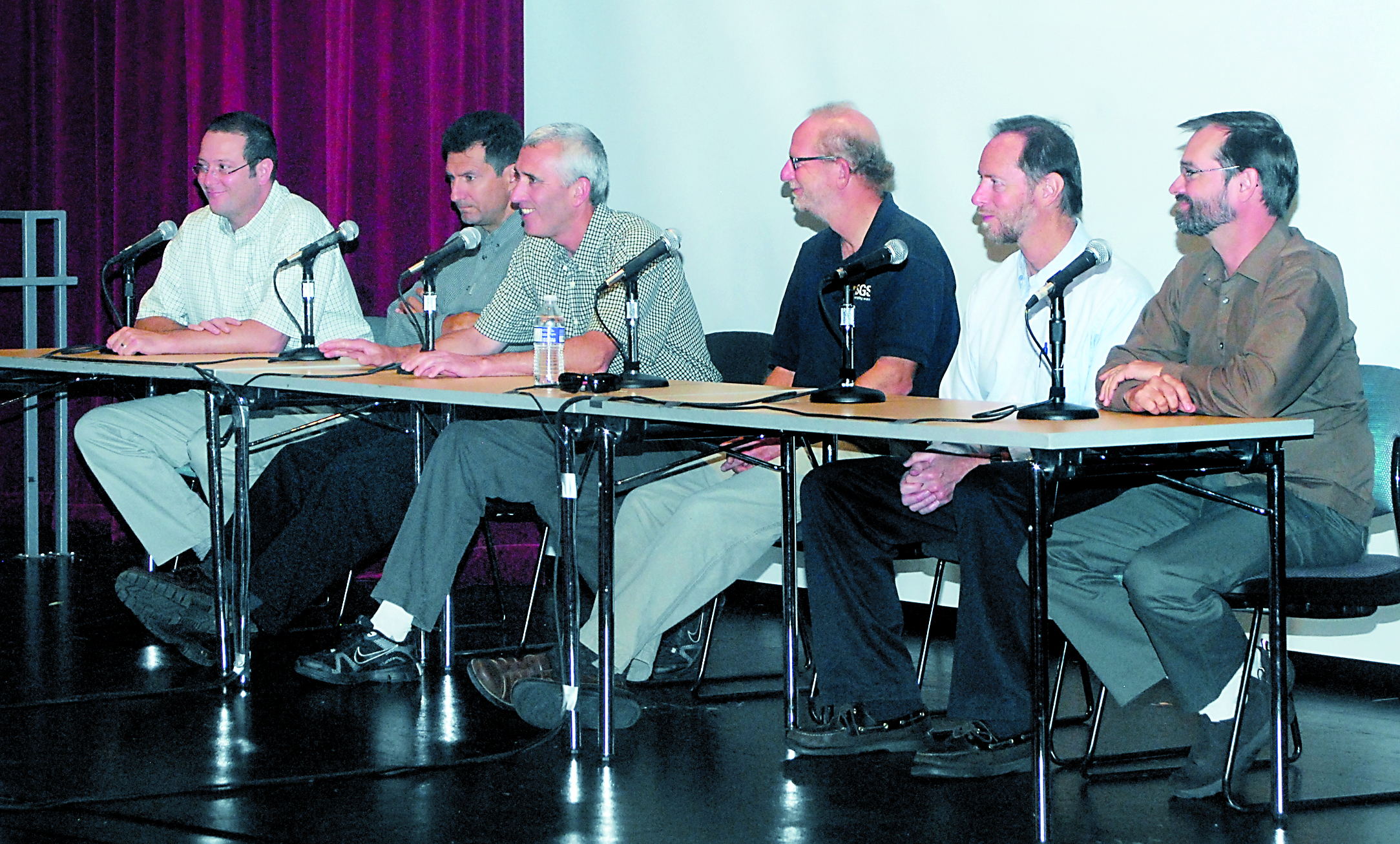
PORT ANGELES — The landmark Elwha River Restoration Project is exceeding expectations so far on several fronts, a panel of key players in the effort said this week.
Panel members spoke to a crowd of about 75 at Peninsula College on Wednesday.
King salmon recently were observed in the river at Altair Campground just below what’s left of Glines Canyon Dam.
It was the first time the species was observed so far upstream — 12.5 miles from the river mouth — since the lower Elwha Dam was built without fish ladders a century ago.
The big news
“You heard the big news yesterday that king salmon have been observed up at Altair,” said Mike McHenry, fisheries habitat biologist with the Lower Elwha Klallam tribe.
“Well, I would like to add to that that on a snorkel survey, juvenile chinook salmon were observed at the [Olympic National] Park boundary.”
The public forum at the college was part of the four-day Elwha River Science Symposium, a technical summary of the progress made since the dam removal began last September.
Other speakers at the forum — the second of two public events at the science symposium — were Aaron Jenkins and Dan Link of Barnard Construction, Tim Randle of the Bureau of Reclamation, George Pess of the National Oceanic and Atmospheric Administration, Guy Gelfenbaum of the U.S. Geological Survey and Joshua Chenoweth of Olympic National Park.
“We don’t have all the answers yet,” McHenry said of the salmon recovery, a major impetus behind the $325 million federal project.
“It’s still pretty early in the game.”
Fish showing the way
“We haven’t really gone through the big sediment impacts yet to date, but I’d say so far, the fish are showing us the way, and it’s game on for them,” McHenry said.
Last year, about 700 hatchery coho salmon were released above Elwha Dam.
About 60 percent of those fell back over the dam, he said.
“But the good news is that were able to account for nearly 100 redds, or nests, that the fish create when they spawn in different parts of the middle reach,” McHenry said.
“We found that the fish really like Little River and Indian Creek,” he added.
“It was really hard to track the fish in the main stem because we couldn’t see, but I’m happy to say that juvenile coho are well-distributed in the middle reach and in both tributaries.”
An adult fish-capture weir downstream of the site of the former Elwha Dam — which was demolished by March — is helping federal, state and tribal scientists study the fish going upstream and downstream.
Fish in the main stem are difficult to observe because of murky sediments being released from the rapidly draining Lake Mills and the former bed of Lake Aldwell.
The 3-year-old weir — the largest in the Pacific Northwest — can operate when flows are below 2,500 cubic feet per second.
“We’re able to operate this thing in early spring and during late fall,” McHenry said. “This is a pretty cool and powerful tool because you actually can get your hands on the fish.
“You can determine if they are of hatchery or wild origin,” he said. “You can remove unwanted hatchery fish if you desire, and then you can also use them to tag fish to study colonization.”
Barnard Construction of Montana was awarded a $26.9 million contract to remove the dams according to specific guidelines, including a series of fish windows to protect salmon from toxic levels of sediments.
Glines Canyon Dam
In the current six-week fish window, crews are removing the 115-foot intake tower at the upper dam, Glines Canyon Dam, and drilling holes in the top of its edifice to prepare for the next blasts in mid-September.
“They’ve just done a really wonderful job in terms of doing the actual construction and engineering activities involved with removing the dams,” said Jeff Duda, research ecologist for the U.S. Geological Survey and moderator of the panel discussion.
Jenkins, project superintendent for Barnard Construction, summarized the removal of Elwha Dam that was completed March 9.
Crews diverted the river nine times to accomplish the task.
Eight miles upstream, Barnard Construction lowered Lake Mills by notching the top of the 210-foot Glines Canyon Dam with a hydraulic hammer on a barge.
The rest of the dam will be blasted away.
24 million cubic yards
Randle, hydraulic engineer for the Bureau of Reclamation, discussed the management of some 24 million cubic yards of sediment that was constricted by the dams.
“The objective for the sediment management was to try to get as much of the sediment that is eventually going to erode during the course of dam removal,” he said.
“The reservoir sediment erosion and redistribution is keeping pace with the rate of dam removal.”
Incremental drawdown of the reservoirs and fish windows “seem to be working just fine,” he added.
“Largely when we draw it down, we’re getting vertical erosion, and then when we hold it constant, we’re getting the lateral erosion.”
Randle and other panelists said the turbidity of the water will increase with the continuing removal of Glines Canyon Dam.
Pess addressed changes in river geomorphology since dam removal began.
“The size and timing of reservoir sediment release will influence where sediment accumulates in the Elwha,” Pess said.
The lower river, including floodplain channels, already have begun to fill with silt.
“Some of the sand, which is transported at a slower rate, is actually being deposited as well in river pools and eddies and other slack-water areas,” he said.
Sediment flow
Gelfenbaum, coastal geologist with the U.S. Geological Survey, discussed changes in the near-shore waters in the Strait of Juan de Fuca.
“When it exits the river into the Strait, some of the material may travel along the beaches, some may go out onto the delta, and some may go offshore and be carried away,” he said.
Since the sediment was choked off when Elwha Dam was built, waves in the Strait have eroded beaches east of the river mouth.
“Prior to construction of the dams, the lower part of the beaches were very sandy, and that’s a habitat that can entertain things like clams, which the tribes were interested in,” Gelfenbaum said.
“With this low-tide terrace being very coarse and cobbly, not as much lives there.
“So we have significant changes, both to the beaches, the shoreline and the habitat, because of the dams.”
Plant life
Chenoweth, botanical restorationist with Olympic National Park, discussed the seeding being done to protect the former reservoir beds from invasive species.
“It’s a bit early to talk about how plants are doing,” he said.
“One of the things that’s happening out there is that these silts take a long time to dry out, so this year might be a bit of an anomaly, and next year would be maybe more typical of how plants are going to respond.”
_________
Reporter Rob Ollikainen can be reached at 360-452-2345, ext. 5072, or at rob.ollikainen@peninsuladailynews.com.
