
By Phuong Le
The Associated Press
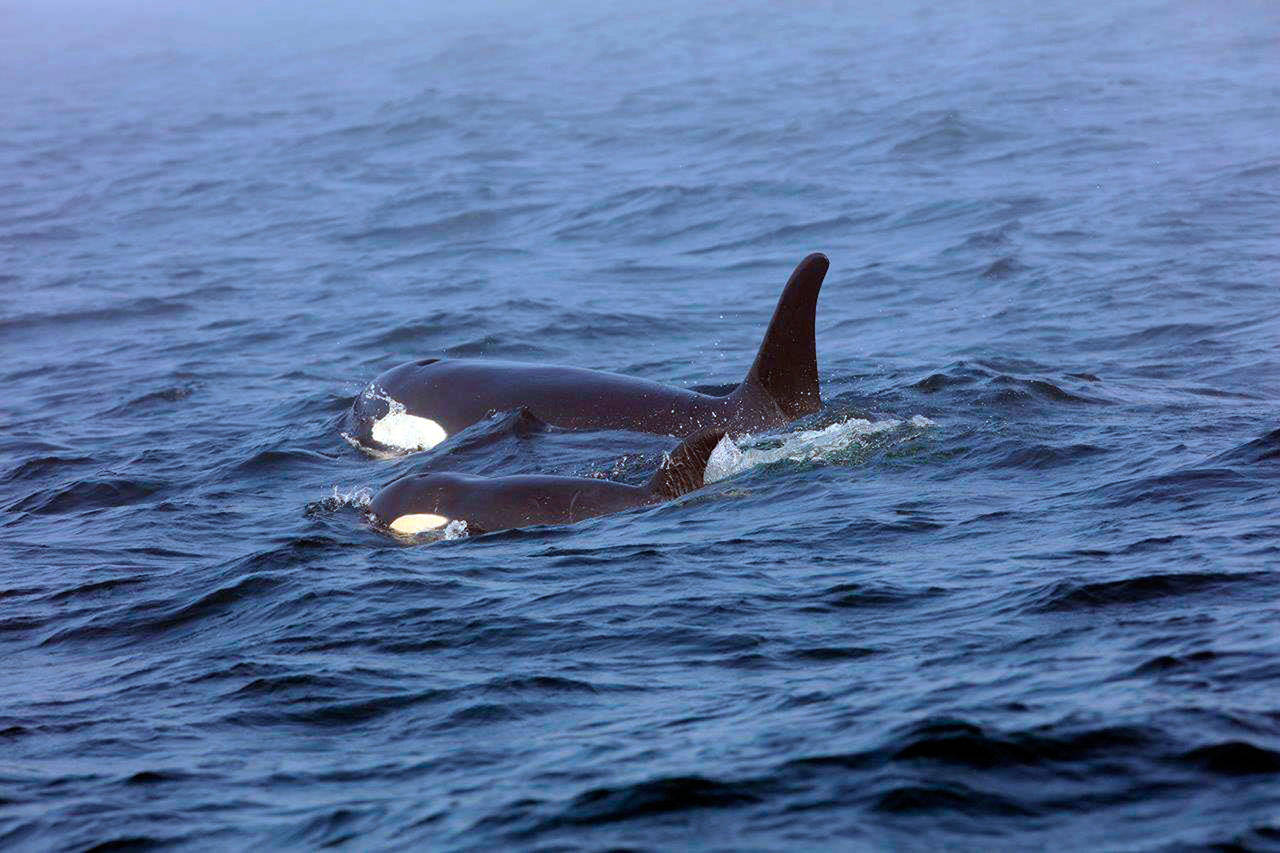
SEATTLE — Federal biologists said Wednesday they are preparing a plan to capture and treat a sick, critically endangered orca if there is no other way to save her in the wild.
Officials said they will intervene and rescue the orca only if she becomes stranded or separated from the rest of her tightly knit group of orcas.
They want the 4-year-old orca known as J50 to survive in the wild and contribute to the recovery of southern resident orcas, without putting the rest of the orcas in her pod at risk.
“We don’t intend to intervene while she’s with her family. If we are presented with a situation where a rescue is the only viable alternative, we will rescue her,” Chris Yates, assistant regional administrator for NOAA’s protected resources division, told reporters during a call.
Veterinarians believe they have exhausted treatment options in the field that included twice injecting the free-swimming whale with antibiotics in Pacific Northwest waters. Despite the treatment, J50 is thinner than ever due to undetermined health issues.
“This is a very sick whale,” said Joe Gaydos, a wildlife veterinarian and science director of SeaDoc Society. “We don’t think she has long.”
Another whale in the same pod, known as J35, triggered international sympathy this summer when she kept the body of her dead calf afloat in waters for more than two weeks.
The two whales are among just 75 of the fish-eating orcas that spend time in Pacific Northwest waters.
The southern resident orcas don’t have enough chinook salmon, the staple of their diet. They also face threats from toxic contamination as well as vessel noise and disturbances that disrupt their ability to communicate and forage.
There hasn’t been a successful birth in the population since 2015. Losing J50 would also mean losing her reproductive potential.
NOAA Fisheries said the next steps could include doing a hands-on physical exam, which could lead to quick medical treatment and release. Another option at that point would be holding her in a marine net pen in Puget Sound for a short time for rehabilitation and medical care before returning her to the wild to reunite with her family.
J50 has lagged behind her group in the ocean, at times trailing for miles, raising questions about what criteria would be used to determine if she has separated enough for scientists to attempt capture.
Yates said J50 would have to show more extreme behavior than what she has exhibited so far, and scientists will act if they don’t believe she’ll reconnect with her pod.
An international team of Canadian and U.S. whale experts has mounted an intensive effort to help the orca since concerns were raised in mid-July.
They have taken breath and fecal samples but still don’t know for certain what’s wrong with J50.
Response teams have tried to give her medication to help with parasitic worms, which they believe she has based on fecal samples taken from her mother.
Teams have also dropped l live salmon from a boat as J50 and her pod swam behind — a test to see whether fish could be used as a means of delivering medication.
Drone images taken Monday showed J50 much thinner than she was last year. Her mother, J16, has also declined in the past month, perhaps because of the burden of helping catch and share food with J50, experts said.
“We don’t want to take her from her mom where we have a J35 situation,” Gaydos said. “These are very hard questions to answer and I think that right now the good thing is we’re talking about all the options.”
NOAA Fisheries announced two meetings in Washington state this weekend — in Friday Harbor and Seattle — to get public input.
What to do to help J50 has generated intense emotional reactions on social media and other forums. Some have pleaded with federal officials to do everything they can to save her, including feeding her or capturing her. Others worry that more intervention would stress her and her family members. They think that nature should be allowed to run its course.
“We would love J50 to survive,” said Susan Berta, co-founder of the Orca Network, an advocacy group. “At what point are we doing more harm than good?”
