
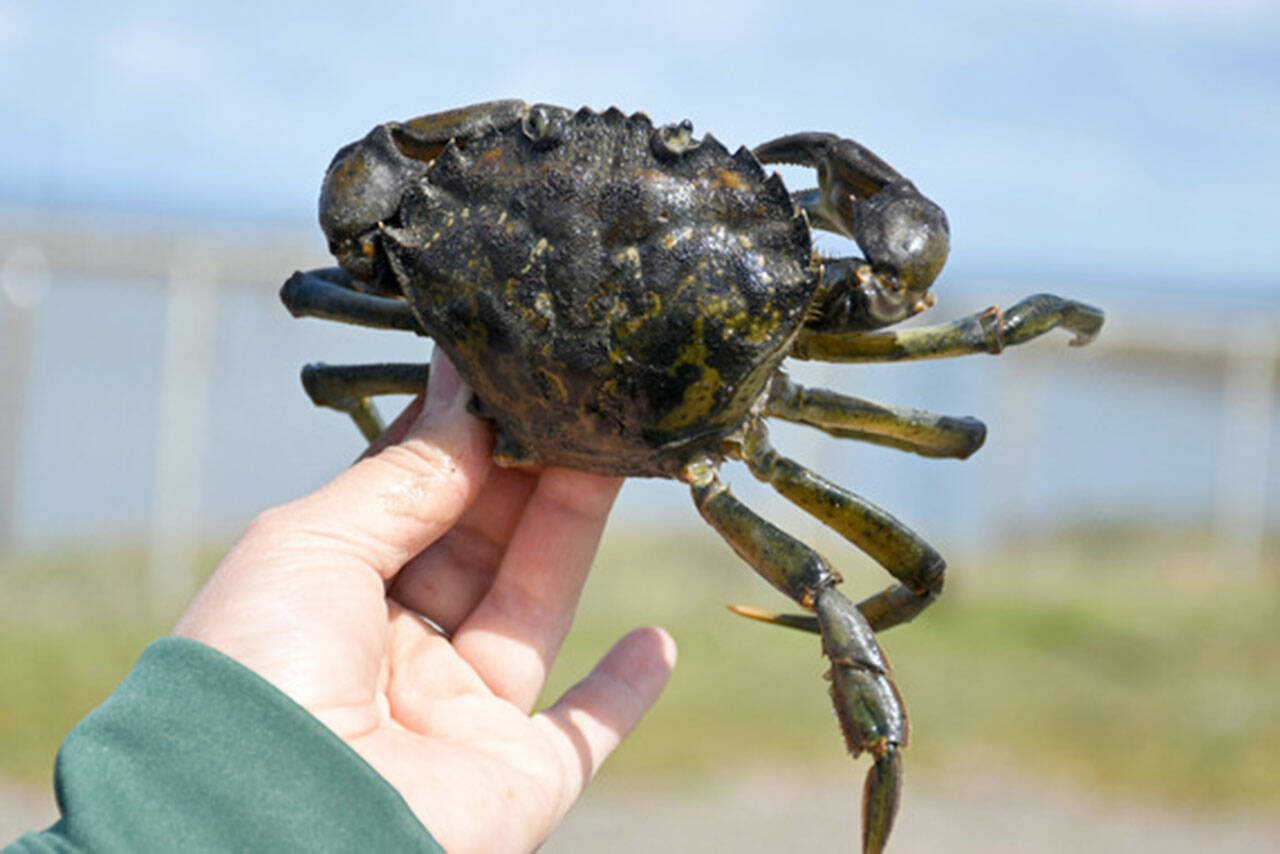
LA PUSH — European green crabs have been detected for the first time in the Quillayute River estuary.
A joint survey conducted by the Quileute Tribe, the state Department of Fish and Wildlife, the Northwest Indian Fisheries Commission and Washington Sea Grant found 33 green crabs earlier this month.
The survey marked the first time the invasive crabs had been found in the North Central Coast Management Area.
The European green crab is a damaging invasive species that threatens native shellfish, eelgrass and estuary habitat that is critical for salmon and many other species.
The species is found in shallow areas, typically less than 25 feet of water, including estuaries, mudflats, intertidal zones and beaches.
“The detection of invasive crabs around La Push is not surprising given their populations to the north in Makah Bay and to the south in Grays Harbor and Willapa Bay,” said Chelsey Buffington, the European green crab project lead at Fish and Wildlife. “This detection provides an opportunity to keep EGC numbers low and avoid harm to tribal, cultural, environmental or economic resources.”
The survey also found Dungeness crabs and molts at numerous traps near the Quileute Marina and other sites in the estuary, which is considered a positive sign that the native crab population is doing well.
“European green crabs do not respect jurisdictional boundaries,” said Justin Bush, an aquatic invasive species policy coordinator at the Department of Fish and Wildlife. “This is an excellent example of tribal nations, the state and researchers working together to address a shared problem that threatens our environment and coastal economies.”
The Quileute Tribe is developing large-scale plans for the 2025 trapping season in coordination with Fish and Wildlife.
“Now that we know they are here in the Quillayute River system, our management strategy will need to revisited,” said Jennifer Hagen, a marine biologist and policy advisor with Quileute Natural Resources. “Ultimately, our concern is the displacement of native species and species that are of cultural importance to the Quileute Tribe.”
Fish and Wildlife, co-managers, tribes, shellfish growers and other agencies and partners have removed more than 258,000 European green crabs from Washington waters so far in 2024, most from Willapa Bay and Grays Harbor on the southern Washington coast.
The numbers have decreased significantly in areas of the North Puget Sound Region in recent years due to sustained heavy trapping by Fish and Wildlife, tribes, shellfish growers and other partners.
The public is asked not to tamper with green crab traps, which often are deployed in shallow areas exposed at low tide and usually identified with a bright orange buoy and an official tag or permit.
Invasive green crabs are a prohibited species in Washington. It is illegal to possess a live specimen.
The Department of Fish and Wildlife does not request the public kill the invasive crabs when found.
Members of the public who find a green crab or molt should leave the crab where they find it. Molts may be kept. Report a sighting by taking photos of the topside and underside of the crab and recording its location.
The department said this policy is designed to protect natives species that may be misidentified as European green crabs.
European green crabs may be green, red, brown or orange.
Their most distinctive feature is the five spines, sometimes called marginal teeth, on either side of their eyes; no other crab in Washington state has this characteristic.
They also have three rounded lobes, called rostral bumps, between their eyes, and their last pair of legs are somewhat flattened.
Fish and Wildlife’s current crab fishery rules are posted at www.eregulations.com/washington/fishing/crab-rules.
More information is available on Fish and Wildlife’s European Green Crab Hub at wdfw.wa.gov/greencrabhub.
