
Peninsula Daily News and news sources
VICTORIA — Politically stalled plans for the Victoria region’s first-ever sewage treatment has captured the ire of politicos on the Washington state side — from Congress through the governor’s mansion.
And now a coalition of Vancouver Island environmental groups is pressuring the Esquimalt Town Council — which is using land-use legislation to block a sewage treatment plant to be built on Victoria Harbour — to reconsider.
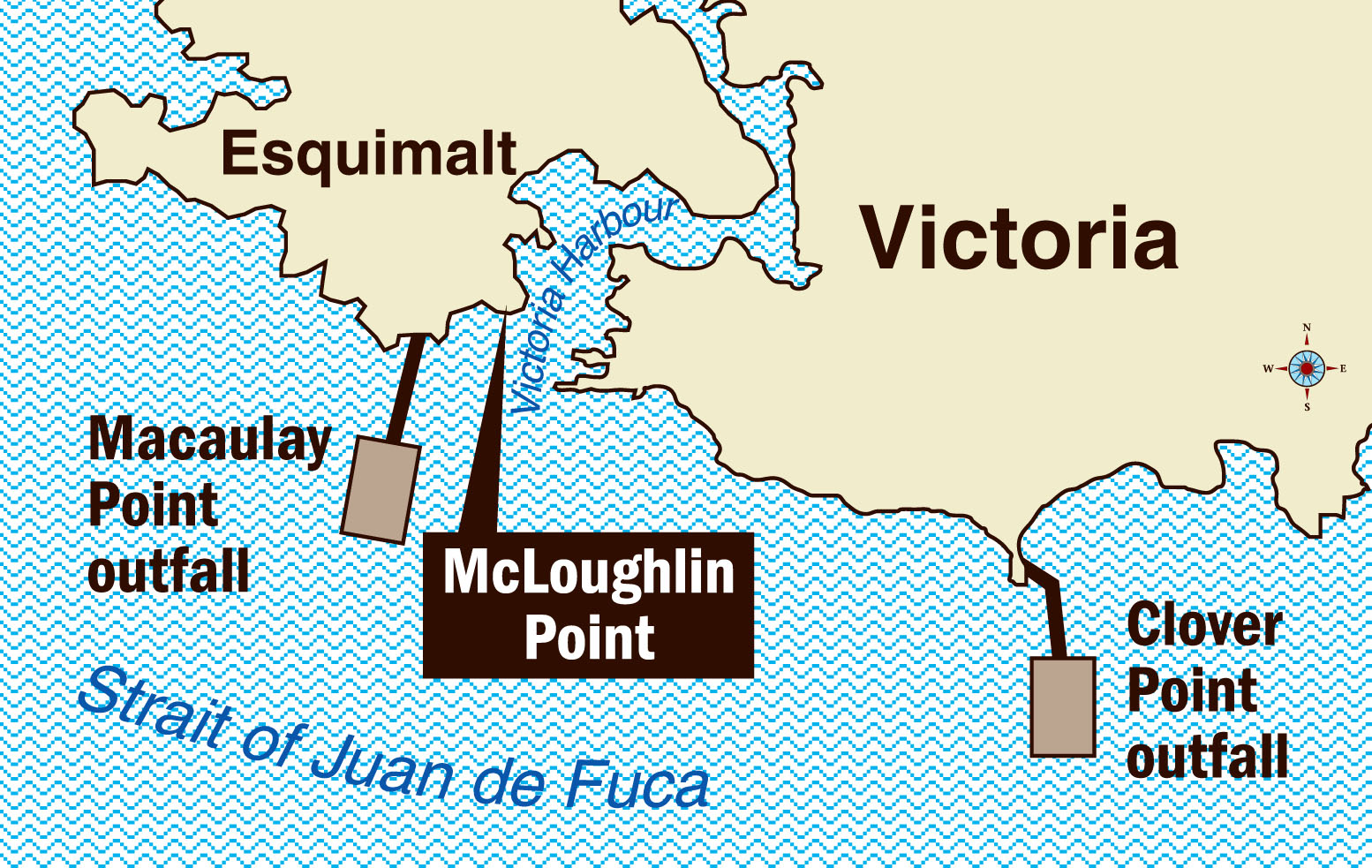
Margot Venton, a lawyer for the coalition Ecojustice, wrote to the Esquimalt council warning that its plan to downzone McLoughlin Point to prevent a sewage treatment plant could mean that local municipalities would have to bear the costs of additional environmental cleanup around the two existing sewage outfalls.
The two outfalls pump about 38 million gallons of untreated effluent daily through two 39-inch pipes into Strait of Juan de Fuca waters directly across from the North Olympic Peninsula.
“It’s a reminder that there is a real environmental problem here,” Venton said.
“This is not just a bell and a whistle that is needlessly being tacked on to a city that is already doing a fine job of dealing with its sewage.
“This ongoing dumping of sewage into the ocean has caused an identifiable problem.”
Venton’s letter, first reported by the Victoria Times Colonist, is the latest salvo in many since the Esquimalt council’s refusal in April put the brakes on a proposed $783 million ($721.6 million U.S.) treatment plant that is required by Ottawa.
The plant was on track by a regional amalgamation of governments called the Capital Regional District, or CRD, to become operational at McLoughlin Point near the entrance to the harbor by 2017.
The refusal has sparked pleas from Washington Gov. Jay Inslee, U.S. Sens. Patty Murray and Maria Cantwell, and the state’s Democratic congressional delegation to British Columbia Premier Christy Clark — Inslee’s provincial counterpart — to use her office to resume sewage treatment planning.
Clark reportedly has not answered any of the correspondence, yielding to her environment minister, Mary Polak.
Polak in May ruled out the possibility of forcing through the wastewater treatment plant at McLoughlin Point.
In the latest salvo from south of the Canadian border, U.S. Rep. Derek Kilmer, at whose 6th Congressional District the two sewage outfalls are pointed, urged the U.S. Environmental Protection Agency on July 3 to press the Canadian government for “a speedy solution.”
Kilmer said in his letter that the EPA has noted a correlation between Victoria’s effluent and decreasing levels of dissolved oxygen in the Salish Sea, which includes the Strait, Puget Sound and the waters surrounding the San Juan Islands.
Venton, the environmentalists’ lawyer, noted that a 2005 assessment of the seabeds around the outfalls found they legally qualify as contaminated sites under provincial law.
If Esquimalt now blocks implementation of the CRD plans for the plant by downzoning the McLoughlin site, the environmental groups will press the province for cleanup, Venton said.
And possibly sue.
Venton said her clients don’t want the underlying contamination being caused by the lack of sewage treatment to be lost in the ongoing debate.
Esquimalt Mayor Barb Desjardins said her city’s refusal to rezone McLoughlin and its plans to prohibit any sewage treatment plant there are not a rejection of the concept.
“We all want to get to sewage treatment. Esquimalt wants that as much as anyone else, which is why we all need to move forward,” Desjardins told the Times Colonist, adding that a number of cities now are looking for alternatives to the McLoughlin plan.
The fact that the current plans have stalled is not Esquimalt’s fault, Desjardins said.
“The process has occurred the way it has,” she said.
