
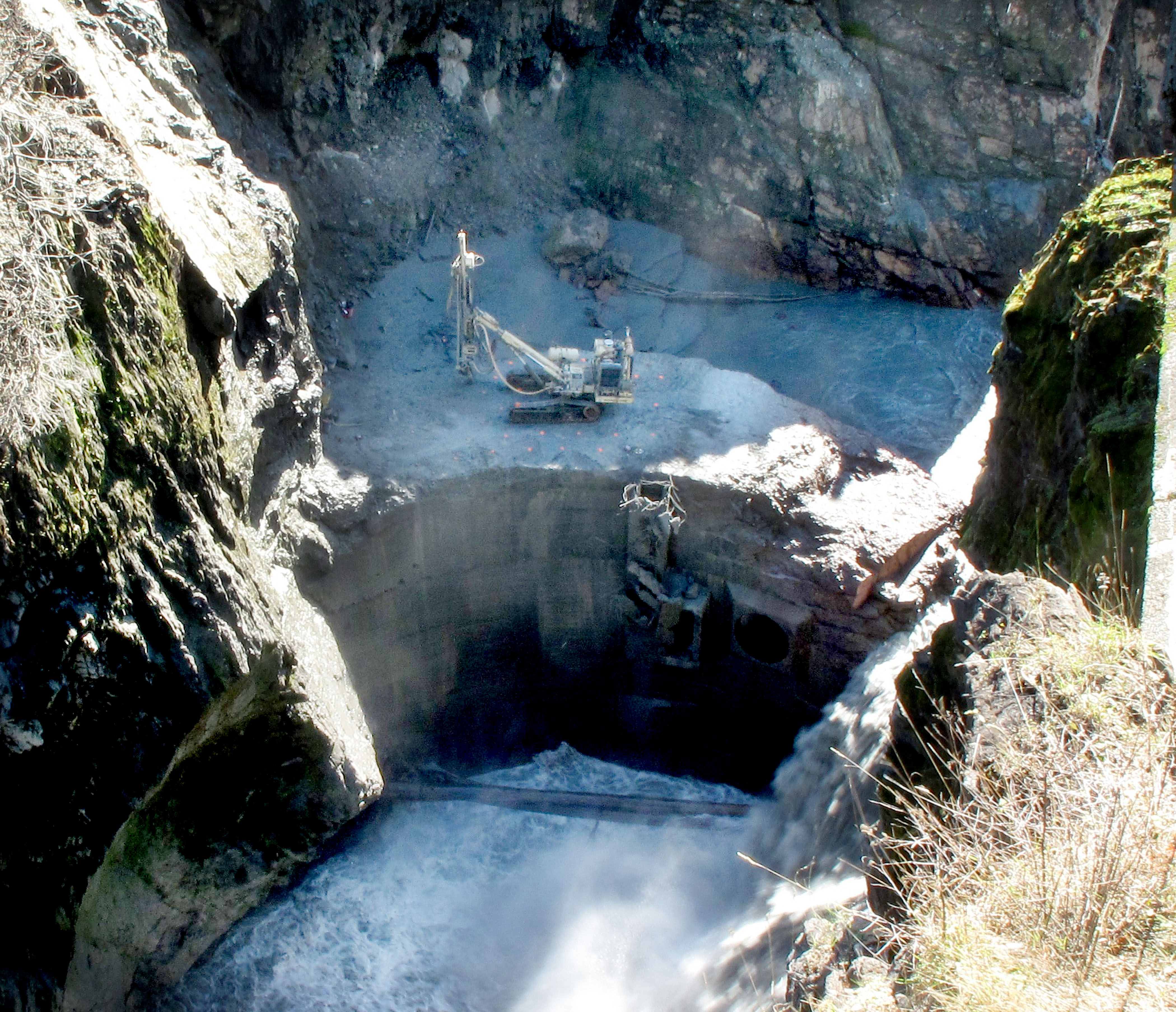
OLYMPIC NATIONAL PARK — After a yearlong project hiatus, an 800-square-foot hole will be blasted into Glines Canyon Dam on Saturday as work resumes on the teardown of the final 50 feet of the Elwha River edifice.
Completion of the $29.5 million dam teardown phase of the $325 million Elwha River restoration project was delayed in October 2012 by sediment clogging the Elwha Water Treatment Plant after river water was released from behind the Glines Canyon and Elwha dams.
Olympic National Park Superintendent Sarah Creachbaum was confident Thursday that the most recent $3.8 million in upgrades to the plant were sufficient to handle sediment loads and that issues related to salmon being harmed by that sediment have been addressed.
“We’ve been working in cooperation with all of our partners on a lot of issues back and forth, and we all feel confident about moving forward at this time,” she said.
“The system has been tested, and this is the prudent thing to do.”
The water-treatment plant processes river water for four downstream users, including the city of Port Angeles.
The fix included a pump that was installed at the plant that is designed to filter gravel from gold, park spokeswoman Barb Maynes said.
Workers from the Bozeman, Mont.-based Barnard Construction Co. Inc. started drilling blast holes in Glines Canyon Dam last week for explosives that likely will be detonated early Saturday afternoon.
The dam once stood 210 feet, making its demise and that of the 108-foot Elwha Dam, which came down in March 2012, the largest dam-removal project in the nation’s history.
“We’re happy to get started again,”company Project Manager Brian Krohmer said Thursday.
“It’s been a long wait.”
After Saturday’s blast, workers will ensure there is a passable fish channel on the floor of the river canyon.
“It’s possible we’ll do another blast there,” Krohmer said.
“Then we’ll be done for the year.”
The project is scheduled for completion by September 2014, but 5½ months of fish windows interspersed throughout the year prohibit blasting to protect migrating salmon.
The windows will allow dam removal in October, January-April and July.
They prevent work after July until October next year.
Barnard has three more blasts to conduct, Krohmer said, adding that he expects the project will be completed on time.
Dam-removal work can proceed during the partial shutdown of the federal government that is indefinitely closing the park to visitors, the last of whom had to leave by 6 p.m. Thursday.
The dam-removal project “is already paid for and appropriated,” Maynes said.
Maynes said restoration project officials were encouraged that heavy rains that pummeled the North Olympic Peninsula over the weekend and at the beginning of this week created high river flows “that were handled just fine” by the plant.
The water-treatment plant was designed to filter fine sediment, not the gravel and sand that water intakes were allowing to get through before work was halted in October 2012, Maynes said.
Pumps from Alaska were installed between the intakes and the water-treatment plant to remove the gravel and sand before they get into the plant, Maynes said.
“These pumps are made to pump gravel to reveal gold,” Maynes said.
“A variety of things have been done over the winter and spring, and some over the summer, too,” she added.
“Those corrections have enabled the plant to function at a much higher level than it did last year.”
Construction of an alternative intake structure will be completed this fall, she said.
“The goal is to have a new, alternative intake so the root cause [of the sediment problems] will be addressed.”
More than 1,700 adult chinook were counted in a multi-agency survey of the Elwha River and tributaries Sept. 17, but the salmon run is over, Maynes said.
“Any adult fish that are in there will not be living much longer anyway,” Maynes said. “They are probably dead by now.”
Clear-water refuge for remaining salmon also is provided by backup facilities such as the state Department of Fish and Wildlife rearing channel and the Lower Elwha Klallam tribe’s fish hatchery, Maynes said.
About 34 million cubic yards of sediment was locked behind the dam’s two reservoirs.
About 8 million cubic yards has been released as the dams have been dismantled, but not all the remaining sediment will flow downstream.
The water-treatment plant filters river water and routes it downstream to Nippon Paper Industries USA, the state Department of Fish and Wildlife fish-rearing channel, the Lower Elwha Klallam tribe’s fish hatchery and the Port Angeles Water Treatment Plant, which provides drinking water for city residents.
Water quality to those users has declined, forcing the city to rely on its Ranney well — the city’s main source of drinking water — more than expected. The well is located near the water-treatment plant.
“We feel comfortable at this point with the notching that is being proposed for the dam,” City Manager Dan McKeen said.
“We will be monitoring the situation, as will the National Park Service.”
________
Senior Staff Writer Paul Gottlieb can be reached at 360-452-2345, ext. 5060, or at pgottlieb@peninsuladailynews.com.
