
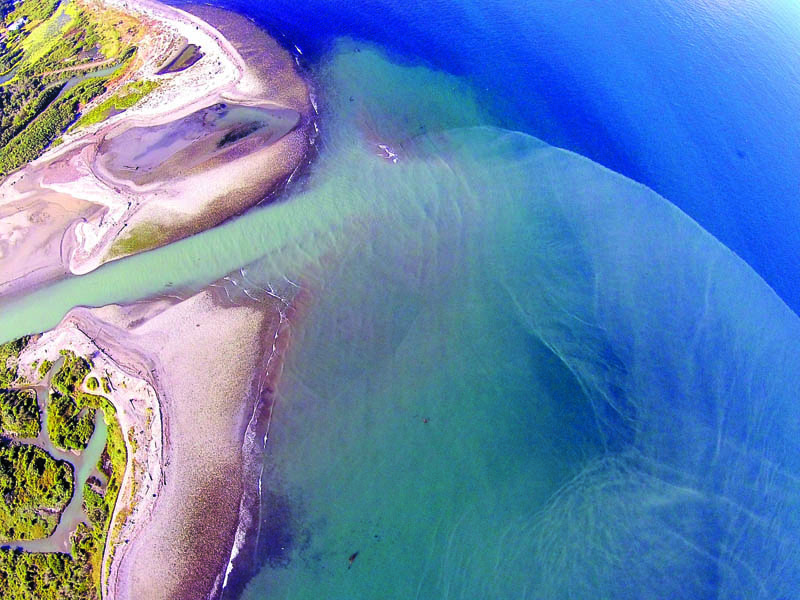
PORT ANGELES — Biologists watching the Elwha River’s recovery process believe that about half the material expected to flow toward the Strait of Juan de Fuca is yet to come.
Flowing with it: the keys to restoring the river’s once legendary fish habitat.
Both state and private biologists are anticipating fall storms to bring higher water flows through the Elwha, along with coarser and larger-grained material than the fine silt that began entering the strait last spring.
Anne Shaffer, marine biologist and executive director of the Port Angeles-based Coastal Watershed Institute, said the coarse sand, which salmon need for spawning, will help kickstart the long habitat restoration process for both the river bed and nearshore area.
“We haven’t even started yet,” Shaffer said. “We’re at the very beginning of habitat restoration.”
Shaffer said the decreasing sediment levels in August and September are more or less exactly what models predicted for this period of the restoration project.
Chris Byrnes, Washington Department of Fish and Wildlife habitat biologist, said the river’s turbidity levels have stayed steady throughout the summer and also are what flow models forecast.
“Visually, the river looks really normal right now,” Byrnes said.
Shaffer expects the most sediment to be released following the demolition of the 85-year-old Glines Canyon Dam, which sits 9 miles up river from where the Elwha River Dam once stood.
The removal of the 210-foot Glines Canyon Dam, the second phase of the $325 million Elwha restoration project, is expected to be completed by spring of next year, according to Olympic National Park spokeswoman Barb Maynes.
Roughly half of the dam had been removed as of May.
The construction of both dams in the early 1900s took out roughly 70 miles of pristine salmon spawning habitat, much of which now sits within the Olympic National Park.
Crews from Barnard Construction will restart work demolishing the Glines dam after the most recent fish window ends Saturday, Maynes said.
During the window, which started Aug. 1, crews were barred from doing any work on the dam demolition that would have allowed more water, and subsequently more silt, to flow down the Elwha, Maynes said.
This limitation was put in place to protect migrating fish.
“The contractor has not done anything to release more sediment since the last day of July,” Maynes said.
The last fish window of 2012 will span all of November and December, she said, with the first window of 2013 beginning in May.
Maynes said crews did complete demolition of an intake tower at Glines that once was used for hydrolectric power generation.
“They’re still working; they’re just not lowering the dam,” she said.
Once the current fish window ends, crews will begin “notching” the Glines dam, or removing it, via controlled blasts, at no more than 1½ feet a day, Maynes said.
Workers will be have to stop blasting for 14 days for every 15 feet of the dam that’s removed, Maynes explained, in order to avoid extreme pulses of sediment flowing down the Elwha. These pulses could prove harmful to the fish that have begun returning to the river.
The 14-day holds, as they’re called, will allow the river to stabilize itself after receiving increased water flow from Lake Mills, which formed behind the Glines Canyon Dam, Maynes said.
The Elwha removes backed-up sediment from Lake Mills differently depending on when the dam was most recently lowered, Maynes said.
Immediately after blasting, the river eats away at sediment vertically, but once flows lessen the river removes sediment with a side-to-side motion.
“It’s the difference between using a hoe to dig a trench and using a rake,” Maynes said.
The restart of demolition, combined with higher flow levels in the river expected this fall and winter will carry more material down the Elwha, slowly restoring spawning habitat that salmon had been deprived of for the better part of a century.
“What the salmon are after is the sand and the gravel,” Maynes said.
Reporter Jeremy Schwartz can be reached at 360-452-2345, ext. 5074, or at jschwartz@peninsuladailynews.com.
