
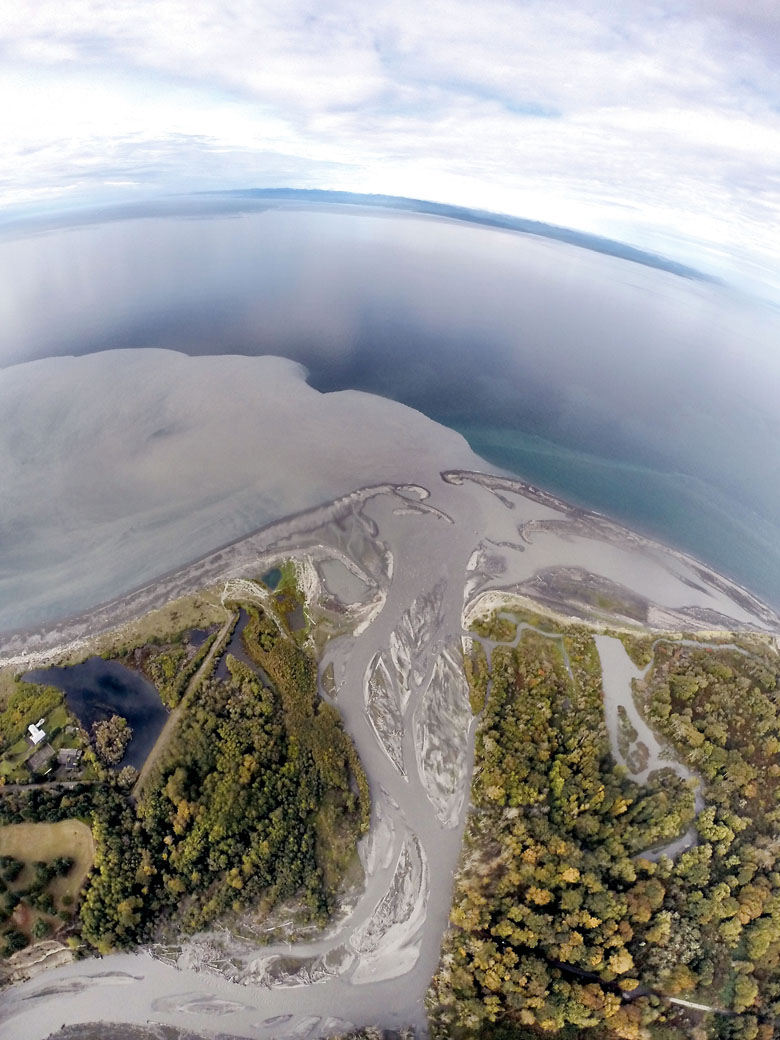
PORT ANGELES — Sediment once locked behind two dams has built some 70 acres of new estuary at the mouth of the Elwha River since 2011, according to the Coastal Watershed Institute.
That has created new habitat that fish are flocking to use, said Anne Shaffer, a biologist who is executive director of the Coastal Watershed Institute based in Port Angeles.
“As soon as the estuary habitat is available, the fish are using it,” she said, obviously delighted by the quick changes.
Before dam removal began in September 2011, the river mouth on the Strait of Juan de Fuca west of Port Angeles was lined with cobbles.
Estuary habitat — a mix of fresh water and salt water from the Strait — extended upriver.
Now that both the Elwha and Glines Canyon dams have been removed, the lower river is fresh water only, and the new estuary offers large spawning ground for fish, Shaffer said.
Dam removal and the dispersion of sediment once buried in lakes Mills and Aldwell behind the dams “has created more lower-river habitat,” she said.
“The old estuary habitat is now lower-river, and new estuary habitat is forming.
“It’s changed because the riverbed has raised and the river mouth has moved north, so the water from the Strait isn’t able to come up that far up the river,” she explained.
Fish in new habitat
“We’ve also documented that fish use of this area has changed,” Shaffer said.
“The new estuary has been immediately accessed by eulachon as well as juvenile chinook, chum and coho salmon; bull trout; and smelt,” she said, citing research by Amy East of the U.S. Geological Survey and Andy Ritchie, Olympic National Park Elwha project hydrologist.
Eulachon, a small anadromous fish federally listed as a threatened species, is spawning at the “head of tide,” the transition between salt water and fresh water, Shaffer said.
The fish once were an important part of the diet of indigenous people.
Also found in the new estuary “unfortunately,” according to Shaffer, are juvenile shad, “a non-native nuisance species in the new estuary areas.
“And last but not least, we documented, with Dan Penttila and National Geographic Student Explorers, that surf smelt are spawning along new western shoreline [but not the eastern area],” Shaffer said.
The dam removal phase of the $325 million Elwha River restoration project — the largest such process undertaken in the U.S. — was finished after the final blast Aug. 26 of a 30-foot remnant of the once-210-foot Glines Canyon Dam 13 miles from the river’s mouth.
Elwha Dam, built in 1911 and opened in 1913 about 5 miles from the mouth of the river, had been demolished by March 2012.
Sediment flows
Sediment released from the lakebeds ran thick in the river, but so far, only about 30 percent of the estimated 24 million cubic yards of sediment built up behind the dams has arrived in the nearshore area at the river mouth, Shaffer said, citing East’s studies.
“The nearshore restoration response has just begun,” Shaffer said.
“This whole hydrodynamic process has been reactivated.”
As more sediment is delivered, “we will see an increase in the estuary out there, but more important, a larger amount of sediment will be delivered to nearshore,” Shaffer added.
Waves and currents will move sediment to Freshwater Bay or to beaches between the river mouth and Angeles Point, with some moving “around the corner” and out to Ediz Hook, she said.
The process has already begun.
Recent sampling by David Parks of the state Department of Natural Resources has found that more than a meter of new sand has been deposited on the low-tide beach terrace along unarmored feeder bluffs about 1.5 miles east of the Elwha River mouth, Shaffer said.
Bluff erosion
The buildup of sediment is expected to slow erosion of surrounding bluffs, such as the one containing the city of Port Angeles’ shuttered landfill.
Erosion of the bluff containing the landfill at the west end of 18th Street has led to a $21.25 million project to move garbage back so it doesn’t fall into the Strait.
“Bluffs, such as those containing the landfill, have been sediment-starved,” Shaffer said.
“If the dams hadn’t been put in, that shoreline wouldn’t have eroded that quickly,” she added.
“The sediment coming out now should ease the erosion.
“We don’t know how much.”
________
Managing Editor/News Leah Leach can be reached at 360-417-3531 or at leah.leach@peninsuladailynews.com.
