
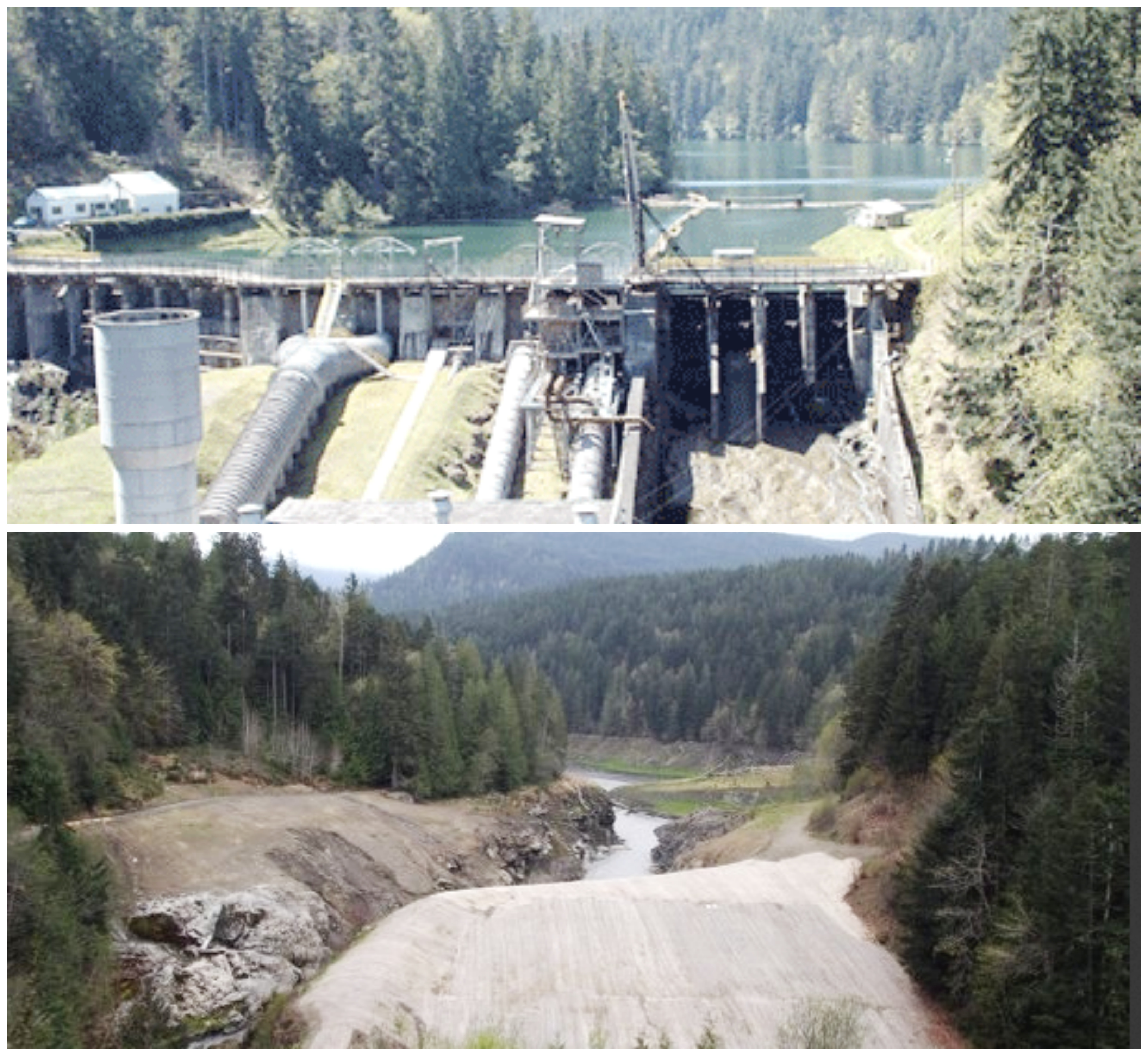
EDITOR’S NOTE: See time-lapse video, below, of the removal of the Elwha Dam between Sept. 13, 2011, and July 15, 2012.
IN ADDITION, see the Elwha restoration first-hand. The Elwha River and the now-drained Lake Aldwell area behind the Elwha Dam site are open year-round to hikers (during the summer there are ranger-led tours). See “Go on a walk . . . to see former Lake Aldwell green with new growth after dam removal [*Photo Gallery*]” at https://giftsnap.shop/article/20130825/NEWS/308259998
SEATTLE — The story is as rich as its source.
“Elwha: A River Reborn,” the exhibition that just opened at the University of Washington’s Burke Museum, details the decades-long fight to remove the river’s two dams, and the environmental renewal happening right now.
The largest dam removal in U.S. history, demolition of the Elwha and Glines Canyon dams — built with no fish ladders, cutting off access to more than 70 miles of river habitat — officially began in September 2011.
Engineers and scientists have since come from around the world to study the $325 million Elwha River Restoration project.
The last parts of the 108-foot Elwha Dam were taken out in March 2012. The 210-foot Glines Canyon Dam is scheduled for complete removal in late 2014.
Salmon and steelhead now spawn in the river above the Elwha dam site.
But “A River Reborn” goes beyond the technical.
The exhibit also offers a spiritual perspective through photographs and words from the Lower Elwha Klallam tribe, whose members have lived beside the river for millennia.
“We were here. We are still here,” the late Klallam elder Beatrice Charles declares in a quotation on the exhibition’s front wall.
Tribal Chairwoman Frances Charles, in a speech at the exhibition preview last week, paid tribute to the elders who have long fought for the river.
Connection to the Elwha
She also sought to evoke her people’s connection to the Elwha of the past and future.
Charles recalled a walk by the riverside above the Elwha Dam site.
“It gave me that enrichment,” she said, her voice catching. Walking, she could see the fish, the birds — 18 eagles on one fine day — “and feel the emotions of our ancestors.”
Standing in silence, she could envision what the Elwha looked like in the time before the dams were built, before her tribe was displaced.
The Burke exhibition doesn’t sugarcoat this part of the story.
“The Lower Elwha Klallam tribe lost the most” when the dams stopped the salmon, one panel says.
The dams’ construction, 1910 through 1927, destroyed the river’s natural abundance; flooded sacred sites, camps and burials.
“In Port Angeles, Klallam residents were pushed out of what had been their traditional village sites on the waterfront. Klallam families were moved and moved again,” the panel continues.
For “a lumber mill built in the early 1890s atop Tse-whit-zen, an ancient Klallam village and burial ground . . . developers of the mill drove pilings right through the graves.”
The “Elwha: A River Reborn” exhibition includes artifacts from Tse-whit-zen, uncovered beginning in 2003 when the state Department of Transportation started building a graving yard — an on-shore dry dock — in Port Angeles.
The exhibition also shows the massive restoration effort, with pictures of Olympic National Park botanist Dave Allen and volunteer coordinator Jill Zarzeczny at work on the revegetation along the river and lakebeds.
A river as medicine
Today, the river, with its wildlife, acts as a medicine both spiritual and physical.
Elders use fish-head soup as a cold and flu remedy, Charles said. And then there’s her grandnephew Sequoia, age 4.
“He loves to eat fish-head soup,” she said.
And like the other young children in her family, he watches his elders closely when they’re working in the kitchen.
“We always say: If our children aren’t eating a food, then we’re going to lose our resources,” Charles said.
She’s pleased that young members of the Elwha tribe are learning about the salmon runs — and the whole ecosystem around them.
That’s the value of the Burke exhibition, Charles added: giving people information they can share with the rest of the world.
Four van loads — elders and youths — were scheduled for Saturday’s opening celebration at the Burke, Charles said.
And come September 2014, when the last pieces of Glines Canyon Dam are slated to be taken away, “we’re going to celebrate again.”
________
Features Editor Diane Urbani de la Paz can be reached at 360-452-2345, ext. 5062, or at diane.urbani@peninsuladailynews.com.
Time-lapse video of the removal of the Elwha Dam between Sept. 13, 2011, and July 15, 2012.
