
OLYMPIA — The results of the state Department of Ecology’s Japanese earthquake debris collection pilot program are in — three crews, four days, three beaches and 70 pickup-truck loads later.
The three six-member crews were deployed from June 25 to last Thursday to clean up marine debris and to determine what, if any, debris stemmed from the earthquake and tsunami that took place March 11, 2011, off Tokohu, Japan.
In addition to measuring the volume of debris already on the beaches, the pilot program also showed the speed at which debris is arriving, said an Ecology report released last week.
It’s arriving at a mind-boggling pace.
“We would clear a stretch of beach, and within 20 minutes, more marine debris washed up,” said Jered Pomeroy, a Washington Conservation Corps crew member.
“Keeping our beaches clear will definitely take a concentrated community effort,” Pomeroy, of Lakewood, was quoted as saying in the report.
Some of the debris had Asian characters on it, but none of it could be definitively identified as having come from the tsunami, Ecology said.
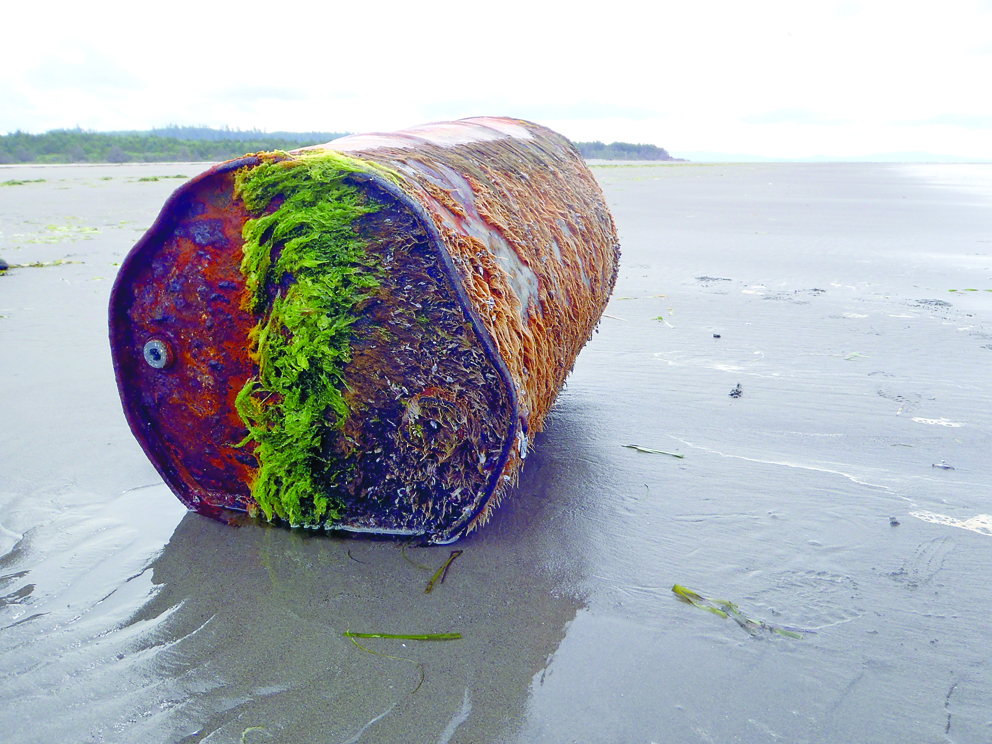
After their initial sweep clearing Westport to Washaway Beach, Pomeroy and other members of his crew discovered an unmarked 55-gallon oil drum that was washed up by the waves.
The drum was reported to state and federal responders, who removed it for safe disposal.
Ecology WCC crews collected the debris along 57 miles of Washington shoreline, from Cape Disappointment on the Oregon border up to Moclips, which is about 10 miles north of Copalis Beach in Grays Harbor County.
It still is not known when, or if, the program will be extended to Olympic Peninsula beaches, said Linda Kent, Ecology spokeswoman.
Once the results are in from the pilot program — and when the official report is approved from the interagency tsunami debris meeting that was held in May — decisions will be made on what happens next, Kent said.
Debris the workers picked up included refrigerators, an oil drum, Styrofoam, pieces of plastic, large crates and containers, buoys, ropes and household garbage.
“The vast majority of the debris we found was Styrofoam, and it’s hard to say exactly where it came from,” said Shawn Zaniewski, crew supervisor. “We did, however, find some large items with Japanese symbols.”
Officials have said that Styrofoam is one of the materials expected to arrive in large amounts, along with lumber, because both float easily.
Removal of non-hazardous marine debris is usually handled by the many dedicated volunteer groups that organize regular beach clean-up projects in Washington, according Ecology.
But under state and federal statutes, no one local, tribal, state or federal agency is charged with picking up marine debris along beaches.
Items from Asia, including buoys or consumer plastics, regularly wash up on the Washington coast regularly. But it is difficult to tell the exact origin of the debris if they lack unique identifying information, such as a name or number.
Zaniewski said crews found numerous items with Asian writing on them.
Pomeroy and Zaniewski were on a crew that cleared the area from Westport to Washaway Beach. A crew clearing the area from Moclips to Ocean Shores consisted of recently returning military veterans.
“Ocean Shores had the heaviest amount of debris in the north beach area,” crew supervisor Phil Hansen reported. “We had to make several passes along the same stretch of beach due to additional debris coming onshore.”
A third WCC crew covered the Long Beach area.
Crews said that residents, beachcombers and community volunteers had reduced the amount of marine debris found along popular stretches of beach, but in less-visited areas, the debris was denser.
Oceanographer Curtis Ebbesmeyer, a wind and ocean current specialist, had predicted that the main body of the tsunami debris would begin arriving in October and continue showing up on West Coast shorelines for years.
“It’s just dribs and drabs right now,” he said last month. “You can expect the main mass to arrive in October. It could be 100 times this.”
Ebbesmeyer and Jim Ingraham are experts in “flotsametrics,” or the movement of ocean debris driven by ocean and wind currents, with more than 20 years of experience.
In 2011, their ocean model, Ocean Surface Current Simulator, or OSCURS, predicted that some items with low drag and areas exposed to the wind would arrive last fall.
So far, their predictions have been proven correct, including the fast arrival of lightweight fishing floats, which took only seven months to cross the Pacific.
Members of the public are requested to report debris sightings to NOAA at
disasterdebris@noaa.gov. Anyone encountering oil or hazardous materials on state beaches should phone 800-OILS-911 (800-645-7911).
Other numbers are the National Response Center at 800-424-8802 and the state Military Department Emergency Management Division at 800-258-5990.
If boaters encounter large debris items still in the water, phone the National Response Center at 800-424-8802.
Ecology’s guide for what to do when encountering tsunami debris is at http://tinyurl.com/debrisguide.
For more details, visit www.marinedebris.noaa.gov/tsunamidebris/
Reporter Arwyn Rice can be reached at 360-452-2345, ext. 5070, or at arwyn.rice@peninsuladailynews.com.
