
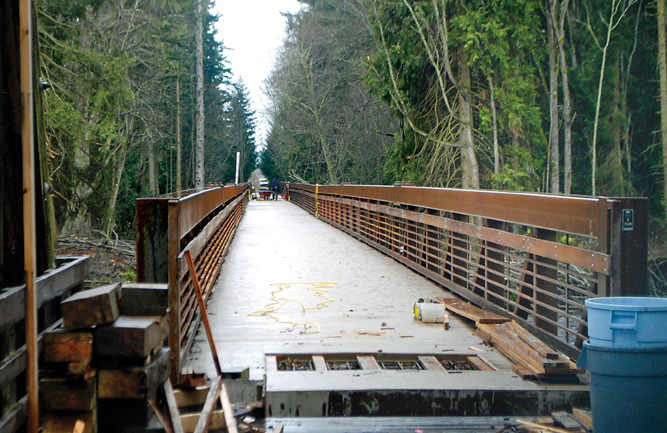
SEQUIM — About 10 months after being damaged and closed by flooding, the Dungeness River Bridge is set to reopen to the public Thursday, Dec. 24.
The Jamestown S’Klallam tribe owns the structure and adjacent Railroad Bridge Park at 2151 W. Hendrickson Road.
A grand opening ceremony to commemorate the near completion of the $1.53 million construction project is tentatively scheduled for 1 p.m. Wednesday, Dec. 30.
“We are really pleased to be able to see it open in time for the holidays,” Annette Nesse, Jamestown S’Klallam chief operations officer, said Thursday.
Visitors now have a “sound, secure structure that should last for many, many years,” she said.
The tribe had initially scheduled the bridge to reopen earlier this month, but as “construction progressed, it looked like late December or early January,” Nesse said.
“I have to tip my hat and give a lot of kudos to Randy Johnson, our project manager, and also Nordland Construction, who have just done an amazing job of keeping that project moving forward and keeping in mind that the public is more than ready to have their structure back.”
Nordland Construction, headquartered in Port Townsend, was contracted by the tribe to complete the project using design and engineering schematics by Otak of Portland, Ore.
The new 750-foot-trestle replaces a 570-foot-long wooden trestle severely damaged by a storm in February. The damaged trestle has been demolished and removed.
The Howe Truss bridge was undamaged, but foot and bike traffic over the river has been closed since February because the old trestle connecting it to the west bank was unsafe.
That blocked a portion of the Olympic Discovery Trail, which is planned to eventually span the North Olympic Peninsula from Port Townsend to La Push.
The replacement trestle allows logs and migrating salmon to pass beneath without hindrance by reducing the number of support beams needed to prop up the walkway, the tribe said.
“The structure does not impede the river and is an important plus for salmon habitat,” Nesse said.
Finishing touches
Construction crews are putting the finishing touches on the new trestle, and some work will continue into January, Nesse said.
“They are working on the center of the crossing, which is the observation area,” she said.
“That won’t quite be complete by Dec. 24, but the main crossing over the river will be.”
The construction crew is currently awaiting the arrival of steel handrails “that were a little bit difficult to procure,” Nesse said.
“We have some temporary railings that will be up” in time for next Thursday’s opening, “and it will still be very safe for people to use the structure until” the new permanent railing is installed, she said.
The final installation date was unknown Thursday, she said.
“I know the [railings] have been ordered; it is just a matter of when it can be delivered,” she said.
The tribe also has received an additional $100,000 grant to replace the wooden decking on the existing Howe Truss bridge to match the decking on the new trestle, Nesse said.
“First Federal generously granted us some funding under their community foundation grant to redeck the bridge as well,” she said.
“That won’t be ready by the 24th. It will happen after the new year, but at some point, it will all look the same and have the same concrete decking.”
Construction phases
In early August, a demolition crew removed about 90 feet of the old wooden trestle in preparation for the construction of its replacement and to allow spawning salmon to travel through the area unhindered.
In late August, Nordland Construction began removing the remaining portions of the trestle, taking special measures to do the work without disturbing salmon and other wildlife, Thomas Johnson, president of Nordland Construction, said at the time.
The crews installed an 800-foot access road parallel to the trestle to accommodate large machinery, Johnson said.
Railroad car bridge
The temporary roadway included an 89-foot-long railroad car bridge that spanned the river channel, allowing machinery to move across and onto an island in the center without entering the waterway.
That roadway was in the process of being dismantled and removed this week, Nesse said.
Once the old trestle was completely removed in October, crews began driving steel pilings to support the new trestle into the ground at four locations.
After the steel pilings were driven, concrete piers were placed on top of the pilings to hold up the trestle.
A concrete pier beneath the existing Howe Truss bridge supports the new trestle where the two structures connect.
The new trestle began arriving in October in prefabricated 60-foot-long, 9-foot-deep sections.
The steel sections were manufactured by Wheeler Lumber LLC — a Minnesota firm that specializes in metal, fiberglass and timber prefabricated bridges — and transported to Sequim on flatbed trucks.
Crews bolted the sections together to create four 182-foot-long sections. A fifth 22-foot-long section was placed in the middle.
The final phase was to lower the walkway onto the piers with two massive cranes and install decking.
________
Sequim-Dungeness Valley Editor Chris McDaniel can be reached at 360-681-2390, ext. 5052, or cmcdaniel@peninsuladailynews.com.
