
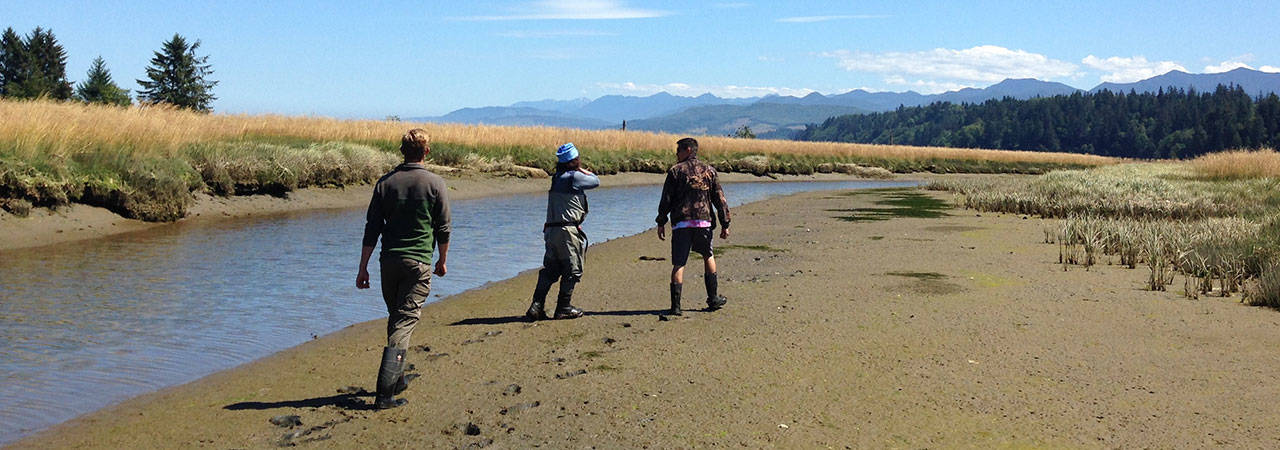
SEQUIM — In the coming week, resource managers on the Dungeness Spit look to wrap up their season’s hunt for the invasive European green crab.
The crabs were discovered last April on Graveyard Spit north of Dungeness Landing. Researchers have found a total of 93 green crabs — 54 males and 39 females — as of last Thursday.
Lorenz Sollmann, deputy project leader at the Washington Maritime National Wildlife Refuge, said because of high tides this week, staff and volunteers will set traps for five days.
They will start Saturday before determining whether they’ll stop for the season and pick up again in April.
Emily Grason, crab team project coordinator through Washington Sea Grant, said research in Willapa Bay near Long Beach in the late 1990s and early 2000s showed that green crabs don’t come to traps in the same numbers in the winters as the summer.
“It doesn’t make a good use of people’s time [to search in winter months],” she said.
Throughout the summer, Sollmann worked with fellow staffers and about 20 volunteers, including some with Clallam County Streamkeepers, to place as many as 127 traps at a time.
The European green crab, known for its five spines on each side of its eyes, is considered one of the most invasive species on Earth, according to scientists, and it has been reported to have damaged shellfish harvests and seagrass beds in the northeastern United States.
A man-made lagoon northwest of San Francisco holds an infestation of more than 100,000 green crabs that locals have been unable to contain despite trapping efforts, since being discovered in San Francisco Bay in 1989.
Grason said research shows a female green crab can release up to 500,000 larvae at a time, and that it’s possible they have more than one brood a year.
Sollmann said if local green crabs had bred by now in Dungeness, larvae would have showed up in their minnow traps.
Resource managers also estimate the green crabs in Dungeness all come from the same 2016 age group because of their similar size.
Things were looking positive for the trapping effort as resource managers went about one month without catching any green crabs, but two females were captured in the same trap on separate days two weeks ago, Sollmann said.
“We’ll trap in the next two weeks and see where we’re at,” he said. “We’ve been putting 50 traps out for a few months now.”
Allen Pleus, aquatic invasive species coordinator for the state Department of Fish and Wildlife, said resource managers have been trying to “find the needles in the haystack when the populations are small” since April.
“We need to attack it as early as we can,” Pleus said.
“It’s similar to a wildfire and trying to find hot spots. It’s also similar to illnesses like Ebola or avian flu. If you find small pockets, you try to get rid of it before it gets exponentially worse.”
Sollmann said rapid response to trapping is the “most efficient and economically feasible way of handling the crabs.
“If we can control the population in this estuary, then we’re preventing it from infesting another one down the water. It’s not like a weed you can spray and it’ll go away,” he said.
Early detection monitoring has been ongoing since 2001 along the Dungeness Spit. The first green crabs were discovered in April after crab team staff members helped realign traps to possible habitat spots.
Sollmann said he made an effort to continue twice-a-month trapping after grant funding ran out in 2010.
“I was afraid we’d miss something,” he said.
Until recently, Dungeness was one of three recent state sightings of green crab, including Westcott Bay on San Juan Island and Padilla Bay near Anacortes in the summer of 2016.
However, two more lone green crabs were found on the west side of Whidbey Island at Lagoon Point, a male, in early September, and a female in Sequim Bay on Aug. 15.
Grason theorizes that it’s possible the Whidbey Island crab is linked to Dungeness’ crab, but its size indicates it was born in 2017, compared to the local crab born sometime in 2016.
In Blyn, Neil Harrington, environmental biologist for the Jamestown S’Klallam Tribe, led trapping efforts that found a single green crab, likely born in 2016, in the Jimmycomelately Creek estuary in the southern part of Sequim Bay.
In the month since then, Harrington and co-workers have placed 316 traps over the span across the bay but did not find any more crabs.
He plans to trap a few more locations that he hasn’t covered in the bay in the coming week but says it might be his last trapping days until next spring.
Grason said because of the amount of traps placed and with no other signs of green crabs, Sequim Bay’s crab is “likely one lucky crab who survived a very low probability scenario.”
Next steps
This winter, Pleus said resource managers will work on a management plan for 2018 while expanding partnerships among agencies.
Sollmann estimates his team will place 50 traps next April to assess the number of green crabs and move to monitoring monthly if they aren’t seeing much results from trapping.
“Have we managed to capture every crab? Certainly not, but the numbers are lower,” Grason said about the efforts in Dungeness.
“From our perspective, it’s been really successful and it shows it takes a lot of effort. Their response is ideal.”
How the crabs ended up in Dungeness or where they came from remains a mystery.
Grason has said there are multiple options as to how they arrived here such as floating as larvae from another infested area — perhaps British Columbia’s Sooke Basin, or as far away as Oregon or California.
Grason said 15 samples of green crabs from Dungeness have been frozen for a scientist to genetically test, but grant funding will be needed to pay for the process.
The crab team hosts 52 early detection sites with help from more than 200 volunteers and dozens of partner agencies’ staff, including working with the Lower Elwha Tribe at the Pysht Estuary southeast of Clallam Bay.
________
Matthew Nash is a reporter with the Olympic Peninsula News Group, which is composed of Sound Publishing newspapers Peninsula Daily News, Sequim Gazette and Forks Forum. Reach him at mnash@sequimgazette.com.
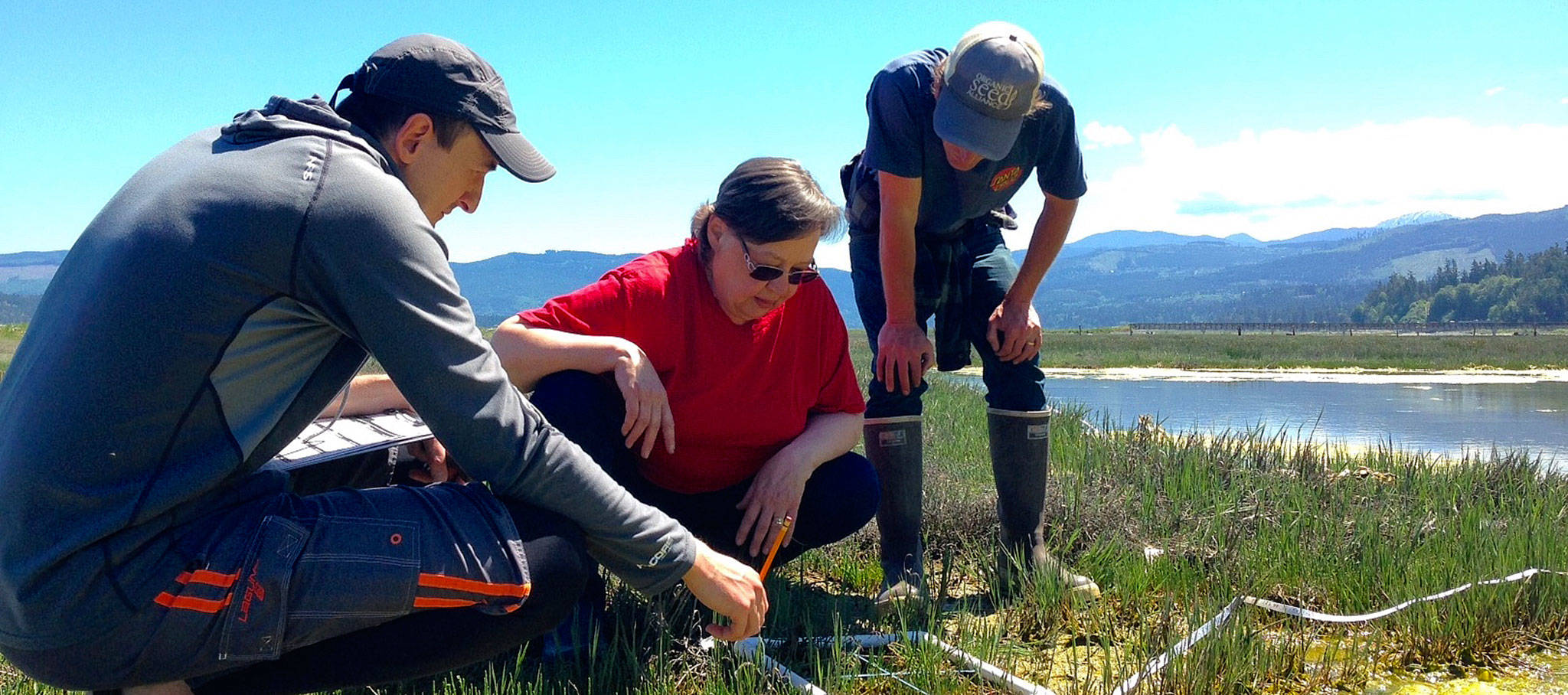
Late last summer, Crab Team Volunteers Shanon Dell and Sue Bonomo and Neil Harrington, environmental biologist for Jamestown S’Klallam Tribe, assess shoreline vegetation at Washington Harbor in Sequim Bay for possible habitat for European green crab. One crab was found in Sequim Bay in mid-August but not since then. (Emily Grason/Washington Sea Grant)
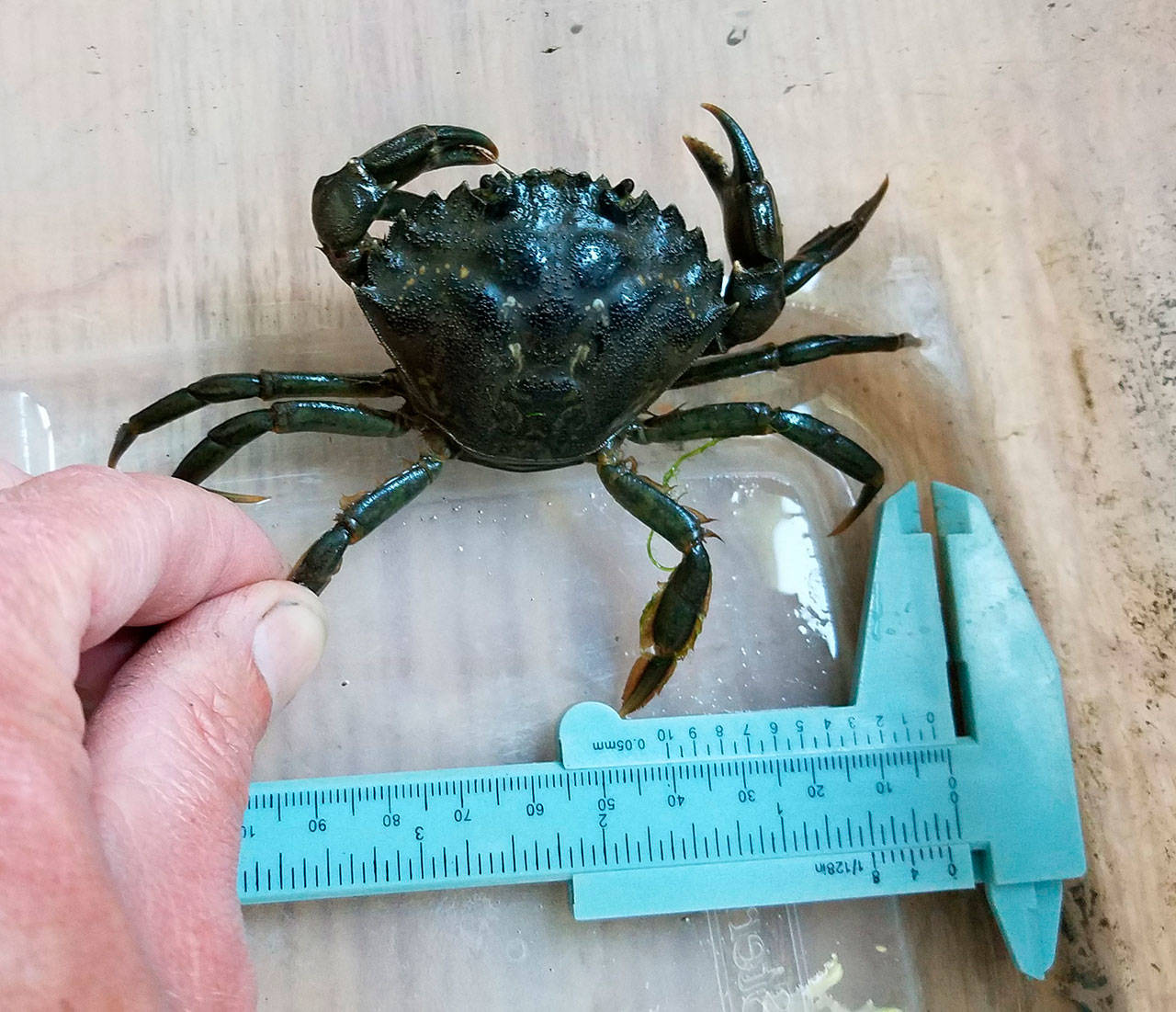
One female European green crab was trapped in mid-August in Jimmycomelately Creek’s estuary, but none has been found since then. (Neil Harrington /Jamestown S’Klallam Tribe)
