
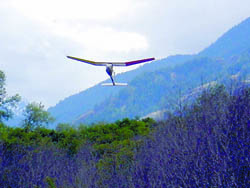
PORT ANGELES — Electronic “Ravens” join hungry raptors, their eyes fixed on the flowing water below, as they swoop over the Elwha River this week.
The 4½-foot-wide aircraft, resembling radio-controlled airplanes, are steered by researchers on the ground.
They took flight Monday, continued Tuesday and will be in the air today.
The hands behind the controls and the eyes watching the video streaming from cameras on the craft to a laptop computer will belong to researchers from the U.S. Geological Survey, the federal Bureau of Land Management and the National Park Service.
It’s the second series of flights over the Elwha for the Ravens, as their California manufacturer has christened them.
The first flights were in June, when the small aircraft glided almost silently about 500 feet above the river, just south of what was at one point Lake Aldwell.
The researchers’ mission: to determine how best these coffee-table-sized aircraft can be used to study not just the $315 million Elwha River project but also other such projects.
Mike Hutt, unmanned aerial system project manager for the U.S. Geological Survey, said the second goal is to take video of river sediment newly released by the removal of Elwha Dam and the ongoing demolition of Glines Canyon Dam 9 miles upriver.
The just-more-than 14 missions flown so far — multiple flights can be completed in a single day — have collected nearly 60 gigabytes of high-quality video, Hutt said.
Biologists and other researchers watching the dam-removal process are using this information, roughly 15 hours’ worth, to help estimate how much sediment has spilled into the Strait of Juan de Fuca and how much is yet to come.
In addition, researchers are using the video to watch the recovery of riverside habitat and the creation of sandbars and other geographic features, Hutt said.
Early feedback suggests other scientists will ask for more fly-over operations as the restoration project progresses, Hutt said.
For example, biologists studying the return of salmon and other species have expressed interest in using the Ravens’ heat-sensing capabilities to detect water temperatures along the river.
Different temperatures indicate habitat attractive to different species of fish, Hutt said.
The flights over the Elwha are the latest example of the myriad research-minded uses that have emerged for technology originally designed for wartime operations in Iraq and Afghanistan.
Hutt said wildlife biologists were some of the first scientists to use unmanned aerial vehicles to study migration patterns.
Research has shown the most common cause of death for wildlife biologists is plane crashes, so these scientists were understandably eager to use a piece of technology that could put eyes in the sky while keeping bodies safely on the ground, Hutt explained.
The unmanned craft are hardly a steal at about $20,000 apiece, but Hutt said they run about tenfold cheaper to operate per hour than manned planes and helicopters, which can cost as much as $1,000 per hour to keep in the air.
With biologists leading the way, other agencies have sent these unmanned craft skyward to scope out wildfires, detect underground coal seam fires and hunt down invasive boa constrictors and pythons in the Florida Everglades.
“A new [use] comes out about every day,” Hutt said.
The unmanned craft flying over the Elwha have proved attractive to researchers because of their ruggedness and ease of use in the field, Hutt said.
The Ravens are hand-launched by flight crews and can stay in the air at a maximum altitude of 500 feet for about an hour on a single battery charge.
They come equipped with both standard video and thermal-imaging cameras.
Landing the craft sounds traumatic, since the Ravens are designed to break into four or five pieces once they hit the ground.
“It’s kind of an ugly-looking thing,” Hutt said.
But the only components that have been damaged so far in landings are wings and propellers, since the video cameras onboard are encased in the sturdy nose cone of the craft.
“I don’t know that we’ve ever damaged a camera,” Hutt said. “The cameras are pretty robust.”
Ravens require a minimum two-person crew to operate, with one managing the flight of the craft and the other person monitoring the video recording.
Trained observers also are brought along to make sure the craft don’t interfere with any manned aircraft in the area.
Ravens can be controlled manually or programmed to fly preset routes based on GPS coordinates.
This is how the crafts flying the Elwha missions are operating.
“It’s a lot of technology in a small package,” Hutt said.
No matter what other ways scientists come up with to fly the unmanned aerial vehicles, Hutt said their use represents a blending of different disciplines that is one of the hallmarks of cutting-edge scientific inquiry.
“It’s a nice marriage between computer science, GPS technology and aviation,” Hutt said.
For more information on the U.S. Geological Survey’s use of the Ravens and other unmanned aerial vehicles, visit http://bit.ly/NIZcf5.
Reporter Jeremy Schwartz can be reached at 360-452-2345, ext. 5074, or at jschwartz@peninsuladailynews.com.
