
By Dominic Gates
McClatchy News Service
QUEETS — Officials fighting a forest fire in Olympic National Park say they successfully used a drone last week to get overhead infrared video to steer water-dropping helicopters to their target.
“They were watching a live feed and were able to direct helicopter bucket drops to heat,” said Brentwood Reid, fire information officer for the Paradise Fire.
“Because the forest canopy is so dense, it’s very difficult to detect hot spots and even the fire’s edge.”
The weeklong test was the first time the U.S. Department of the Interior has operated a drone in firefighting, but it’s likely not the last.
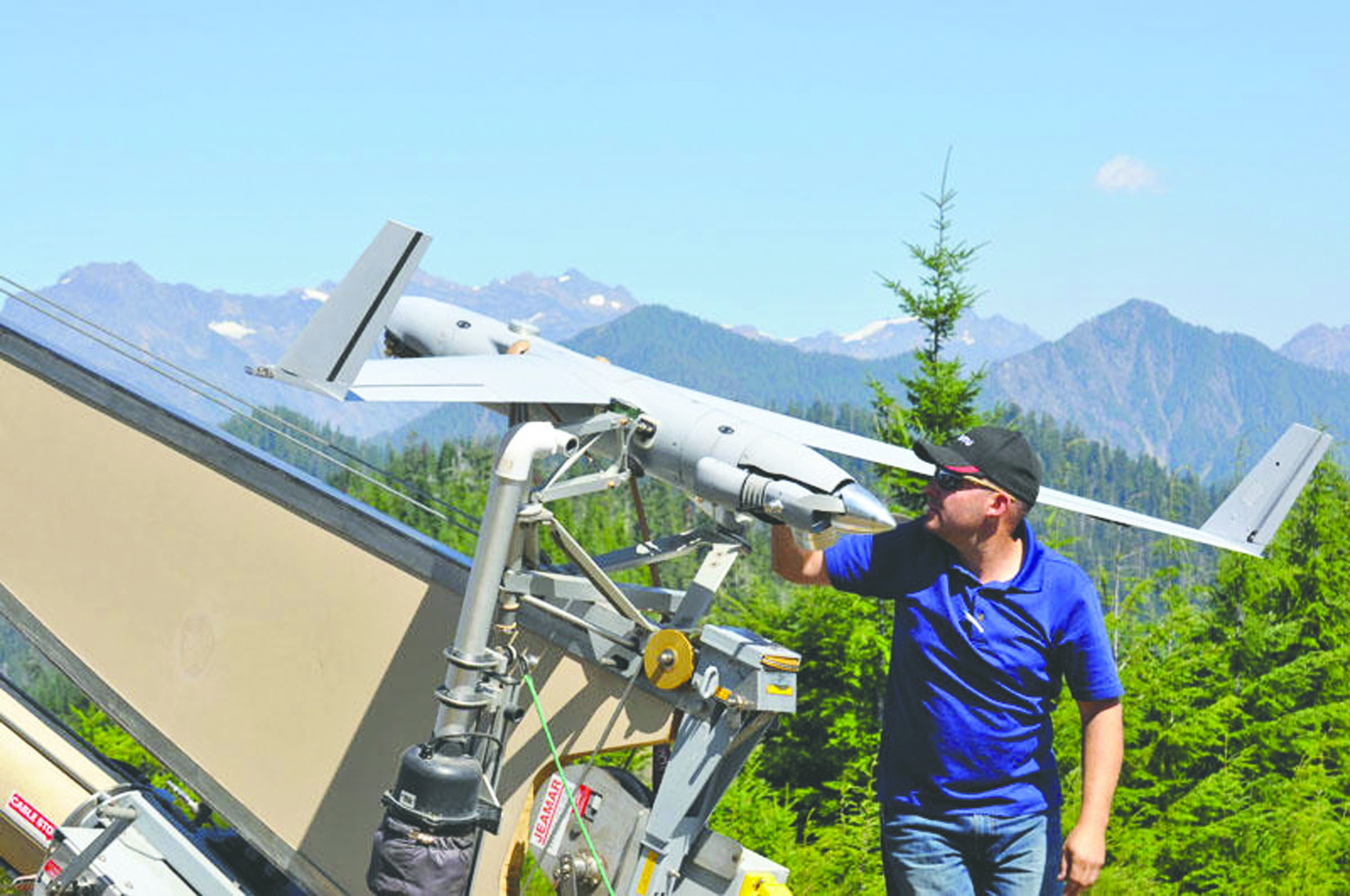
The ScanEagle drone used at the Paradise Fire was designed and built by Boeing’s unmanned-aerial-vehicle subsidiary InSitu in the Klickitat County town of Bingen and provided by the company at no direct cost to the government as an operational test.
The Department of the Interior is testing the use of drones for wildfire suppression this year, though it’s likely to be several years before they are deployed in significant numbers.
“We have to determine how we’ll safely integrate these things into our existing tactical-aircraft fire-traffic area,” said Brad Koeckeritz, Interior’s national unmanned-aircraft specialist.
“By next year, we’ll see increased usage. It’ll be consistent growth of these [unmanned] aircraft as time goes on.”
See through smoke
Koeckeritz said the ScanEagle test over the Paradise Fire was “highly successful.”
Fire managers “were able to see through the smoke very clearly. They were able to determine the intensity of the fire and clearly see the fire’s edge,” Koeckeritz said.
In addition to using drones on surveillance missions, Koeckeritz said Interior will test an “optionally manned” helicopter for delivering supplies and water to firefighters in Boise, Idaho, in October.
Such a vehicle could be piloted on clear days but sent up unmanned at times when manned helicopters cannot fly, either at night or when smoke reduces visibility.
With fires burning throughout the state and across the Western U.S., manned aircraft, both helicopters and fixed-wing planes, are spread thin.
The ScanEagle drone, which first flew in 2002, weighs approximately 50 pounds and is about 5 feet long, with a wingspan of just over 10 feet.
It flew over the Paradise Fire in the remote wilderness of the Queets Valley at an altitude of 9,500 feet.
It’s launched by a mobile catapult. When it returns, it’s caught via a rope suspended from a boom that snags the drone’s upturned wingtips.
The ScanEagle system was originally developed to track shoals of fish from Pacific Ocean fishing boats.
Later, it was successfully deployed by the Marines in combat operations in Iraq and subsequently became a standard surveillance tool for the U.S. military.
Rainforest burning
The statewide drought has affected even the Olympic Peninsula rain forest, where Reid said the snowpack on the mountains is 14 percent of normal and melted off four months earlier than usual.
In the area of the wildfire, which was detected back in June, large dead trees are dried out and provide heavy fuel for the blaze.
It’s also burning as much as 6 inches deep into the forest duff — a thick mat on the forest floor composed of years of accumulated dead leaves and other organic material.
Unlike live trees, which may burn only superficially as a fire passes through, such deep fuel, said Reid, “will burn and burn and burn.”
Because of the high fuel load and steep canyons in the area, it’s too dangerous to try to attack the interior of the fire.
The strategy then is to let it burn clean in the interior and confine it on the edges.
Drone’s advantages
The firefighting airplanes in use now in Eastern Washington cost millions of dollars and are mostly provided to the government by private contractors at a cost of $27,000 per day, plus $10,000 per hour of flying.
Buying a ScanEagle system costs much less than a manned aircraft. Koeckeritz said the government will likely set up a similar, private contracting system for firefighting drones.
Unmanned and relatively cheap, drones present a much lower risk if anything goes wrong.
As a result, said Reid, the National Park Service is considering drones for other missions, including search-and-rescue operations.
He said fire managers using the InSitu video feed “watched a helicopter land and saw people get out of the helicopter and get back on again.”
“With the heat signature, they are able to see an individual person, so they’re thinking this could also be used in search and rescue, particularly at night or in smoky conditions,” said Reid.
Last month, InSitu launched a ScanEagle from Oliktok Point on Alaska’s North Slope in a demonstration for the Coast Guard of its capabilities in remote search-and-rescue operations.
This was not the first drone to be flown in Olympic National Park.
The park in 2012 used a different drone — the Raven, designed by California-based AeroVironment — to monitor the flow of sediment in the Elwha River as part of the Elwha restoration project.
