
By Phuong Le and Rachel La Corte
The Associated Press
SEATTLE — A pilot driver escorting an oversize load that triggered an Interstate 5 bridge collapse north of Seattle told investigators that the clearance pole mounted on her car never hit the structure.
But in documents released by federal investigators Wednesday, one witness reported seeing the pole strike the Skagit River bridge several times, indicating there may not have been proper clearance for the oversize load.
The National Transportation Safety Board will have to sort through the conflicting accounts as it determines what likely caused the May 23, 2013, bridge collapse.
The agency, expected to release its final report this summer, made public more than 2,000 pages of documents, including interviews, cellphone logs and incident reports.
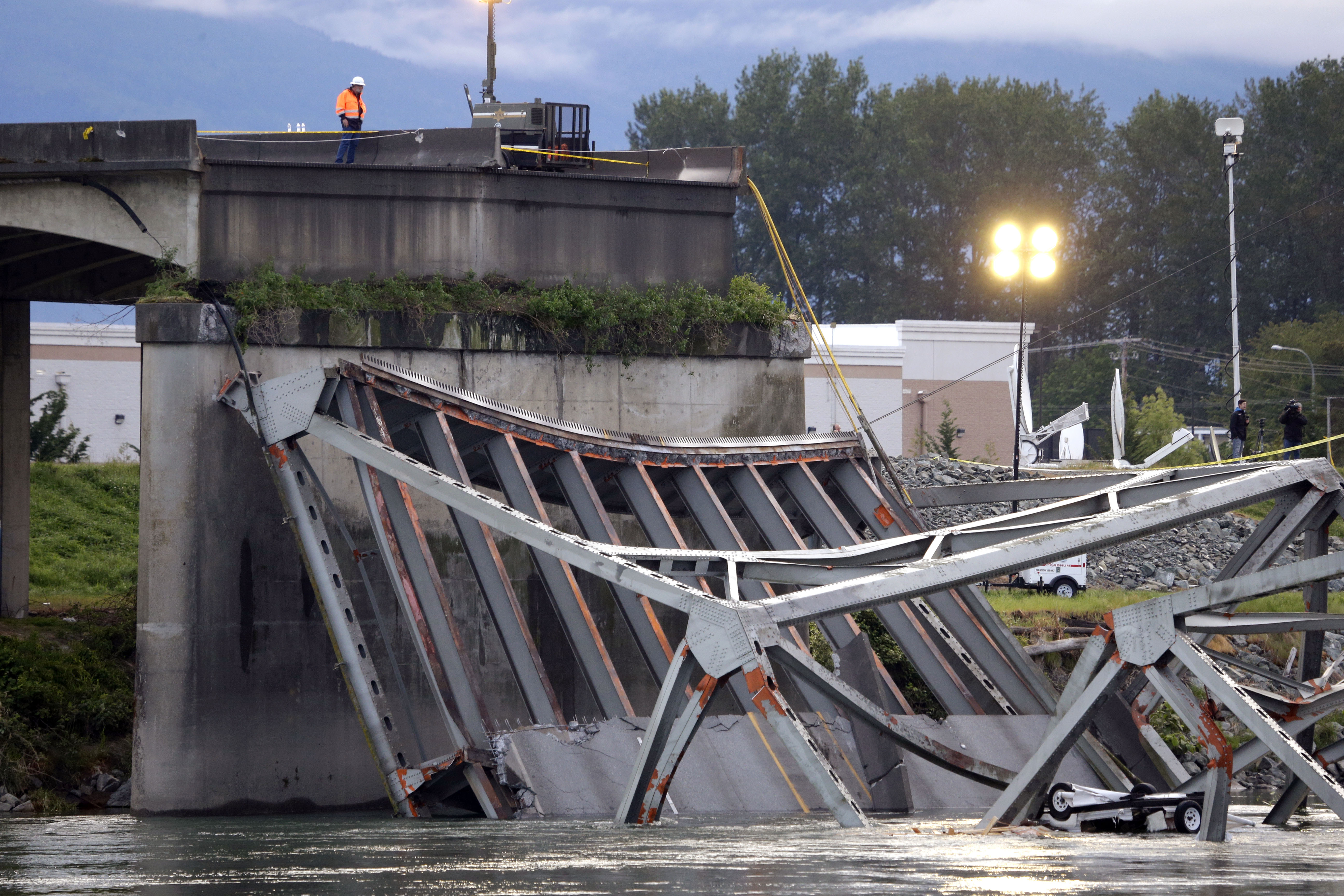
A section of the span fell into the water after a truck carrying a tall load hit the bridge about 60 miles north of Seattle. Two other vehicles fell into the river, and three people were rescued with minor injuries.
William Scott, who was driving the truck with the tall load, told investigators that a freight truck “came up very fast on the left” and “squeezed me as we were coming to the bridge.” He told investigators that he moved his vehicle to the right side of the bridge.
The right side had a lower vertical clearance than the center lane of the bridge, the NTSB said.
As they approached the bridge, Scott said there was “a horrendous boom,” and “it was violent in the cab.”
Scott told investigators that the pilot car driver was in the right lane when she entered the bridge.
He says “the pole went through” and that she didn’t say anything about the pole hitting the bridge.
The two drivers could communicate via radio.
At the time of the bridge collapse, the vertical clearance was 18 feet above the center lanes, but it tapered down to 15 feet, 5 inches at the fog lines on the right side of the roadway.
The lowest portion measured over the shoulder of the roadway was 14 feet, 8 inches, according to the NTSB.
Scott said he thought his load was 15 feet, 9 inches. A Washington State Patrol report notes that the right front of the load was later measured at about 15 feet, 11 inches.
The top of the load, a blue casing shed, collided with the far right side of the overhead truss structure.
The trusses have since been reconfigured by state transportation officials, giving 18 feet of clearance for all traffic lanes.
According to the NTSB, the driver of the pilot vehicle, Tammy Detray, said the clearance pole mounted on the front of her vehicle was set at 16 feet, 2 inches. A state trooper measured it at 16 feet.
According to notes from an interview with Detray, she said the pole on her vehicle did not strike the bridge and that “a cloud of dust was the first indication she had that something was wrong.”
“She was watching the accident truck cross the bridge in her rear-view and side mirrors and saw dust and the bridge collapse,” the notes of the interview read.
She also told investigators that she was using her cellphone on a hands-free device at the time of the accident and was talking to her husband about a route she would be taking the next day, according to a summary report.
Detray and Scott both said the pole didn’t strike the bridge, but the driver of a Ford Ranger, Dale Odgen, who was passing both vehicles, told investigators that as he was looking at the pilot car, he “saw the pole strike 4 or 5 of the bridge elements.
“The Ford Ranger driver looked in his mirror and saw the load strike the bridge,” the report read.
Scott cleared the bridge and stopped on the right shoulder, and did not realize that the bridge had collapsed until he was told by another driver who had also pulled over, according to the documents.
The 59-year-old bridge carries an average of 71,000 vehicles a day over the Skagit River on I-5, Washington’s major north-south roadway between Oregon and Canada.
Workers installed an emergency span and then replaced it with a permanent span in September.
