
When it comes to the Elwha River, appearances aren’t always what they seem.
That silt-laden, murky plume flowing through two deconstructed dams and their former lake beds has had minimal effect on the alluvial sea floor at the river’s mouth.
A new underwater survey in Freshwater Bay at the mouth of the Elwha isn’t showing a lot of silt accumulation, at least so far, said researchers who conducted dives at the mouth of the Elwha River last week.
Jeff Duda, a research ecologist for the U.S. Geological Survey, said the discharge from the river into the Strait of Juan de Fuca has been kind of a surprise.
“We really haven’t seen that much silting despite the striking aerial photos everybody has seen of the plume entering the Strait of Juan de Fuca,” he said.
“We really haven’t seen as much accumulation as you would think based upon just looking at what’s going on at the surface.”
Researchers are studying the effect of the removal of two dams on the Elwha River, a process that began in September as part of the $325 million National Park Service project to restore the Elwha River and its fish runs.
Elwha Dam removal was finished in March, while Barnard Construction crews will resume controlled blasting at Glines Canyon Dam today, according to Olympic National Park.
According to a Geological Survey estimate, more than 24 million cubic yards of sediment was backed up behind Elwha Dam at Lake Aldwell and farther upstream at Glines Canyon Dam at Lake Mills.
That would be enough to fill eight National Football League football stadiums.
About 400,000 cubic yards of sediment has been released so far in the removal of Elwha Dam and partial removal of Glines Canyon Dam, with more sediment still impounded in what remains of Lake Mills.
“But not all of that is going to get transported by the river,” Duda said.
“Some of it’s going to remain in place in the former reservoir area.”
Since a dam-removal project of this magnitude has never been attempted before, scientists were keen to study the effects of silt load and turbidity on marine life in the near-shore environment.
Before the river restoration project began, divers staked out study plots in a series of locations around the river mouth.
An inventory of plant and animal life within those plots is providing a baseline for an ongoing look at the effects of dam removal.
The first survey performed four years ago was to determine the characteristics of the floor of the Strait just beyond the river mouth.
Researchers were looking at the size of the particles carried by the river as it emptied into the Strait, as well as elevations and sand content of the sea bottom.
Additionally, researchers were looking at marine life and how it was affected by fresh water pouring from the river.
Those baseline studies will be compared with current effects brought on by sediment load carried by the river through dam removal.
Future surveys will look for what restored upstream ecosystems may do to help or hinder creatures that make their home on the boundary of fresh and salt water, Duda said.
Steve Rubin, a research diver for the Geological Survey, said the current survey is the first in-depth look below the surface since dam deconstruction began.
Divers expected to find profound negative impacts on marine life in the path of the silty outflow of the Elwha, but the diversity of plants and animals surprised them, he said.
“When they first started bringing back photos, I was stunned,” Rubin said.
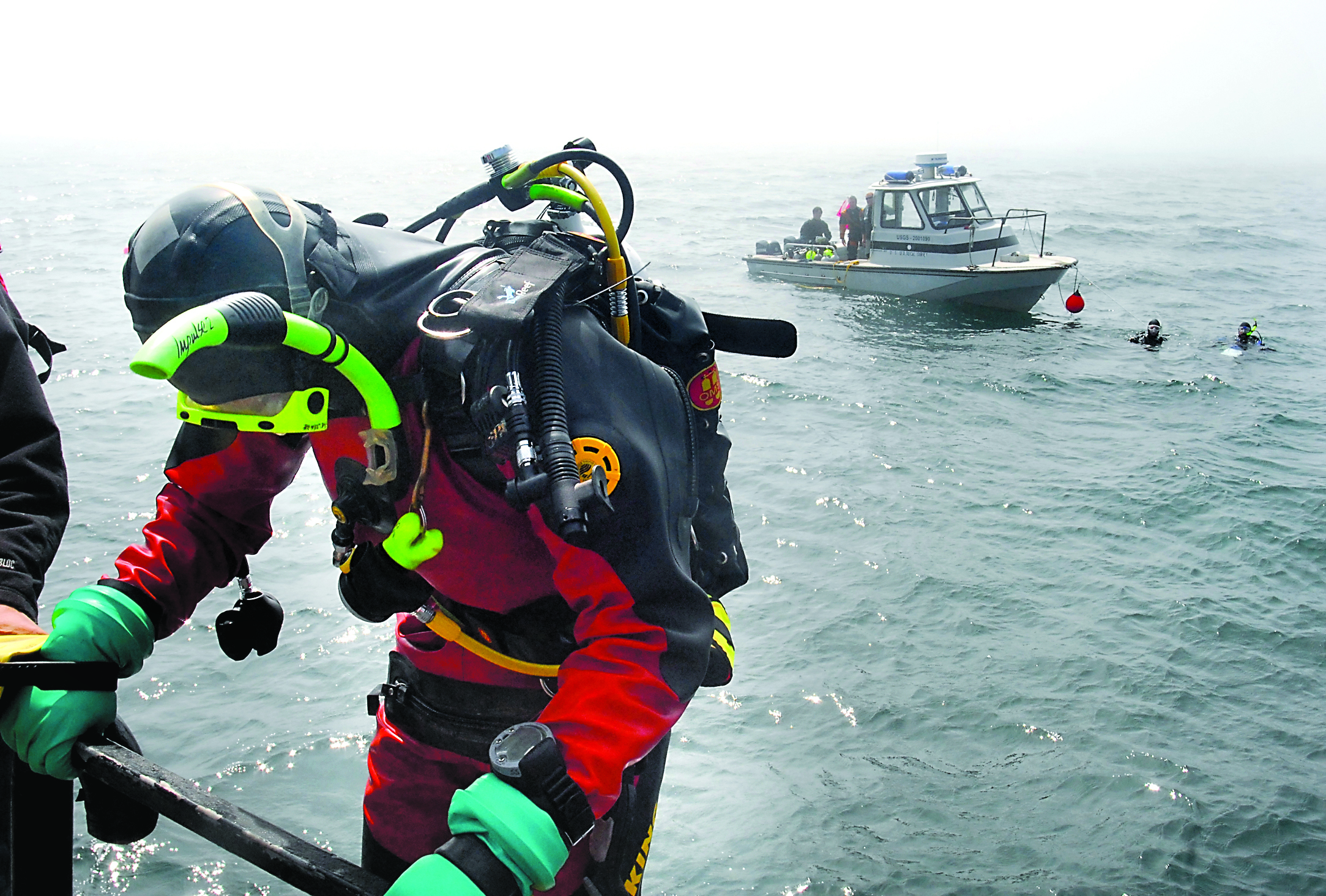
Thursday’s dive to a point dubbed C2 — termed “Charlie 2” — several hundred yards offshore northwest of the river’s mouth found divers from the Environmental Protection Agency and the Geological Survey looking at the marked plot 80 feet below the surface on the floor of Freshwater Bay.
Two boats stationed themselves just at the edge of the brownish plume of Elwha outflow.
Teams were taking stock of life at the bottom.
Sean Sheldrake, a diver with the EPA, said he was impressed with the clarity of the water just outside the plume.
But even within the plume, the most turbid water was mainly near the surface.
Researchers were finding only pockets of new silt and gravel in the near-shore research area.
Underwater visibility could range from 6 inches to 20 yards, depending on river flow rates and tidal currents.
Rubin described the plume as often having the opacity of chocolate milk.
Duda said the current silt load of the river is about 87 percent fine particles at this point in the dam-removal process, but he expected heavier particles to accumulate later as the Elwha cuts deeper into the lake beds behind the decommissioned dams.
Seasonal variations in the flow rate of the Elwha also would bring sand and rocks to Freshwater Bay and the rest of the Strait.
Outflow from the Elwha was a major force behind the original formation of Ediz Hook at Port Angeles.
Researchers hope Elwha sediment will eventually help rebuild disturbed habitats along the hook and other coastal areas near the river delta.
The Lower Elwha Klallam tribe — a partner in the river restoration — also is interested in changes in its namesake river, Duda said.
Besides restoration of salmon runs, the tribe is paying attention to the geography of the river near its mouth.
“They are very concerned with coastal erosion,” he said.
And of course, the river itself will benefit from dam removal, especially salmon.
The regular return of natural silt to the lower portion of the river will contribute to the health of future salmon runs.
“We’re interested in learning as much as possible about how the ecosystem responds to changes that are associated with the dam-removal process and the restoration of more natural sediment delivery as well as the ability of salmonids to return to the upper portions of the watershed,” Duda said.
________
Photojournalist Keith Thorpe can be reached at 360-452-2345, ext. 5058, or at keith.thorpe@peninsuladailynews.com.
