
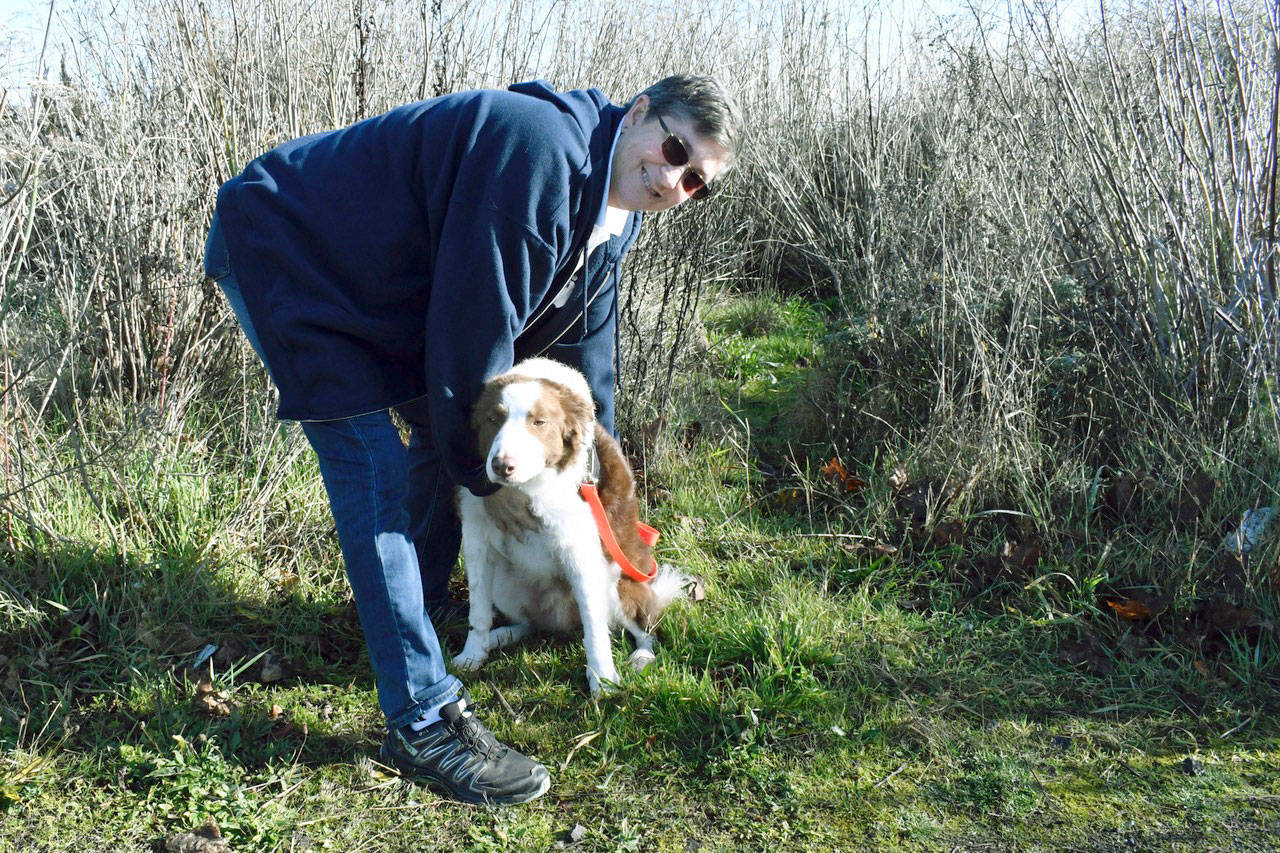
PORT TOWNSEND — Discovery Bay resident Lynne Angeloro and her search dog Berkeley, a border collie, will head to California for a month to help recover lost cremains in the ashes of the recent Camp Fire.
Angeloro is vice president of the Institute for Canine Forensics, a nonprofit organization specializing in historic and pre-historic burials and human remains detection. She has been doing this work for 12 years.
She will leave in mid-December to work, with her group of 13 volunteers and their dogs, in Paradise, Calif., and surrounding area. The town in the Sierra Nevada foothills was torched during the wildfire that was contained Sunday. The quick-moving fire burned for 17 days, destroying nearly 14,000 homes. The latest death toll was 88, with 203 people still missing.
“Our goal is to go into areas where homes were located,” said Angeloro, as Berkeley napped next to her. “Over 100 people have contacted us about their homes destroyed in the Camp Fire.
“We’ll search and find the cremated remains of their loved ones. These are the urns left on bookshelves or mantels that were left behind because of the immediacy to evacuate.”
Angeloro said that although recent rains may have changed the character of the remains, they still can be located.
“It clumps and stays put,” she said.
She said the area has been closed to this type of work until now.
“Half of the teams do human remains detection for those people who perished in the flames,” Angeloro said. “The other half of the team, like Berkeley, look for historic human remains, or cremated remains.”
She said that most cremations are not complete, leaving behind bits of bone fragments. That’s what Berkeley searches for.
Berkeley, 9, has been part of Angeloro’s life since he was 14 weeks old. They are together 24/7 and she said he’ll work until he is 13.
When out on the job, Berkeley is all business and has been trained to alert Angeloro as to what he’s found.
“I start him out and his nose is to the ground. It’s slow and methodical. He is searching into a huge scent pool.
“As he gets closer to the most intense scent, he wags the tip off his tail which is white and easily seen,” she said. “When he is ready to alert, his whole body wags. When he is at the most intense scent, he will lay down.
“That’s where I put in a pin and the waypoint number on GPS.”
Angeloro has another search dog, Eros, Berkeley’s uncle from Arkansas.
“They fly in the cabin at my feet, under the seat in front of me,” she said.
Angeloro and her team have traveled around the world doing the forensic work. Archaeologists and the Army Corps of Engineers have hired them.
In June 2017, National Geographic Society contacted Angeloro to help search for the remains of Amelia Earhardt, the first female aviator to fly solo, who disappeared July 2, 1937, as she flew over the Pacific Ocean.
Angeloro said that she and an archaeologist who was part of a group that has been been looking for the remains for the past 30 years — “worked for five years to get people to believe that the dogs could actually do this work.
“We got them to believe this was possible and we made incredible arrangements to take four teams over to this deserted island, Nikumaroro, part of the Phoenix Islands, in the Kiribati group,” Angeloro said.
”We stayed on a large ship every night. We got on a tender with archaeologists and there were some areas of specific interest that they wanted us to search. One area in particular was called the Seven Site.
“Berk was first up and he went in and had an alert immediately at the perimeter of the area. As we went further, he had a number of other alerts. They were very solid. The dogs have no bias, and we can’t do anything to influence them.”
Angeloro said she flagged and marked GPS coordinates at each site. The next team went in and corroborated Berkeley’s work. The next day two more teams went in looking for a potential location for Fred Noonan, Earhardt’s navigator. They had significant alerts.
“They dug and never came up with a bone, but as they dug, the dogs had significant alerts,” she said. “They took coral and it was shipped off to a facility that can extract DNA from soil, an extremely new technology.
“It’s been 18 months. They have identified it as human, but there’s no positive identification as of yet,” she said.
In Fort Leavenworth, Kan., oral histories revealed 13 Native American children died and were buried, but there were no markers. Angeloro and one of her dogs searched a large area without knowing exactly where remains might be.
“We found a 30-foot square area where multiple dogs alerted us,” she said. “Native burials are not to be dug up. They just wanted to know where the children were.”
Close to home, she was called to be part of the 2014 Oso mudslide search when 49 homes and structures were destroyed and 43 deaths were reported.
The California effort is funded by donations to the nonprofit group.
A gofundme site had raised $11,724 of a $30,000 goal as of Tuesday. To donate, go to www.gofundme.com/Recovering-Lost-Loved-Ones.
For more information on the Institute for Canine Forensics, see www.hhrdd.org.
________
Jefferson County Editor/Reporter Jeannie McMacken can be reached at 360-385-2335 or at jmcmacken@peninsuladailynews.com.
