
By Peninsula Daily News staff
and news services
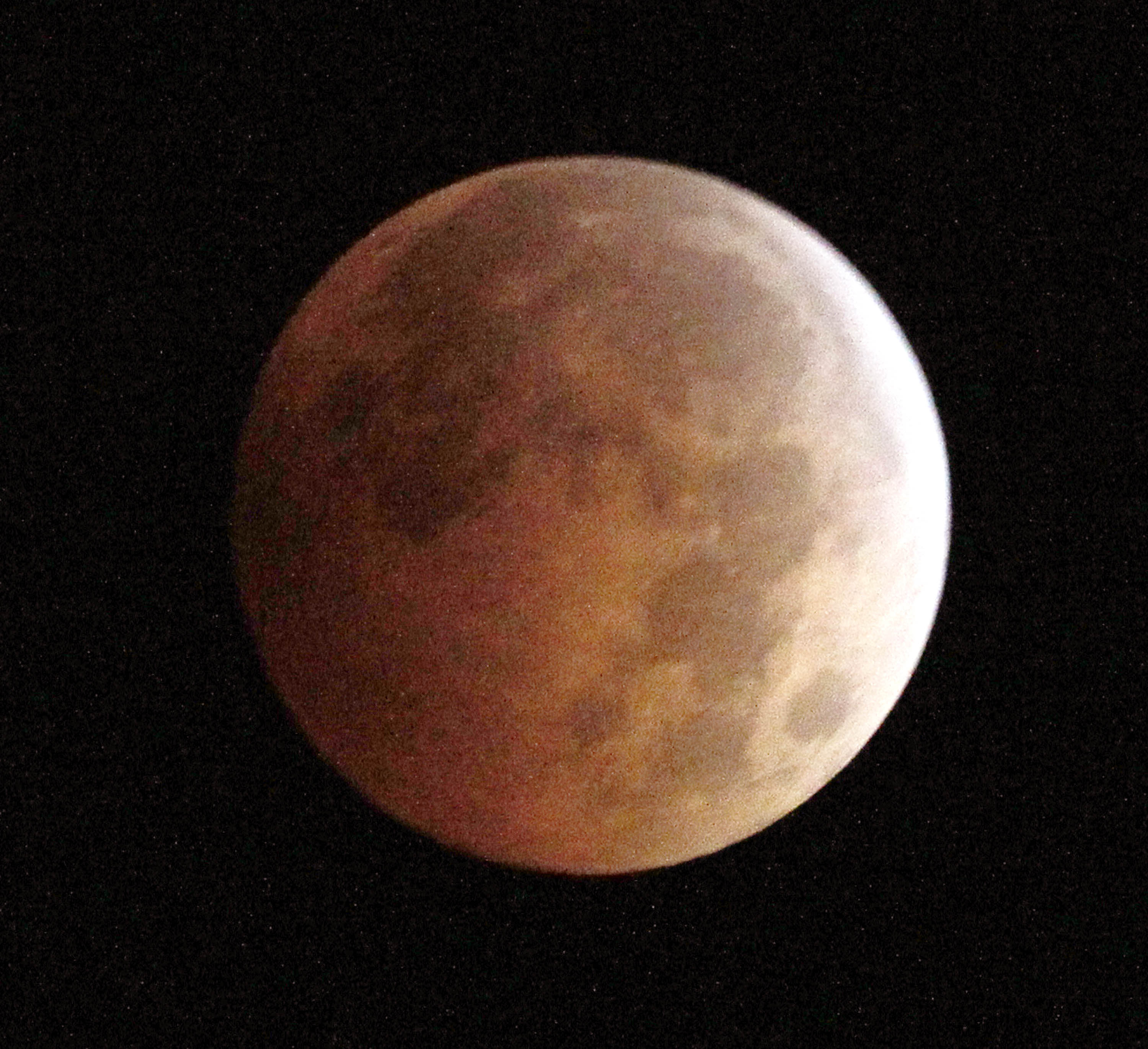
EARLY MORNING SKYWATCHERS across the North Olympic Peninsula were treated to a stunning lunar eclipse, though clouds obscured it for some.
Lucky ones saw the moon turn orange or red in what is known as a “blood moon.” The hue results from sunlight scattering off Earth’s atmosphere.
Partially cloudy skies made viewing the blood moon difficult for people in some parts of Jefferson and Clallam counties.
The eclipse — viewable in much of North America and in many other areas including Australia and Japan — is the second in a rare series known as the tetrad, in which the moon is completely covered by the Earth’s umbral shadow for four eclipses in a row, as opposed to only partial eclipses that fall in the outer penumbra.
If you pressed snooze on your alarm at 3 a.m., you’ll have two more chances to catch a blood moon next year.
The next total lunar eclipse will be on April 4, 2015, according to NASA.
In addition, in about two weeks the Peninsula gets another cosmic treat: A partial eclipse of the sun Thursday afternoon, Oct. 23.
(See more about this in ‘Other Sky Events’ in our previous story, below.)
PREVIOUS STORY:
If sky conditions cooperate, North Olympic Peninsula residents should be able to see a total lunar eclipse the early hours of Wednesday morning.
Weather forecasts call for partly cloudy skies as October’s full Hunter’s Moon glides through the northern part of Earth’s shadow.
The moon will gradually get darker and then take on a coppery-red or deep-red hue once it is completely in the Earth’s shadow, prompting some to label this a “blood moon” eclipse.
The official start of the eclipse is 1:17 a.m., when the east side of the moon moves into the outer fuzzy part of Earth’s shadow, the penumbra.
A clearly defined dark bite out of the east side of the moon appears at 2:18 a.m., marking the moon’s passage into the umbra, the dark inner shadow of the earth.
The eclipse becomes total at 3:55 a.m.
The moon remains totally eclipsed until 4:22 a.m. It comes to an end at 5:34 a.m.
In case of clouds, look online to www.Slooh.com, where the eclipse will be webcast live starting at 2 a.m. Wednesday.
Other sky events
■ In about two weeks, the Peninsula gets another cosmic treat: A partial eclipse of the sun Thursday afternoon, Oct. 23.
The moon takes its first bite out of the sun at 1:34 p.m., and maximum eclipse is at 2:59 p.m., when almost 52 percent of the sun’s face will be covered.
The eclipse ends at 4:18 p.m., about two hours before the sun sets.
When watching any solar eclipse, do not observe it directly without protection. This can cause permanent eye damage or blindness.
Sunglasses won’t work. Wear welder’s goggles rated 14 or higher, or use a pinhole projector.
You can also order $5 “eclipse glasses” online at http://tinyurl.com/pdn-eclipseglasses
For lunar eclipses, no special precautions or gizmos are necessary.
■ Look for the annual Orionid meteors — up to 20 meteors an hour — streaming from the south after midnight Oct. 21 and 22.
■ The International Space Station, now carrying the six crew members of Expedition 41, makes appearances in our Peninsula sky every night this week and evenings through much of the rest of the month.
The ISS is easy to see with the naked eye — it is the third-brightest object in the sky and looks like a fast-moving plane — but it’s dozens of times higher than any airplane and travels thousands of miles an hour faster.
For exact times and locations in our sky, visit the ISS section of the NASA website, http://tinyurl.com/pdn-spacestation. You can also sign up there for email alerts on local ISS fly-bys.
