
PORT TOWNSEND — Jefferson Healthcare’s $96 million expansion project has been successful in achieving notable reductions in carbon emissions, thanks in large part to an integrated design-build process.
“By going through that progressive design-build method, we were able to select a team that this was part of their mission,” said Jacob Davidson, COO of Jefferson Healthcare. “Of course, our mission is getting as much space at the lowest cost, but you have a bunch of sub-tiers, right? Being environmentally friendly is a huge sub-tier for us, and they really knocked that out of the park.”
Design-build partners from ZGF Architecture, engineering firm Coughlin Porter Lundeen (CPL) and Abbott Construction opened conversations early in the process to consider how to keep embodied carbon emissions low on the project.
“If you’re looking at the whole life cycle of a building, there’s a bunch of carbon associated with just creating the building itself,” said Laura Lindeman, CPL structural project manager. “How are the materials that are going into the building impacting the environment as you’re bringing it onto site and as you’re building your structure? That’s what we call embodied carbon.”
Lindeman gave a presentation outlining strategies and outcomes of efforts made to minimize carbon emissions throughout the construction of the new building at 834 Sheridan St.
“For Jefferson Healthcare, we had a lot of challenges and also opportunities for how we could approach reducing embodied carbon on this project,” Lindeman said. “Being able to talk with the contractor early on was crucial to make sure that we could understand what different supplies we could use and what materials we could get. Our site was also a challenge. Obviously, we’re in this amazing rural community out on the Peninsula, but it becomes a challenge to bring products on. You can’t get any material from anywhere in the state of Washington.
“It did create an opportunity. We really incentivized getting local materials and helping out the local industries.”
All of the concrete for the project was mixed and delivered by Cotton-Shold of Port Hadlock, which sourced mix materials from LaFarge and Ash Grove of Seattle.
With cement being a high contributor to carbon emissions, the project used several methods to reduce its use, including replacing 20 percent with supplementary cementitious materials, which was also more affordable than cement.
The project also used a new type of cement fairly new to the U.S. market, Lindeman said.
“You can’t reduce and replace all of the cement,” Lindeman said. “You still have to use some in all of your mixes. There is a new type of cement that’s fairly new to the market that’s called Portland limestone cement, and our concrete provider was able to use this for all of the cement on the project. This alone gives you a 10 percent reduction in the embodied carbon of your concrete.”
Additionally, the foundation was given a long cure time, providing a chance for it to strengthen up with less cement, Lindeman said.
The design-build team focused on procuring steel with some recycled content present, and using steel mills that were powered by electricity, Lindeman said. The team got EPDs for this process as well, Lindeman said.
“These are documentations that go through the entire life cycle of making a steel product,” Lindeman said. “From getting the raw materials, melting it down, creating the shapes, everything all the way up until it gets delivered. It ends up giving you a single number for the embodied carbon of each piece of steel.”
The design-build team also helped Cotton-Shold get third-party environmental product declaration’s (EPDs) for its mixes, allowing them to account for the carbon emissions of the products.
Embodied carbon is typically calculated in kilograms of CO2 equivalent, which can feel vague, Lindeman said.
“But you can equate it down to carbon sequestered by an acre of forest for an entire year in the United States,” she said.
When they initially crunched the numbers for all of the components in the project, they came up with an ambition to reduce emissions equivalent to the carbon sequestered in 500 acres of forest for a year, Lindeman said.
Actual numbers ended up being closer to 800 acres of U.S. forest, she said.
Construction milestones
Davidson said the project is under budget and on schedule to be open in July 2025.
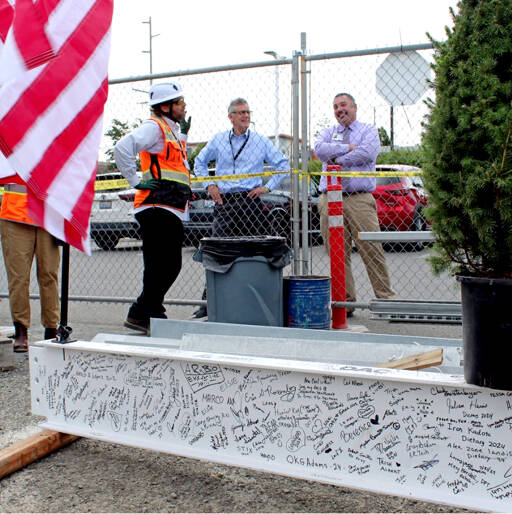
Recent milestones have included setting the top steel beam onto the building and pouring the concrete for the linear accelerator vault building. The machine, used for cancer treatment, is surrounded by thick concrete walls on every side, to prevent radiation from escaping, he said.
At their thickest, the walls are 6 feet wide with concrete.
________
Reporter Elijah Sussman can be reached by email at elijah.sussman@sequimgazette.com.
