
By Jeff Donn
The Associated Press
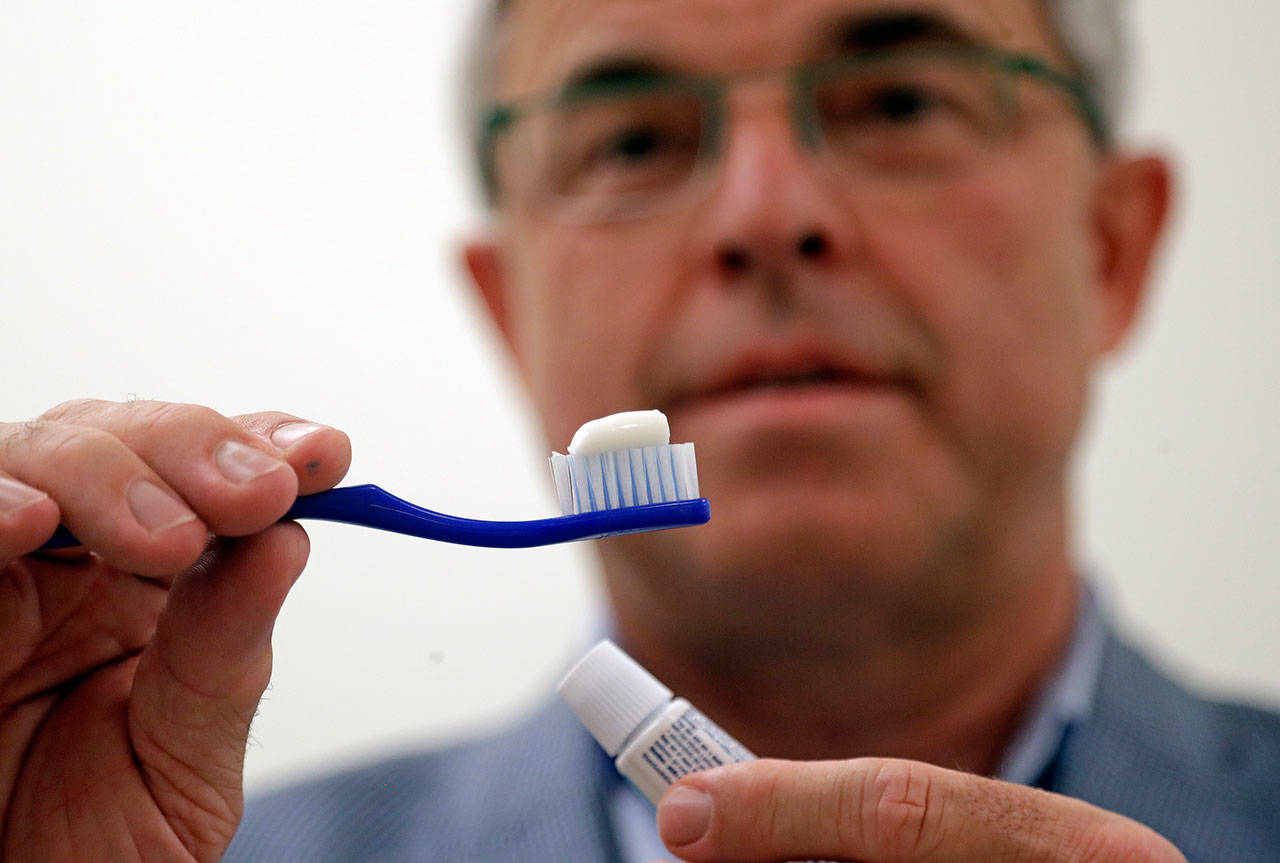
Dental health experts worry that more people are using toothpaste that skips the most important ingredient — fluoride — and leaves them at a greater risk of cavities.
Most toothpastes already contain fluoride. While health authorities recognize fluoride as a cavity blocker, the internet is dotted with claims, often from “natural” toothpaste marketers and alternative medicine advocates, that fluoride-free toothpaste also prevents cavities.
Dental authorities disagree.
“It’s really important to debunk this idea that brushing your teeth stops decay. You need to have the fluoride,” said Damien Walmsley, a scientific adviser to the British Dental Association and dentistry professor at the University of Birmingham.
That view was underscored last week by an article in the dental journal Gerodontology that reviewed the scientific literature on cavities. Its primary conclusion is that, without fluoride, oral hygiene efforts have “no impact” on cavity rates.
The idea that just brushing teeth doesn’t stop cavities has largely been accepted among individual researchers for decades, but not always by the public.
Dentists generally recommend fluoride for cavity fighting, but even some of them continue to believe that the mechanics of wiping your teeth clean of plaque also reduces cavities.
The review findings, published Monday, gave pause to at least one dentist.
“It violates certain principles we’ve been taught and that we teach and that we believe,” said Richard Niederman, a dentist and professor at New York University who saw an advance copy of the study and found the findings credible. “What it says to me is that the toothbrush is just a delivery system.”
Few studies of the question have been carried out in recent years because the value of fluoride has been widely accepted for decades.
In the review, University of Washington researchers looked for high-quality studies since 1950 and found just three. They were carried out in the U.S. and Great Britain and published from 1977 to 1981. They involved a total of 743 children aged 10 to 13 years who flossed and brushed for up to three years.
When the studies were evaluated statistically as a whole, there was no significant cavity reduction from simply brushing or flossing without fluoride.
Dentist J. Leslie Winston, oral care director for Crest toothpaste maker Procter & Gamble, said the review “serves as an important reminder.”
“Despite a large body of scientific evidence, there are growing numbers of consumers who believe that all toothpastes are the same and that as long as you clean your teeth effectively with a toothbrush or other device which cleans in-between the teeth, you can prevent decay,” he said in a statement.
The market share for fluoride-free toothpaste is closely held company data.
Industry sources estimate it at no more than 5 percent of all toothpaste sold, but with projected growth of over 5 percent annually.
On Aug. 6, Tom’s of Maine anti-plaque and whitening toothpaste, which is fluoride-free, was listed as the second-best selling toothpaste on Amazon’s online buying platform.
Paul Jessen, a brand manager at Tom’s of Maine, said “the products that don’t contain fluoride that we offer do not promise that benefit” to fight cavities. He said his company’s customers generally understand this.
Yet customer comment on Amazon’s website sometimes indicates otherwise, with many reviews insisting that the company’s fluoride-free toothpaste does fight cavities.
“If you brush regularly with or without fluoride, you reduce the risk of cavities,” asserts one customer.
Oral care companies themselves also stray into such claims. The website of Revitin non-fluoride toothpaste says it “strengthens your teeth against tooth decay.”
Gerald Curatola, the dentist who founded Revitin and now serves as chief science officer, called the review “misleading.” He said that the latest science suggests that a healthy mix of oral bacteria is key to dental health.
“I don’t think fluoride makes a difference at all,” he said.
However, referring to his company’s decay-fighting claim, he added: “After this call, I’m probably going to remove that from the website, because I don’t think that should be on there, because I didn’t know that was on there.”
Jeff Davis, the CEO of Sheffield Pharmaceuticals that sells toothpaste with and without fluoride, said it’s “pretty established” that fluoride is what helps reduce cavities. But he said some people worry about the harmful effect of too much fluoride and so choose fluoride-free toothpaste.
Even without fluoride, dentists say there’s some value in brushing.
Philippe Hujoel, the dentist and University of Washington professor who led the dental review, said oral hygiene without fluoride might produce real cavity-fighting effects too small to detect in a study, or adults might conceivably benefit where the children in the studies did not.
And tooth brushing did reduce swollen gums in Hujoel’s review. Brushing the teeth might also dislodge stuck food and help patients recover from oral surgery.
Dentist Matthew Messina, a spokesman for the American Dental Association, said mechanical brushing can also help avoid decay that sometimes forms, especially in older people, at the normally hidden roots of teeth, which was outside the scope of this review.
“The study is important,” he added, “because the study is supporting what we’ve been contending for a long time.” The ADA recommends using fluoride toothpastes.
The review also cited a 2009 analysis of studies involving 60,000 people that found fluoride rinse prevents cavities about as well as fluoride toothpaste.
In 2016, The Associated Press reported on the poor scientific evidence for the benefits of flossing. As a result, the federal government removed its long-standing flossing recommendation from Dietary Guidelines for Americans.
The review raises questions about how cavities form. Cavities have long been thought to develop in a poorly cleaned mouth when acids left by food start to wear away tooth enamel.
The idea is that clean teeth do not decay. This review, though, argues for an alternate model: Cavities grow in tiny crevices in the enamel that can’t easily be reached with a toothbrush or dental floss alone.
Despite the clear benefit of fluoride, some studies have also challenged the belief that fluoridated drinking water stops dental decay as well as fluoride toothpaste or rinses. In any event, it makes sense to combine fluoridated water and dental products for amplified protection, said Niederman, the NYU dentist.
Some dentists also said the most effective way to prevent cavities is simply to reduce sugars in the diet.
