SEQUIM — A Sequim man will demonstrate his energy-efficient house as part of the American Solar Energy Society’s nationwide open house Saturday.
David Large will explain how he reduced his energy consumption to about a third of a code-built conventional home from 9 a.m. to 5 p.m. Saturday at his residence at 173 Griffith Farm Road just north of Sequim.
“I really wanted to share my expertise because I’ve been studying this for a long time,” said Large, a retired electrical engineer.
“The reason I volunteered to be on the tour was it will give me lots of contacts of people that I can help.”
Large’s home is the only one listed on the weekend tour on the North Olympic Peninsula, according to Solar United Neighbors’ website at nationalsolartour.org. The American Solar Energy Society partnered with Solar United Neighbors to organize the national tour.
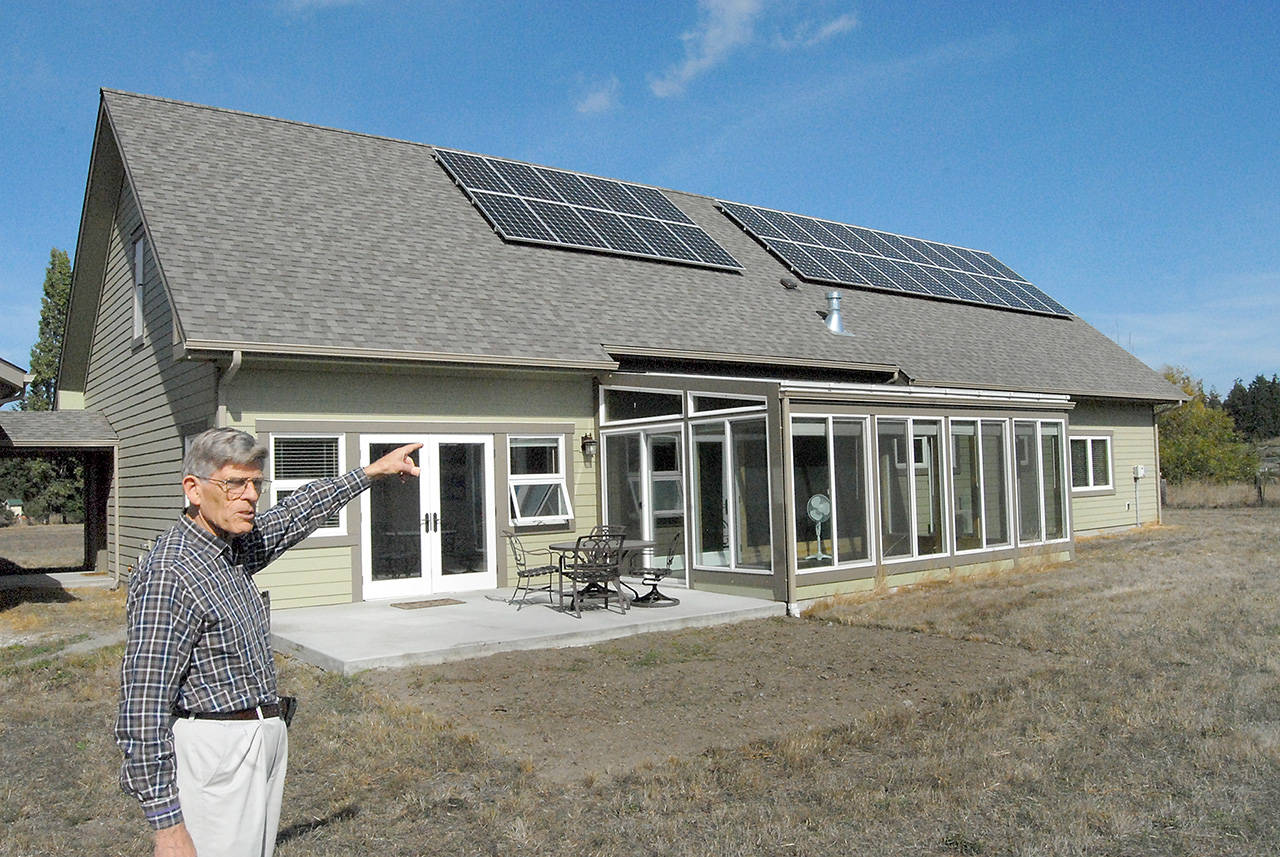
The highly-insulated, solar-powered house was built in 2016 as a demonstration home. It has an array of instruments that register to the watt how much energy Large consumes for things like hot water, heat and his electric car.
“The most important thing about this house is not that it is solar, but that it uses less than a third of the energy of a new code-built house,” Large said.
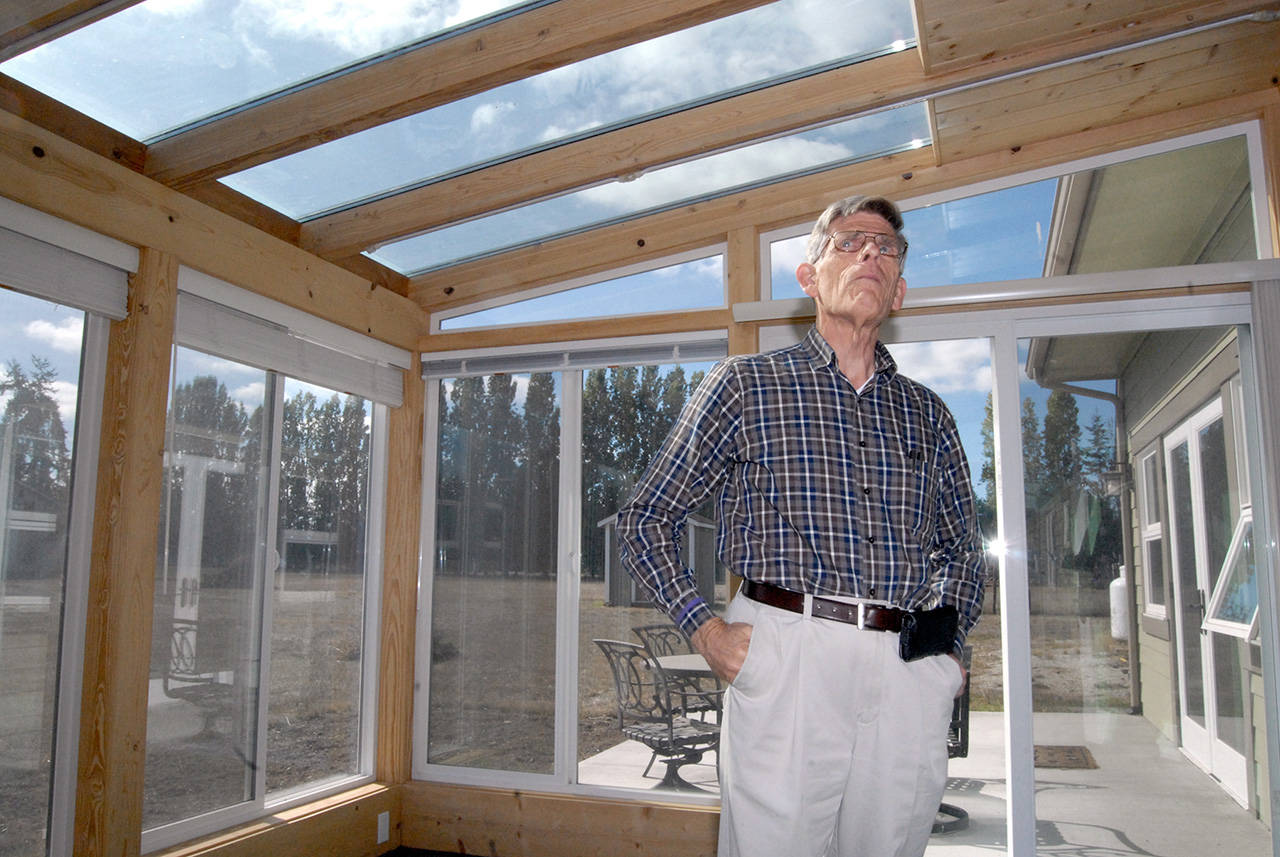
A sunroom with triple-pane windows and heat-absorbing tiles provides a large portion of the heat in David Large’s rural Sequim home. (Keith Thorpe/Peninsula Daily News)
The 2,200-square-foot house is a “net-zero passive home,” meaning that it uses far less energy than most houses and has solar collectors on its south-facing roof to generate residual energy, Large said.
If he did not have solar power, Large said his average heating bill would be $8.53 per month. He would pay about $3.30 per month to run the heat pump water heater and $12.49 per month to power his Chevrolet Volt without solar augmentation.
“The only power that this place uses of any significance is the appliances,” Large said.
Every bit of lighting in the Energy Star-certified home is light-emitting diode, or LED, which uses about a sixth as much power as a standard light bulb, Large said.
The rectangular-shaped house has a slab floor sitting atop a four-inch “bathtub” of insulation, Large said.
“As you look at the house from the inside, most of the things to make it efficient are not obvious,” Large said during a tour last week.
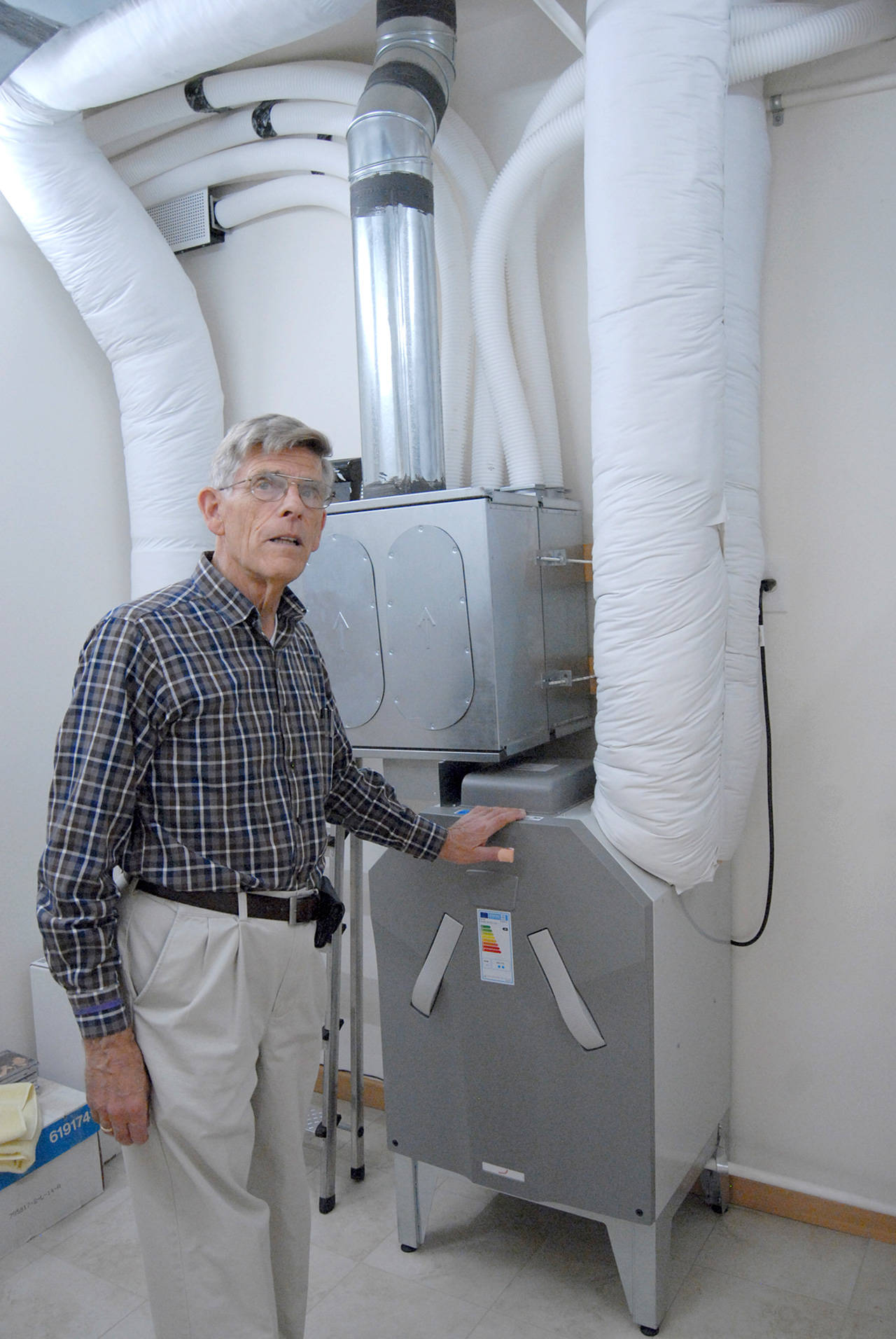
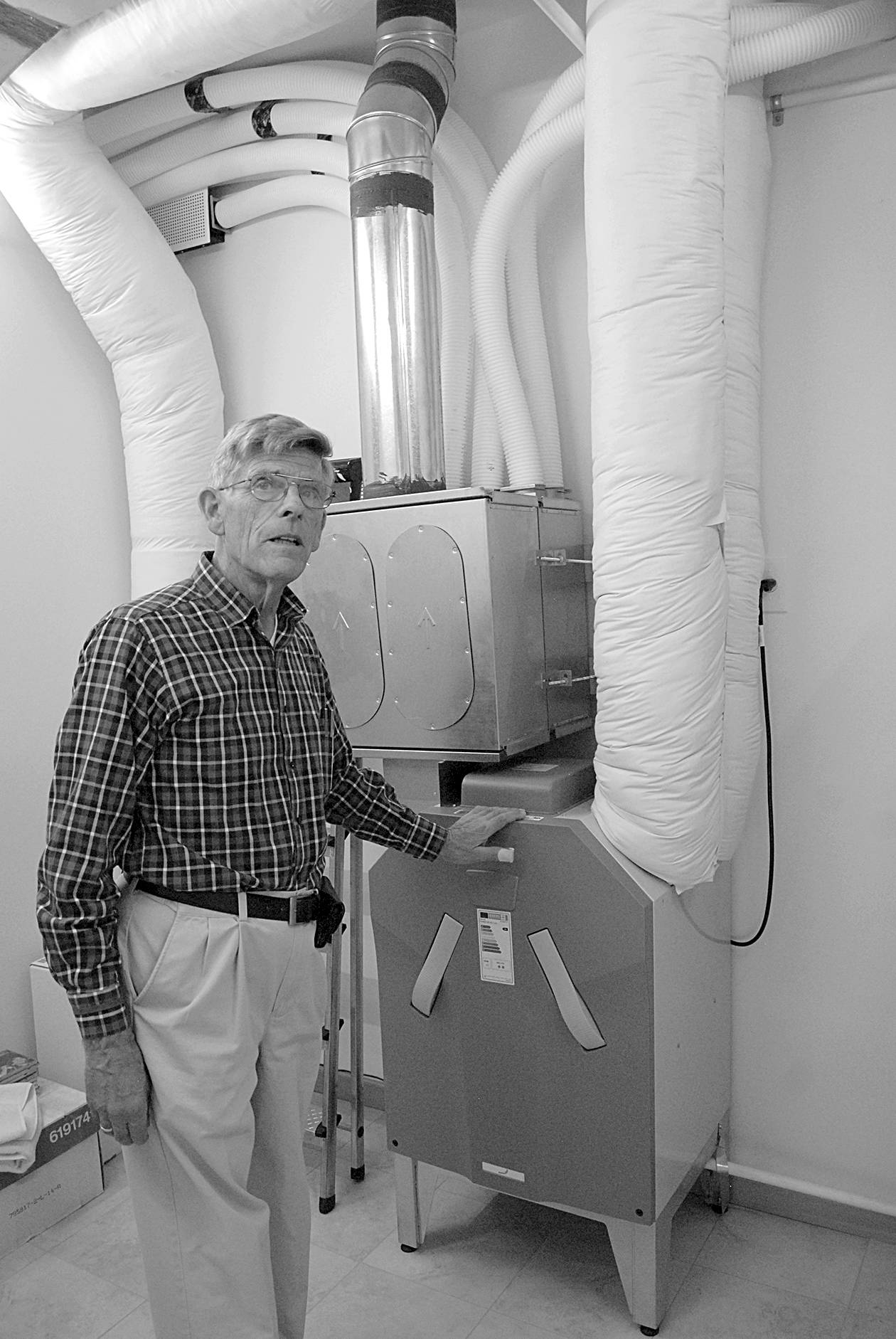
David Large describes the functions of a heat recovery ventilator that transfers warm or cool air trough his energy-efficient house. (Keith Thorpe/Peninsula Daily News)
The triple-pane windows have hinged openings rather than sliding glass for a better seal to prevent air from leaking.
The heavily-insulated walls are about a foot thick. They achieved an R-37 rating in building parlance, which is about twice code, Large said.
“The cat loves that,” Large said of the thick walls. “Every window sill is a wonderful place for the cat to sleep.”
Extending out from the south side of the house is a sunroom that registered 79 degrees on a partly cloudy afternoon Sept. 25. The sunroom, which is part of the heating system, gets up to 95 degrees on a clear day, Large said.
Warm air from the sunroom is pulled through a vent to the back of the house, keeping his heat pump off until the early morning hours.
Large installed a heat recovery ventilation system in which warm, outgoing air and cold fresh air are brought into thermal contact to pre-heat the incoming air.
About two-thirds of house has a 9-foot 5-inch ceiling and one-third has a 8-foot-tall dropped ceiling. The air ducts and water pipes run through the lowered ceiling area rather than the attic to conserve heat.
The kitchen is equipped with an energy-efficient induction cooktop that uses a magnetic field to heat iron pots or magnetic stainless steel without heating the surface.
“A lot of thinking went into this house,” said Large, 77.
“I’m a cook, I’m a wood worker, I’m a bachelor and I’m old. This house is designed for aging in place, real easy care and real efficiencies.”
Large was born in Puyallup, attended high school in Mount Vernon and enrolled at the prestigious California Institute of Technology (Caltech) in Pasadena, Calif.
He purchased an early-model electric motorcycle to commute to work during the oil embargo of the early 1970s.
Large and his late wife, Sally, built a three-story, energy-efficient home in the Santa Cruz Mountains in 1975. The house had double-pane windows, which were relatively new in those days, and a solar-thermal hot water heater.
In 2000, the couple paid a contractor to build an energy-efficient home in Morgan Hill, Calif., achieving net-zero in their electrical consumption using solar power and natural gas for heat.
“Everybody needs to build one house, but I don’t need to build two of them,” Large said.
After he retired, Large found the Sequim-area property in 2010 and started designing a net-zero passive home.
“I didn’t actually get up here until 2016 after my wife passed away, and when she did I changed my plans to make this a demonstration house,” Large said.
Large said he could not quantify the difference in price between a net-zero passive home and a conventional home of the same size.
According to studies, the premium is somewhere around 15 percent to 20 percent, he said.
“That will come down, but that’s about where it is now,” Large said.
Large, a Clallam County Public Utility District customer, pays the minimum on his electric bill every month. The PUD keeps track of how much electricity its solar customers produce.
“If you generated more than you used, you get a credit you carry forward to the next month,” Large explained.
“You keep building that credit in the summer, and then in the winter you’re eating into the credit if you’re generating less than you’re using.”
Last year, Large generated “a little more than I used, but that was before the car.”
Large added three kilowatts of solar power to his roof array to charge his electric car.
“Now I should be self sufficient for everything, including the car,” he said.
When asked how a home-owner on a limited income could improve their energy efficiency, Large said: “Light bulbs.”
“LEDs are really good,” he said.
“It’s the fastest return on investment you can do, absolutely the fastest return on investment.”
________
Reporter Rob Ollikainen can be reached at 360-452-2345, ext. 56450, or at rollikainen@peninsuladailynews.com.