
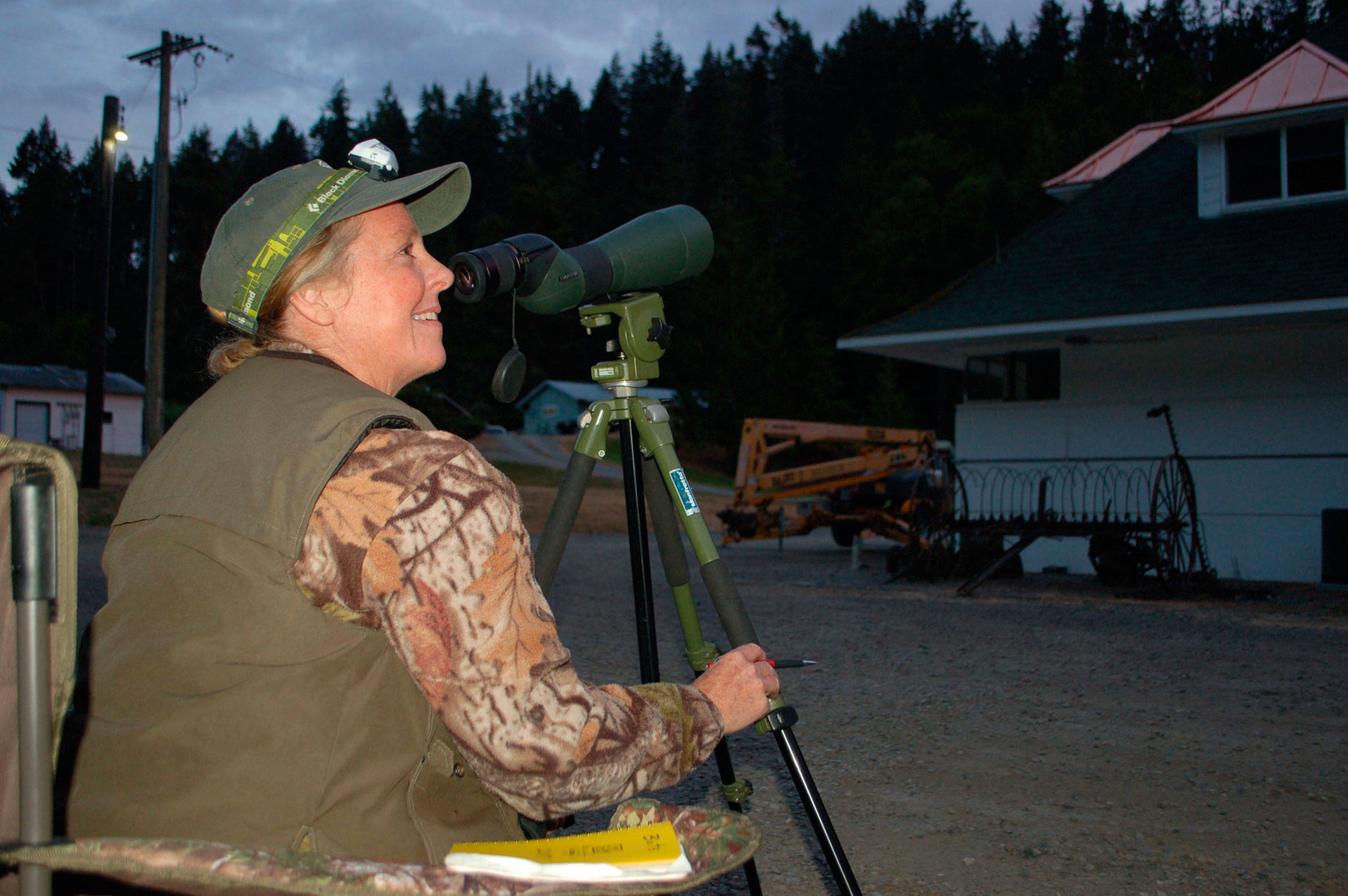
Shelly Ament, Department of Fish and Wildlife assistant district biologist for Clallam and west Jefferson counties, points to one of the areas at the Dungeness Fish Hatchery where bats exit the building to hunt for food in the evenings. Below, two bats roost in a structure at the hatchery where local biologists took bat guano and swab samples to send in for testing of white-nose syndrome. (Erin Hawkins/Olympic Peninsula News Group)

Shelly Ament, Department of Fish and Wildlife assistant district biologist for Clallam and west Jefferson counties, points to one of the areas at the Dungeness Fish Hatchery where bats exit the building to hunt for food in the evenings. Below, two bats roost in a structure at the hatchery where local biologists took bat guano and swab samples to send in for testing of white-nose syndrome. (Erin Hawkins/Olympic Peninsula News Group)

Deadly bat disease found in state; data, samples collected in Clallam

Biologists are gathering field data in Clallam County about bat populations as a deadly disease has made its mark on the West Coast starting near North Bend in King County.

According to the state Department of Fish and Wildlife, white-nose syndrome, a disease estimated to have killed over 6 million bats in eastern North America since 2006 and which can kill up to 100 percent of bats in a colony, made its first appearance on the West Coast near North Bend in 2016.

White-nose syndrome is caused by a fungus that can grow on the nose, wings and ears of an infected bat during winter hibernation. Once the bat wakes from hibernation, the fuzzy, white appearance can go away, but the fungus invades deep skin tissues and causes extensive damage.

Shelly Ament, Fish and Wildlife assistant district wildlife biologist for District 16 — including all of Clallam County and west Jefferson County — her supervisor Anita McMillan, agency staff and volunteers collected data on local bat populations earlier this month at the Dungeness Fish Hatchery, Salt Creek bunkers and a private residence west of Port Angeles where maternity bat colonies have been identified.

“We’re very interested to learn about where there could be more colonies,” Ament said.

Ament and other agency staff have been pinpointing bat populations in their district, performing bat exit counts and capturing bats to take guano (bat feces) and swab samples, and sending them in to the U.S. Department of Agriculture Forest Service Northern Research Station to be tested for white-nose syndrome.

Ament said they performed two bat exit counts at each of the three locations in her district “to get an idea of how many bats are in a site.”

In mid-April of this year, a local rehab facility that specializes in rescuing bats received a call about a bat unable to fly near North Bend. A Fish and Wildlife biologist responded and located the bat, but it died before the biologist’s arrival.

The bat was examined and showed signs of white-nose syndrome and later was tested by the USGS National Wildlife and Health Center where scientists confirmed the bat had the disease.

“It’s definitely a concern,” said Abby Tobin, a Fish and Wildlife white-nose syndrome coordinator and bat specialist.

“There are still a lot of questions about what the impacts are going to be,” Tobin said.

Tobin said Fish and Wildlife is trying to get a good handle on any declines in bat populations in Washington state by having biologists collect data and research on bat colonies across the state, including 11 counties.

She added that the cases of white-nose syndrome found last year in North Bend were the farthest west the disease has reached and that it has not been determined how the disease has spread.

Tobin said Ament and other biologists across the state are counting bats in colonies to track any decline in bat species that are susceptible to the disease, such as little brown bats and Yuma myotis — two species of bats commonly found in Washington.

Bats are beneficial to humans and help preserve the natural balance of property or neighborhoods as predators of night-flying insects such as mosquitoes, moths, beetles, termites and flies.

During this time of year, bats aggregate in maternity colonies with their babies and can roost in local residences such as chimneys or attics.

Part of the work Ament and others are doing is getting the word out to the public about white-nose syndrome and providing them information on reporting injured or sick bats.

“It’s really important to locate other bat colonies and start monitoring them for this deadly disease,” Ament said.

“This will also help us determine if there are other adverse impacts to our local bat populations.”

She encourages residents within her district to report groups of bats and sick or dead bats found in the area.

To learn more about bats and white-nose syndrome or to report bats, visit wdfw.wa.gov/conservation/health/wns.

________

Erin Hawkins is a reporter with the Olympic Peninsula News Group, which is composed of Sound Publishing newspapers Peninsula Daily News, Sequim Gazette and Forks Forum. Reach her at ehawkins@sequimgazette.com.

More in News

Sue Long, left, Vicki Bennett and Frank Handler, all from Port Townsend, volunteer at the Martin Luther King Day of Service beach restoration on Monday at Fort Worden State Park. The activity took place on Knapp Circle near the Point Wilson Lighthouse. Sixty-four volunteers participated in the removal of non-native beach grasses. (Steve Mullensky/for Peninsula Daily News)
Work party

Sue Long, left, Vicki Bennett and Frank Handler, all from Port Townsend,… Continue reading

Portion of bridge to be replaced

Tribe: Wooden truss at railroad park deteriorating

Kingsya Omega, left, and Ben Wilson settle into a hand-holding exercise. (Aliko Weste)
Process undermines ‘Black brute’ narrative

Port Townsend company’s second film shot in Hawaii

Jefferson PUD to replace water main in Coyle

Jefferson PUD commissioners awarded a $1.3 million construction contract… Continue reading

Scott Mauk.
Chimacum superintendent receives national award

Chimacum School District Superintendent Scott Mauk has received the National… Continue reading

Hood Canal Coordinating Council meeting canceled

The annual meeting of the Hood Canal Coordinating Council, scheduled… Continue reading

Bruce Murray, left, and Ralph Parsons hang a cloth exhibition in the rotunda of the old Clallam County Courthouse on Friday in Port Angeles. The North Olympic History Center exhibit tells the story of the post office past and present across Clallam County. The display will be open until early February, when it will be relocated to the Sequim City Hall followed by stops on the West End. The project was made possible due to a grant from the Clallam County Heritage Advisory Board. (Dave Logan/for Peninsula Daily News)
Post office past and present

Bruce Murray, left, and Ralph Parsons hang a cloth exhibition in the… Continue reading

This agave grew from the size of a baseball in the 1990s to the height of Isobel Johnston’s roof in 2020. She saw it bloom in 2023. Following her death last year, Clallam County Fire District 3 commissioners, who purchased the property on Fifth Avenue in 2015, agreed to sell it to support the building of a new Carlsborg fire station. (Matthew Nash/Olympic Peninsula News Group file)
Fire district to sell property known for its Sequim agave plant

Sale proceeds may support new Carlsborg station project

As part of Olympic Theatre Arts’ energy renovation upgrade project, new lighting has been installed, including on the Elaine and Robert Caldwell Main Stage that allows for new and improved effects. (Olympic Theatre Arts)
Olympic Theatre Arts remodels its building

New roof, LED lights, HVAC throughout

Weekly flight operations scheduled

Field carrier landing practice operations will be conducted for aircraft… Continue reading

Workers from Van Ness Construction in Port Hadlock, one holding a grade rod with a laser pointer, left, and another driving the backhoe, scrape dirt for a new sidewalk of civic improvements at Walker and Washington streets in Port Townsend on Thursday. The sidewalks will be poured in early February and extend down the hill on Washington Street and along Walker Street next to the pickle ball courts. (Steve Mullensky/for Peninsula Daily News)
Sidewalk setup

Workers from Van Ness Construction in Port Hadlock, one holding a grade… Continue reading