
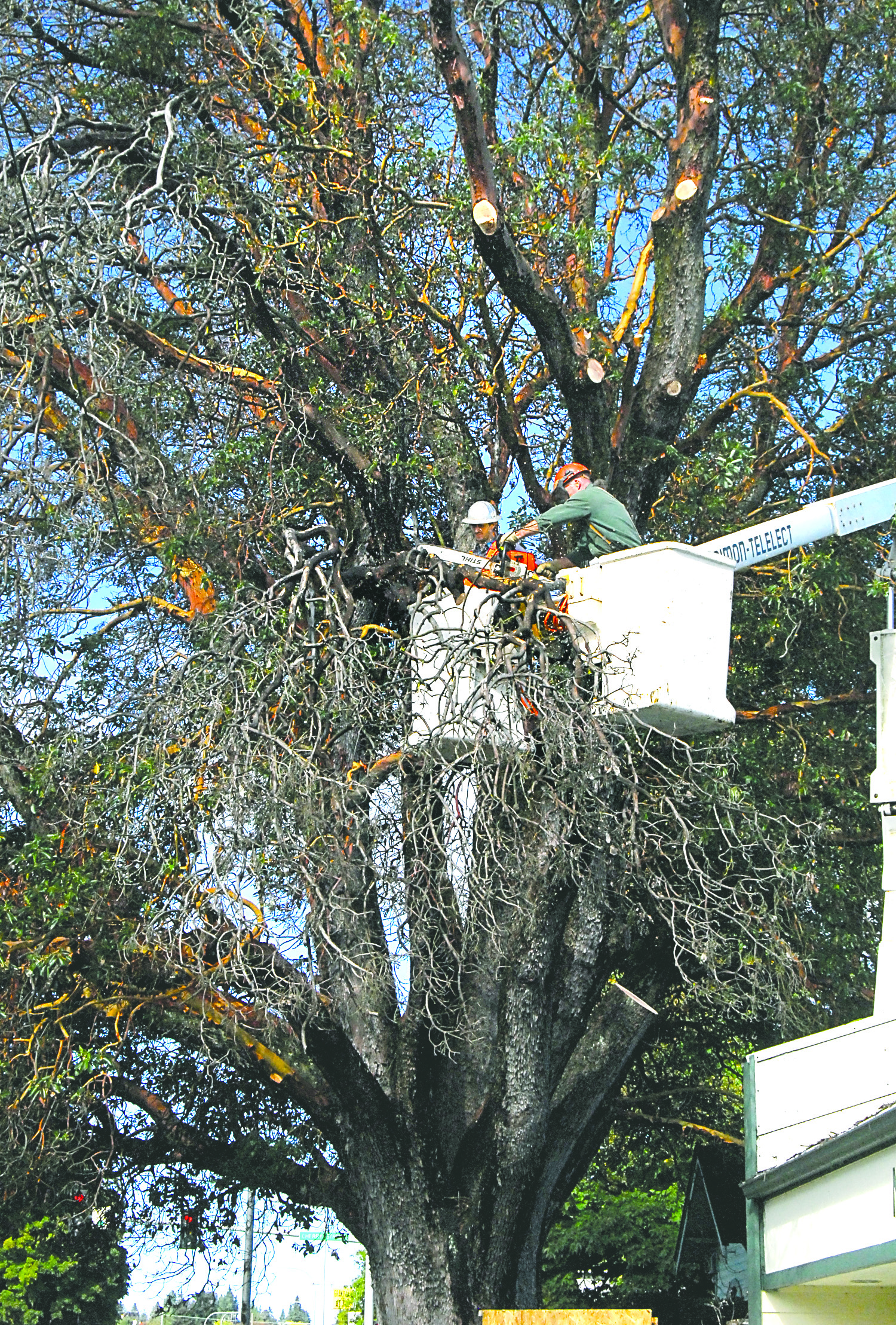
PORT ANGELES — A last-ditch attempt to save a landmark madrona that dates before Port Angeles’ European discovery is underway, but the condition of the huge tree is terminal, according to an arborist familiar with it.
A crew from Blue Mountain Tree Service cut dead limbs from the massive Pacific madrona — the biggest of the species in the state, according to the state Department of Natural Resources — at 231 W. Eighth St. this week.
Its owner, Virginia Serr, 86, of Port Angeles, made sure that not a single living limb was removed.
“That’s enough, guys,” she called to two men cutting large sections from a black, rotted branch more than 20 feet above the ground at Ted’s Tree Park.
Nearly the entire northeast quarter of the madrona was found to be dead, and many dark, leafless sections extended bare, skeletal fingers into the sky.
Once the decaying branches were removed, the once perfectly arched canopy gained a heavily lopsided look as the still-green southern canopy still overhangs the westbound lane of West Eighth Street.
“I want to at least give it a chance to regenerate,” Serr said.
However, an expert who has been monitoring the tree’s health since 1990 said it’s too late for the massive madrona, believed to be as old as 400 years — or more.
“It’s dead already; it just doesn’t know about it yet,” arborist James Causton of Port Angeles said.
It may take years, but the tree is dying from a root fungus, excessive water and a compacted root system, Causton said.
“Everything that could have been done to help that tree has been done,” he said.
In April 2001, the state Department of Natural Resources presented Causton with a Washington State Arbor Day Award, in part for his preservation work.
The Port Angeles madrona is believed to be one of the oldest of its kind in the state.
It has been estimated to be at least 300 years old but could be considerably older, since madronas have a central underground “burl” that can survive fires or being cut down and regenerate a new trunk considerably younger than the tree’s root system.
When last measured in 2007, the giant was 85 feet high; its crown spread to more than 100 feet, shading more than half of West Eighth Street; and it had a circumference of more than 21 feet.
In 1999, Serr purchased the lot where the tree stands as a memorial to her husband, Ted Serr, who died in 1997.
She had the sign for Ted’s Tree Park erected in 2006.
She said her husband, who passed the tree on his way to his office each day, had told her he was afraid the tree might be cut down to make way for construction on the lot.
She purchased the lot and offered it to the city as a pocket park.
The city declined the donation, but Serr said she wanted to keep the tree accessible to the public and decided to create her own park.
Just before Ted Serr died, a business office was built on the neighboring lot, so one of Virginia Serr’s first actions was to have an old house at the back of the lot removed to give the tree as much space as possible.
Causton said the excavator’s 30,000 pounds of weight on the roots likely was the beginning of the end for the tree.
The underground water table has shifted to flow under the property, along the eastern side of the tree’s root system, according to Serr and Causton.
Madronas do not like a lot of water, and the damaged roots and excessive water allowed a root fungus to begin spreading, Causton said.
In 2007, a group of tree specialists from around the Pacific Northwest worked to save the tree, injecting organic microbes to attack the fungi — identified as phytophthora and basidiomycetes — and excavating the decayed roots.
That was unsuccessful, said Causton, one of the specialists who worked on the tree in 2007.
Causton said the only way the fungus could be eradicated is to dry out the root system.
Running out of options, Serr said she turned to a “water witch” to influence the flow of groundwater to go down the street instead of under her property.
It seemed to work for a while, but eventually, it was clear the groundwater was doing its damage, Serr said.
The roots remained wet, and the fungus continued to spread to what few healthy roots remained.
Causton said he believes the fungus will kill or already has killed the tree’s burl, so it cannot regenerate.
The giant madrona and its root system is so huge that each side of the tree is at a different point in the death process, Causton said.
The northeast side of the tree is dead, he said, while the drier southwest side of the tree is still producing new green growth each spring.
The city Public Works Department is monitoring the tree’s stability.
“We will keep a very close eye on the tree,” said Craig Fulton, city public works director, on Thursday.
City arborist Scott Johns estimated that the tree has at least three to five years remaining before it becomes a danger to those who drive and walk under it, Fulton said.
“It’s known as a very strong tree. We have no plans in the immediate future to cut it down,” he said.
________
Reporter Arwyn Rice can be reached at 360-452-2345, ext. 5070, or at arwyn.rice@peninsuladailynews.com.
