
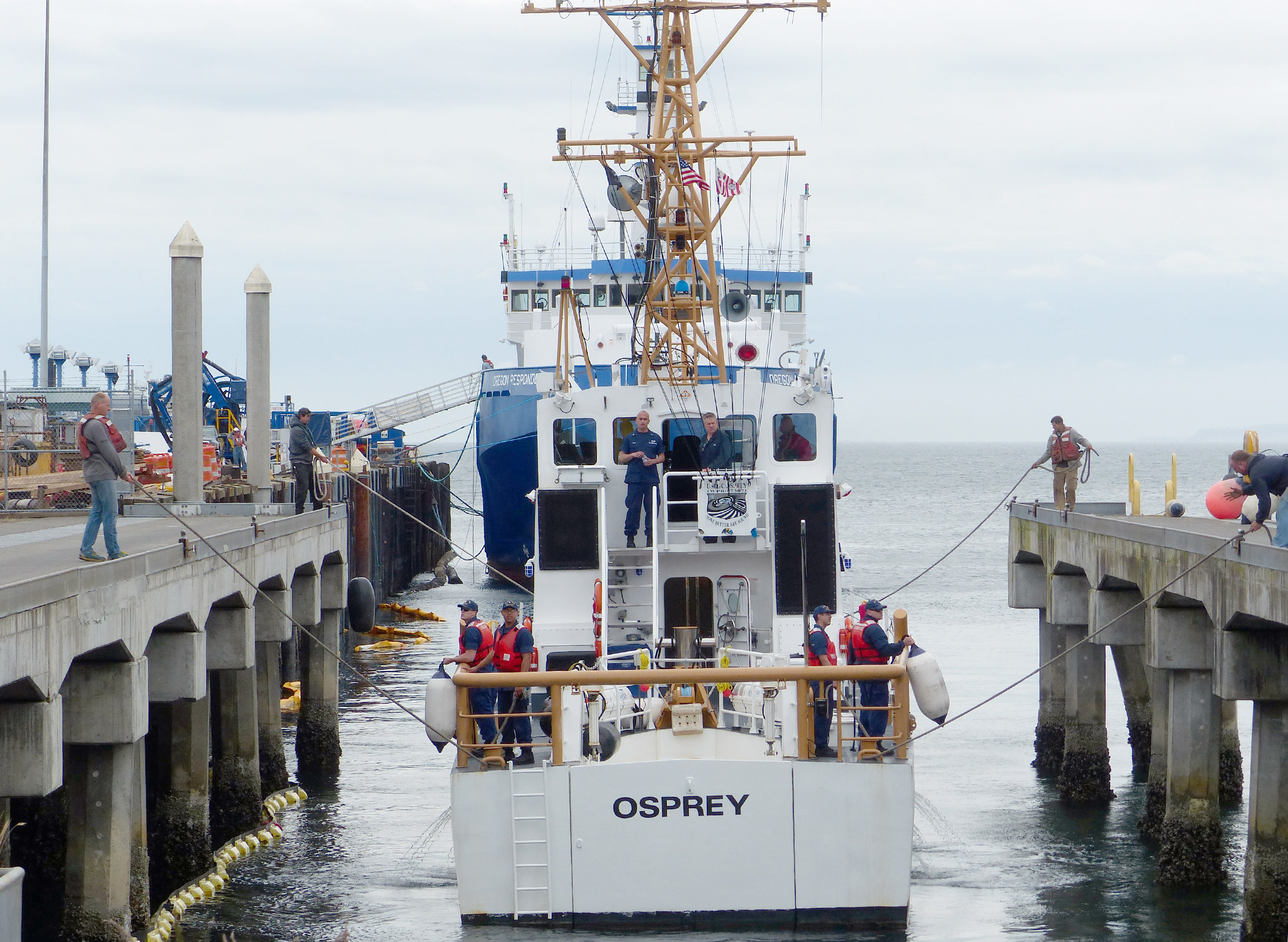
W.C. PARK RESPONDER, the 190-foot blue-and-white oil spill response vessel that is typically moored at the Port of Port Angeles’ Terminal 1 South, was taken to the Foss Maritime Shipyard in Seattle for a scheduled out-of-service period to resolve maintenance issues to ensure the vessel’s long life on the water.
Oregon Responder came up from Oregon to take up the slack during her absence.
Cruising along
The Alaskan cruise ship season is well underway.
Recently, Explorer of the Seas docked at Ogden Point in Victoria.
She is the largest cruise ship,1020 feet long, that has ever docked in Victoria.
The vessel carries 4,029 passengers and a crew of 1,180.
I understand the ship, which is operated by Royal Caribbean, will make another 20 or more port calls to Victoria this season.
Safe Boating Week
National Safe Boating Week began Saturday.
According to a news release from the Coast Guard:
The Coast Guard reminds all boaters to boat responsibly while on the water: wear a life jacket, take a boating safety course, attach an engine cut-off switch, get a free vessel safety check and avoid alcohol or other impairing substance consumption.
The Coast Guard released its 2015 Recreational Boating Statistics ahead of National Safe Boating Week showing a decrease in recreational boating accidents but a rise in recreational boating fatalities in the Coast Guard’s 13th District, which covers the states of Washington, Oregon, Idaho and Montana.
“From 2014 to 2015, accidents decreased from 240 to 225, but fatalities rose from 42 to 63, with Washington having the most recreational boating deaths of the four states at 29.
Of the 63 fatalities, 38 of the victims were not wearing life jackets.
The report also shows that in 2015, the majority of boating accidents, deaths and injuries occurred in lakes, ponds and man-made water resources, namely reservoirs and dams.
Other bodies of water, including bays, inlets, harbors and marinas, were next.
The majority of recreational boating accidents occurred on Saturdays and Sundays between the hours of 4:30 and 6:30 p.m.
Alcohol was the leading known contributing factor in fatal boating accidents within the Coast Guard’s 13th District with a total of 22 accidents, 11 deaths and 20 injuries.
Operator inattention, operator inexperience, improper lookout, machinery failure and excessive speed ranked as the top five primary contributing factors in accidents.
“We are fortunate to have some of the most pristine natural resources right in our own backyard,” said Daniel Shipman, recreational boating safety program manager, Coast Guard 13th District.
“Use sound judgment and follow safe boating and water safety practices when you’re on the water. Even though it is warm outside, the waters are cold and unforgiving.”
Nationwide where the cause of death was known, 76 percent of fatal boating accident victims drowned; of those drowning victims, 85 percent were not wearing a life jacket.
Seventy-one percent of deaths occurred on vessels where the operator had not received boating safety instruction.
The most common types of vessels involved in reported accidents were open motorboats between 16 and 26 feet in length, and the vessel types with the highest number of fatalities were on open motorboats, kayaks and canoes.
The Coast Guard encourages the use of the safe boating apps available on most smartphones.
The phone apps can help boaters request safe boating information, request safety checks, file a float plan, review navigation rules, report hazards or pollution and request emergency assistance.
Although the safe boating app is a great tool, it is still recommended to have a marine VHF-FM radio installed on your boat or carry a handheld version.
Calling on VHF-FM radio is the most reliable way to call for help in case of an emergency.
Osprey haul-out
Platypus Marine, the full-service shipyard, yacht-repair facility and steel-boat manufacturer on Marine Drive in Port Angeles, last week hauled out the 87-foot Coast Guard patrol boat Osprey, which is based in Port Townsend.
She will be out of service for about six weeks, during which time Platypus’ skilled personnel will perform maintenance on the props and shafts as well as sandblast, prime and paint the vessel.
Osprey was the first 87-foot cutter to be placed in service in the Northwest in 1999, replacing the 82-foot Point Class Patrol Boats in service at that time.
The 87-foot patrol boats were designed and built for a 25-year service life.
To that end, every four years, all 87-foot patrol boats in the Coast Guard’s fleet are taken out of service to deal with similar maintenance items to ensure that the vessels’ lifespan remains as anticipated.
Rich Peterson, one of Platypus Marine’s highly skilled specialists who has worked at Platypus for 12 years, retired Wednesday.
To celebrate his exit, management arranged for the delivery of three-dozen pizzas at lunch.
Many of his co-workers thanked him for leaving so they could enjoy lunch on the boss.
Harbor happenings
On Tuesday, Tesoro Petroleum provided bunkers to Liberty Bay, an 823-foot crude oil tanker, in Port Angeles Harbor.
On Wednesday, Tesoro refueled Essie C, a 600-foot petroleum products carrier.
On Friday, Tesoro refueled New Everest, a 577-foot cargo ship.
On Saturday night, Tesoro is scheduled to bunker Ocean Glory, a heavy-lift ship that took on cargo in Tacoma and left Port Angeles for Hawaii and then on to Thailand.
Brian Davis of Port Angeles is an engineer aboard the ship.
_________
David G. Sellars is a Port Angeles resident and former Navy boatswain’s mate who enjoys boats and strolling the area’s waterfronts and boat yards.
Items and questions involving boating, marina and industrial activities and the North Olympic Peninsula waterfronts are always welcome. News announcements about boating groups, including yacht clubs and squadrons, are welcome as well.
Email dgsellars@hotmail.com or phone him at 360-808-3202.
