
Astoria Bay moored to the Port of Port Angeles’ T-Pier on Friday.
At 610 feet long, she is the largest of the ships that come to Port Angeles for a cargo of logs bound for Far East markets.
Later this week, when she eases off Terminal 3 and heads for China, she will no doubt be carrying close to 8 million board feet of logs.
By comparison, the log ship Black Forest, which departed Port Angeles earlier this month for China, was carrying a tick better than 5 million board feet.
Often when log exports are mentioned in this column, I field phone calls and emails from readers whose perception is that the exported logs are processed into lumber that is used to build furniture and knickknacks that are then imported back to the United States for sale in big-box stores.
Some carry the argument further by posing the notion that exporting logs is an example of manufacturing jobs leaving the United States for China and Korea.
On Tuesday, I sat down with Bob Cartano, general manager of Munro LLC, a local company that exports logs to China and South Korea.
Bob has an extensive background in the log-exporting business, and from his numerous trips to China, he has seen firsthand how the logs are processed and what they are used for.
Bob said virtually all of the logs exported to China are hemlock, which is a softwood used almost exclusively in general building construction.
He explained that the predominant construction material for commercial buildings and residential housing — both of which are typically high-rise buildings — is concrete.
Hemlock is an ideal product from which to build the forms necessary to erect these structures.
Not only is the wood easy to work with, but an added bonus is that the forms can be reused a number of times.
Bob went on to say that when the housing units are sold, the interior walls are bare concrete.
The new owners then finish off the walls using drywall or paneling, and the furring strips that are used between the bare concrete and finished wall product also are hemlock.
I asked Bob about the lumber mills that process the logs in China.
He said the logs are not processed in lumber mills per se.
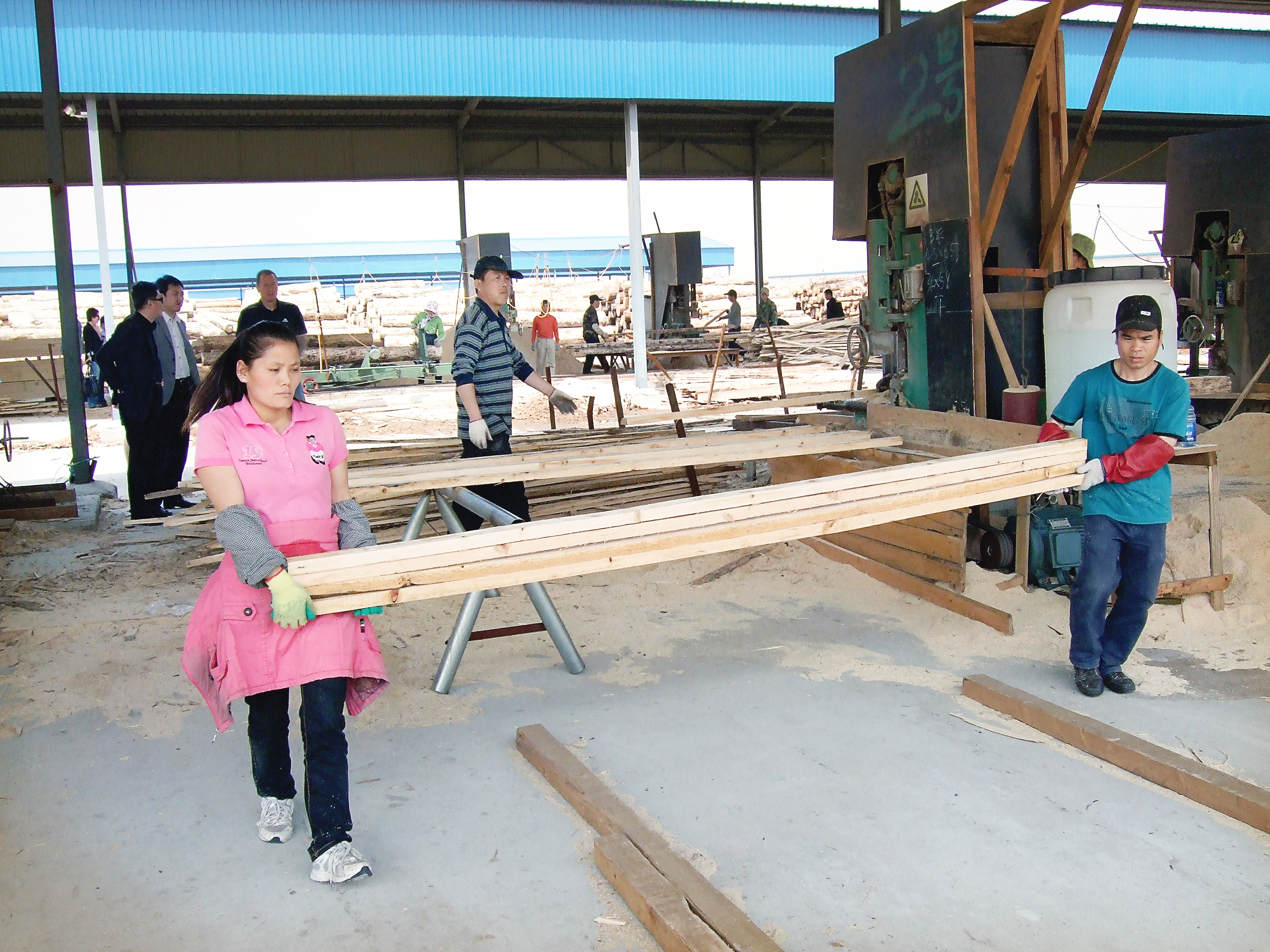
Rather, they are processed on a site that is adjacent to the dock where the log ship is being offloaded.
Bob explained that there are as many as 12 to 15 or more small portable sawmills similar to a Mighty Mite on this contiguous site.
Some of these mills are owned by the operators, and others are leased to the operators with the income apportioned by agreement.
The offloaded logs are sold to the portable-sawmill operators, who process them into lumber according to their respective customers’ requirements or mill them for sale according to the demand of the marketplace.
In addition to the portable-sawmill operators, there are those who have portable veneer-peeling lathes.
These entrepreneurs peel and stack veneer that once air-dried, will be used in the fabrication of plywood that also will be used for concrete forms.
All of the milled lumber is handled by hand.
Nothing about the process is automated until it comes time to load the bundled and strapped lumber on a truck or barge for transportation to the customer.
None of the wood is kiln-dried, there are no lumber grading standards, and there is no quality-control program.
Bob said he has seen sawmill operators secrete rejects into the middle of a lumber bundle prior to strapping it together for shipment.
The logs exported to South Korea are hemlock and spruce.
Because that nation’s industry builds an untold number of products with a focus on electronics, automobiles, ships, machinery, petrochemicals and robotics, manufacturers have a voracious appetite for lumber that is milled from these logs to build crating and specialized packaging for shipment worldwide.
Bob said he is not aware of any furniture that is built in China or South Korea of hemlock or spruce that is then imported into the United States — or anywhere else, for that matter.
He said a consumer might find an occasional picture frame made of these products, but he has yet to come across one.
Bob added that there are hardwoods from the Midwest and South that are exported to foreign markets that likely make their way back to the United States in the form of consumer products.
These logs are typically containerized and shipped from the East Coast.
________
David G. Sellars is a Port Angeles resident and former Navy boatswain’s mate who enjoys boats and strolling the waterfront.
Items involving boating, port activities and the North Olympic Peninsula waterfronts are always welcome.
Email dgsellars@hotmail.com or phone him at 360-808-3202.
His column, On the Waterfront, appears Sundays.
