
Last week’s column introduced us to Durel Wiley, a retired registered nurse and surfboard craftsman who moved to Port Angeles earlier this year.
It also began Durel’s amazing story of the 1976 capsizing and sinking of a 42-foot, gaff-rigged, double-ended ketch, Spirit, bound for San Francisco that he and four others were aboard.
Last week’s installment can be read here: https://giftsnap.shop/article/20120617/NEWS/306179983/0/SEARCH ]
We resume Durel’s story, recalled in his journal, as the five drift in two Avon life rafts in the Pacific about 700 miles west of San Francisco.
Once aboard the rafts, there was little conversation among the crew members.
They did briefly discuss what could have happened to the sailboat, why no flotsam appeared on the surface after she sank and the remote likelihood of being rescued.
Durel recalled that the wide-eyed blank stares on his friends’ faces were reminiscent of pictures he had seen of prisoners of war that conveyed their sense of fear and hopelessness.
By early afternoon, the wind had increased and breaking waves were beginning to hit the rafts, which were by now tethered about 20 feet apart.
Soon the swells were like mountains.
Around 4 o’clock in the afternoon, the raft carrying Durel and Nancy Perry was hit by a breaking wave that seemed to drop tons of water onto it. This scene played itself out three or four times a minute for the rest of the day.
Just before sunset, Durel heard a sound like a tennis racket striking a ball. Their raft gave a mighty lurch and the line holding the two rafts together snapped apart.
He poked his head from beneath the canopy and saw the raft with fellow crew members Jim Ahola, Camilla Arthur and Bruce Collins was rapidly drifting away.
Bruce and Durel gave each other a final wave, and Durel watched as the raft went over the first wave, then onto the crest of the next one — and then there was nothing.
They were gone.
Durel recalled that the first few hours on the raft seemed so unreal, more like the beginning of a bad dream or an episode of “The Twilight Zone.”
As he assessed the situation, he realized that he was confronted with as bleak a set of circumstances as he had ever faced.
Hypothermia was becoming a problem, there was no food and their water would probably last no more than 10 days.
Durel pondered throughout the sleepless night on their impending deaths. It was then that he realized that he had to go on, that if he fought through the fear, the loss of hope and just kept breathing, everything would be all right.
After four or five days, Durel said that hunger ceased being a physical thing and became a constant mental preoccupation.
He daydreamed about barbecued chicken and chocolate milkshakes. And he was irritated with himself for having never entered an all-you-can-eat contest because those people got to eat all that food for nothing.
Plans were formulated in his mind for hiding in a grocery store until everyone had gone home and then spending the night eating his way through the market, leaving behind a trail of empty cans, food wrappers and pop bottles.
One morning as dawn broke, the area around the raft was covered with Valella, a small transparent blue jellyfish about the size of a silver dollar with a sail on its back.
With a certain amount of apprehension, Durel reached into their midst, plucked one from the ocean’s surface and popped it into his mouth, hoping it to be a source of nourishment.
But it dissolved, leaving his mouth numb and tingling with nothing to swallow.
On another day, an albatross appeared on the surface of the ocean about 20 feet away from the raft.
Durel’s mind’s eye pictured a cartoon image of a giant roast turkey floating on a plate with little paper feet on the end of each drumstick and steam rising from it.
He thought that if he was able to dive deep enough, he could come up beneath the bird and grab its feet.
Slowly, Durel slipped into the water, but the wise and weathered bird took flight and within a few seconds was out of sight.
Drinking water ran out on their 11th day adrift.
Two or three hours before dawn on the following day, it began to rain. Durel and Nancy used the side of the raft’s canopy as a funnel and were able to refill the 5-gallon bottle.
Later that day, swells had grown to 20 feet, and the wind was at 45 knots, or about 52 mph.
For the next three days, the air was full of spray and foam. The raft was constantly in motion, sometimes thrown on its edge by a breaking wave, other times filled with salt water.
Durel said there were numerous occasions when the raft would be hit by a wave and it would be thrown ahead of the foam like a tennis ball hit by a gigantic racket.
He calculated that during the three-day storm, they had weathered more than 17,000 assaults by the waves.
Twenty-one days after Spirit had disappeared beneath the waves, Durel noticed a small white square on the horizon.
He thought to himself: “Fine, there’s my first hallucination: a 600-ton sugar cube floating on the ocean.”
After a second and then a third look, he was able to see that it was moving against the wind and that it was the bridge deck of a distant ship.
Durel reached for one of the rocket flares, opened the package and leaned out over the edge of the raft to launch the rocket.
It made a sizzling sound as it flew in an arc into the air and then fell uselessly into the water. The parachute had not deployed, and he was certain no one aboard the ship would have seen it.
He also noticed that the sizzling sound had not stopped. It was then that he saw that the exhaust from the flare had burned a large hole in the raft, which began to immediately deflate.
He knew the hole was too large to patch.
Back next week with the conclusion of this remarkable story.
Port Angeles waterfront news
Platypus Marine at the corner of Marine Drive and Cedar Street on the Port Angeles waterfront hauled out Eliza Joye and stowed her on the hard for a couple of days last week.
She is a 54-foot troller that is owned by John Jenkins of Sooke, B.C., who trolls for albacore from now until October.
The troller is a fiberglass boat that was built in 1979 by Phillbrooks Boatyard in Sidney, B.C.
Incorporated into the bottom of the boat are two aluminum plates that are about 2½ feet to 3 feet square. There are also two plates — one of aluminum and one of copper — that are embedded in the keel.
John is an adherent of the notion that positive ions attract fish.
It begins with the premise that all boats are surrounded by an electrical field that emits either positive or negative ions that repel or attract fish — positive attracts and negative repels.
John is certain that these plates, in concert with the zincs and aluminum anodes that are strategically placed on the bottom of the boat, create a “happy place” of positive ions that attracts tuna to the boat’s wake as she trolls through the water at about 5 knots.
A little research produced some anecdotal evidence that supports John’s attraction to this concept, but I was unable to find any scientific evidence that confirms the theory.
Regardless of the state of the science, John is convinced that the plates work for him, and they will remain on his boat for as long as he owns her.
New in the water
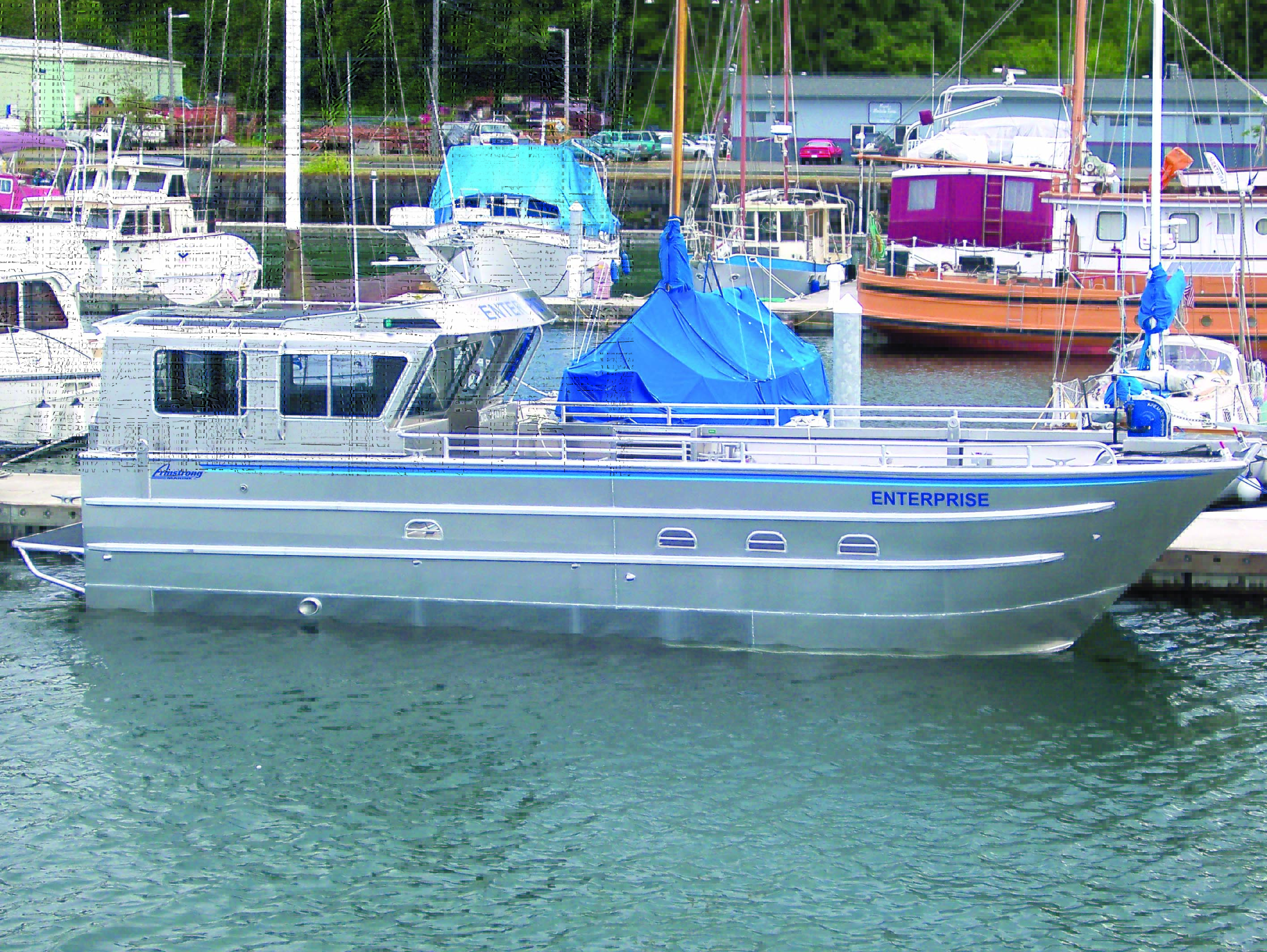
Enterprise, a new 36-foot catamaran, was launched last week by Armstrong Marine, the aluminum-boat fabricator on U.S. Highway 101 midway between Port Angeles and Sequim.
According to Armstrong’s Perry Knudson, the vessel is patterned after a landing craft with an aft cabin that can accommodate up to 15 passengers and a hydraulically operated bow door that allows easy access into the well of the craft for the loading of cargo.
Perry said the vessel, which took only 60 days to build, is for the Kimberlin’s Water Taxi, Tours & Freight company in Valdez, Alaska.
Kimberlin’s operates in and around Prince William Sound and will use the boat to transport personnel and freight to various locations, including Shoup Bay State Park and Jack Bay State Park, as well as to ferry work and safety crews to remote Alaskan locations.
Port Angeles Harbor watch
On Monday in Port Angeles Harbor, Tesoro Petroleum provided bunkers to Firmeza, a Panamanian cargo ship that is 640 feet long with a 105-foot beam.
Tesoro two days later refueled the Crowley-owned articulated tug and barge Vision.
On Thursday, Tesoro bunkered Overseas Nikiski, a 600-foot petroleum-products tanker that is currently moored at the Port of Port Angeles’ Terminal 1 North.
Then Saturday, Tesoro refueled Golden State, a 600-foot petroleum-products tanker that made her way to Port Angeles from Los Angeles.
________
David G. Sellars is a Port Angeles resident and former Navy boatswain’s mate who enjoys boats and strolling the waterfronts.
Items involving boating, port activities and the North Olympic Peninsula waterfronts are always welcome.
Email dgsellars@hotmail.com or phone him at 360-808-3202.
His column, On the Waterfront, appears every Sunday.
