By Seth Borenstein
The Associated Press
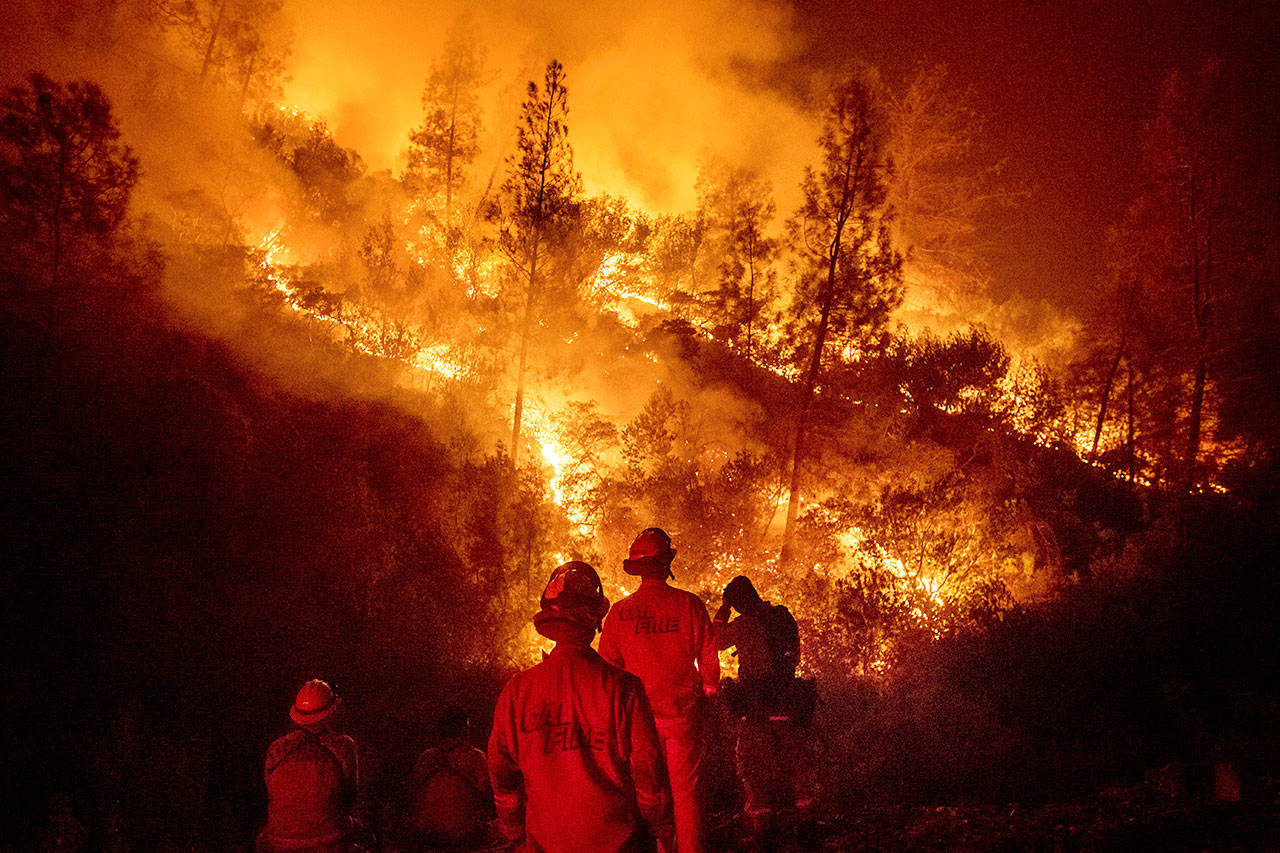
As temperatures rise in the U.S. West, so do the flames.
The years with the most acres burned by wildfires have some of the hottest temperatures, an Associated Press analysis of fire and weather data found. As human-caused climate change has warmed the world throughout the past 35 years, the land consumed by flames has more than doubled.
Experts said the way global warming worsens wildfires comes down to the basic dynamics of fire. Fires need ignition, oxygen and fuel. And what’s really changed is fuel — the trees, brush and other plants that go up in flames.
“Hotter, drier weather means our fuels are drier, so it’s easier for fires to start and spread and burn more intensely,” said University of Alberta fire scientist Mike Flannigan.
It’s simple, he said. “The warmer it is, the more fire we see.”
Federal fire and weather data show higher air temperatures are turbocharging fire season.
The five hottest Aprils to Septembers in the West produced years that on average burned more than 13,500 square miles, according to data at the National Interagency Fire Center and the National Oceanic and Atmospheric Administration.
That’s triple the average for the five coldest Aprils to Septembers.
The Western summer so far is more than 3 degrees Fahrenheit warmer than the 20th century average. California in July logged its hottest month in 124 years of record-keeping.
The five years with the most acres burned since 1983 averaged 63.4 degrees from April to September. That’s 1.2 degrees warmer than average and 2.4 degrees hotter than the years with the least acres burned, AP’s data analysis shows.
In California, the five years with the most acres burned (not including this year) average 2.1 degrees warmer than the five years with the least acres burned.
A degree or two might seem like not much, but it is crucial for fuel. The hotter it is, the more water evaporates from plants. When fuel dries faster, fires spread more and burn more intensely, experts said.
For every 1.8 degrees Fahrenheit that the air warms, it needs 15 percent more rain to make up for the drying of the fuel, Flannigan said.
Fuel moisture levels in California and Oregon are flirting with record dry levels, NOAA Western Regional Climate Centre Director Tim Brown said.
And low humidity is “the key driver of wildfire spread,” according to University of Colorado fire scientist Jennifer Balch who said the Western U.S. soon will start to see wildfires of 1 million acres.
Veteran Colorado hotshot firefighter Mike Sugaski used to consider 10,000-acre fires big, now he fights ones 10 times that or more.
“You kind of keep saying, ‘How can they get much worse?’ But they do,” Sugaski said.
The number of U.S. wildfires hasn’t changed much over the past few decades, but the area consumed has soared.
“The year 2000 seemed to be some kind of turning point,” said Randy Eardley, the fire centre’s chief spokesman.
From 1983 to 1999, the United States didn’t reach 10,000 square miles burned annually. Since then, 10 years have had more than 10,000 square miles burned, including 2017, 2015 and 2006 when more than 15,000 square miles burned.
Some people who reject mainstream climate science point to statistics that seem to show far more acres burned in the 1930s and 1940s. But Eardley said statistics before 1983 are not reliable because fires “may be double-counted, tripled-counted or more.”
Nationally, more than 8,900 square miles have burned this year, about 28 percent more than the 10-year average as of mid-August. California is having one of its worst years.
Scientists generally avoid blaming global warming for specific extreme events without extensive analysis, but scientists have done those extensive examinations on wildfire.
John Abatzgolou of the University of Idaho looked at forest fires and dry conditions in the Western United States from 1979 to 2015 and compared that to computer simulations of what would be expected with no human-caused climate change. He concluded that global warming had a role in an extra 16,200 square miles of forests burning since 1984.
A study of the 2015 Alaska fire season — the second biggest on record — did a similar simulation analysis, concluding that climate change from the burning of coal, oil and gas increased the risk of the fire season being that severe by 34 percent to 60 percent.
One 2015 study said globally fire seasons are about 18.7 percent longer since 1979. Another study that year said climate change is increasing extreme wildfire risk in California where wildfires already are year-round.
Also, drought and bark beetles have killed 129 million trees in California since 2016, creating more fuel.
Contrary to fire scientists, Interior Secretary Ryan Zinke this week told Breitbart radio that “what’s driving” increased wildfires is an increase in fuel. He said the government has “been held hostage by environmental terrorist groups” that oppose clearing dead trees that they say provide wildlife habitat. Zinke, however, has acknowledged that climate change was a factor in worsening wildfires.
