
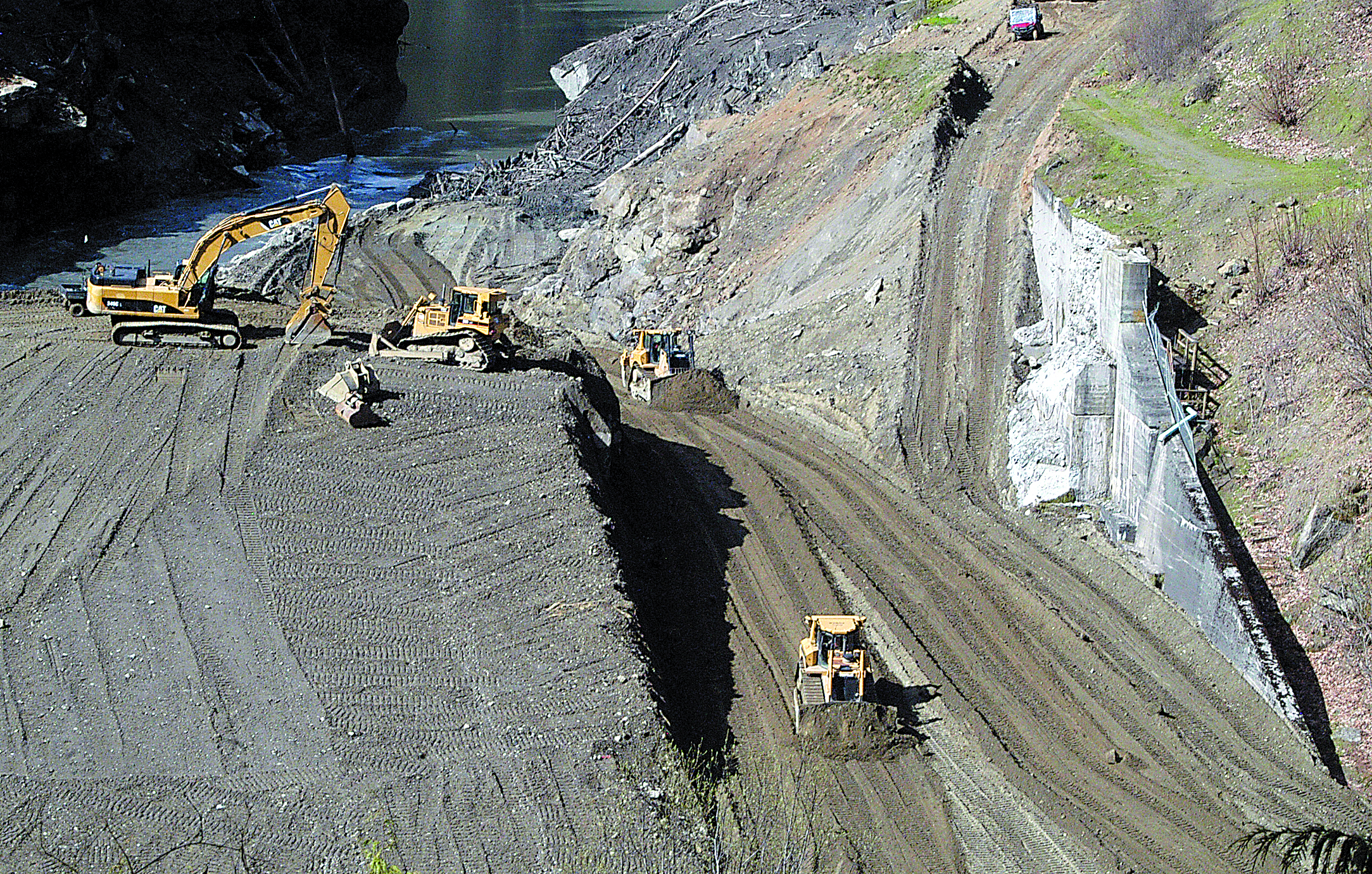
Lake Aldwell is expected to be gone by May 1, said the contractor who is rebuilding the hillside that was dug out nearly a century ago for the now-dismantled Elwha Dam.
The last remnants of Elwha Dam, once 108 feet tall, were removed in mid-March, and the soil and sediments from behind the former dam are being used to restore the hillside that will serve as the west bank of the Elwha River.
The walls of the former spillway and divergence channel on the west side of the dam site will remain and are acting as a retaining feature on the hillside, said Brian Krohmer, project manager for Barnard Construction, which has removed Elwha Dam and is dismantling Glines Canyon Dam upriver in Olympic National Park.
The spillway and channel “are going to be completely buried,” Krohmer said.
By Friday, much of the lower spillway had disappeared under tons of dirt.
Where Lake Aldwell once lapped against the dam is now a canyon of rock walls and mud.
Receding water, which has been draining from the lakebed since September — when dam demolition began — has left behind a muddy landscape with silty water flowing sluggishly through a narrowing channel.
Crews hope to have the last 30 feet of sediment and soil removed from the narrow canyon upriver from the old dam site by the end of the month, Krohmer said.
That should lower the river to approximately its natural riverbed, he said.
How much lower the river will dig its own channel from there is unknown, Krohmer said Friday.
“It’s hard to say where it will stabilize,” he said.
Currently, the river’s natural dredging of the sediments behind the dam site is being controlled by the careful adjustment of large boulders placed in the narrow canyon, allowing the water level to fall by an average of 1½ to 2 feet a day.
Last September, Barnard Construction crews began chipping away at the two dams, which were built without fish ladders, as part of a $325 million federal project to restore the river’s once-famous salmon runs.
Elwha Dam, completed in 1913, blocked the river just 5 miles from where the waterway pours into the Strait of Juan de Fuca at the Lower Elwha Klallam reservation.
Whether the main channel is cleared by May 1 or not, work will stop April 30 for the beginning of a “fish window” that begins May 1 and will continue through June 30.
Fish windows are designed to minimize the amount of silt in the water during fish migration periods.
Two more fish windows remain this year: Aug. 1 through mid-September, and Nov. 1 through Dec. 31.
During those months, all work in the channel stops, and crews work on areas away from the water, such as the continued restoration of plant life along the banks and hillsides that were underwater for the past 100 years.
Crews resumed work on chipping away at the taller of the two Elwha River dams — Glines Canyon, which once stood 210 feet tall and created Lake Mills — on Thursday after a 14-day hold to allow sediment to clear in the river downstream.
During the hold, crews worked on removing the Glines Canyon powerhouse, located below the dam, which is 8 miles upriver from the former Elwha Dam.
The contractor has until September 2014 to complete the project, but work is going more quickly than expected, and the dam — the tallest dam to be dismantled in U.S. history — could be removed as much as a year earlier.
Those watching the work may think that cement rubble from the dam, which was built in 1927, just disappears, but it’s not going anywhere, Krohmer said.
“It’s piling up in the reservoir, behind the dam,” he said.
Currently, the rubble pile is about 35 feet under the current surface of the water, he said.
Once the water level and the rubble pile meet, the excavation of the rubble will begin, he said.
________
Reporter Arwyn Rice can be reached at 360-452-2345, ext. 5070, or at arwyn.rice@peninsuladailynews.com.
