
PORT ANGELES — The Composite Recycling Technology Center, a nonprofit product-development corporation, will continue relying on publicly funded grants for the foreseeable future and plans to create for-profit companies within five years, CEO Dave Walter said Tuesday.
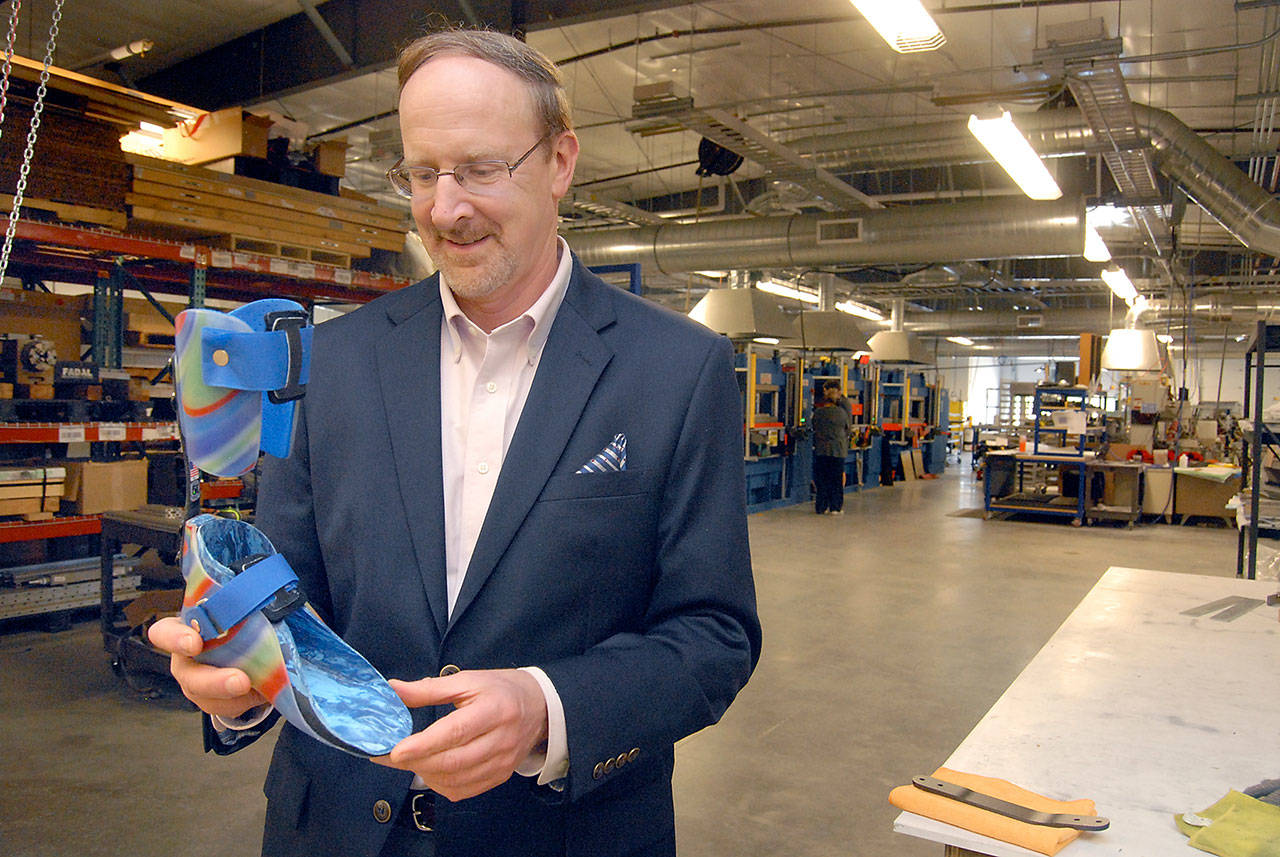
The CRTC’s future includes the Port Angeles-based company continuing its work on projects such as widespread testing of a flat spring for an orthotic leg brace that connects the device’s calf piece to a heel plate, Walter told the Port Angeles Business Association on Tuesday during an hour-long presentation.
The Department of Veterans Affairs is testing the brace at its hospitals, Walter said. (View a video of the device here.)
The CRTC, which has 19 full-time employees and an annual payroll of about $750,000, grossed about $1.2 million in 2018, he said.
Products developed at the CRTC’s 25,000-square-foot, 2220 W. 18th St. building that is owned by the Port of Port Angeles, include $300 pickleball nets, $2,000 park benches and archery stabilizers that can cost $300 to $400 each.
Decorative composite panels developed by the CRTC already hang in Seattle’s Benaroya Hall.
The CRTC also does product development for other companies in Port Angeles.
Established in 2015, the company shares the space with Peninsula College, whose students earn a two-year degree while studying there and often are hired by the CRTC, Walter said.
The company began four years ago fueled entirely by public funds and is currently about 30 percent grant-funded and 70 percent funded by product-development revenue, Walter said.
“I do see that continuing,” he said of the need for grants.
Asked at the meeting if the CRTC is making a profit, Walter responded, “we’re not there yet.”
About 65 percent of expenditures are rent and other overhead such as utilities and materials, the main component of which is carbon fiber scrap processed elsewhere into cylindrical rolls that, when peeled off at the CRTC, are cut and heated under pressure for shaping into product prototypes.
“We’re at about $1.2 million in total revenue, and our expenses are right in there, probably a little higher,” Walter said at the breakfast meeting.
He said he expects the CRTC to be “self-sustainable” through revenue and grants by the end of 2019, calling the effort “challenging.”
“Research dollars are important for bigger projects,” Walter said. “That’s why I think grants are important.”
Walter said in a later interview that grants and other public funding, including about $5 million for development of the West 18th Street facility, has totaled about $8 million since 2015.
State Department of Commerce Energy Fund Grants include $1 million to the port to upgrade the West 18th Street building in the 2013-2015 biennium, $1.7 million in the 2015-17 biennium for research, development and demonstration, and a tentative award of $707,570 that is not yet under contract but will be soon, DOC spokeswoman Penny Thomas said Tuesday in an email.
The latest grant, announced about a month ago, will “develop new lightweight products from recycled aerospace carbon fiber composite scrap for multiple applications, such as marine cabling for kelp and aquatic shellfish farming and advanced cross-laminated timber,” Thomas said.
The composite cable will replace plastic cable for vertical ocean farms that grow shellfish and kelp.
A vertical farm the size of the state of Washington “could feed the world,” Walter told the PABA.
It also would be environmentally friendly by removing plastic from the ocean.
The project is too big, though, for a nonprofit corporation, and needs shareholders to invest funds to make it successful, he said.
Those shareholders will expect a profit, while the CRTC, which will remain a nonprofit entity, could retain intellectual property rights and supply the new entities with carbon fiber, he said.
“We would require some form of spin off there,” Walter said.
The CRTC is within about $100,000 — including grants — of being able to show a profit, which Walter said he expects by year’s end.
Walter, a CRTC board member, is the only paid executive, earning $63,360 a year, according to the company’s 2017 Form 990 filed in May 2018 with the IRS. The form is publicly available, like those of other nonprofit corporations, at www.guidestar.org.
Walter said he did not know when the Form 990 for 2018 will be filed, and does not expect the CRTC to file quarterly or annual reports beyond the Form 990. Filing quarterly reports “drives short-term thinking,” Walter said in the interview.
All other board members, at least some of whom have connections to the CRTC, do not receive compensation, Walter said.
They are chair Charles Brandt of Marine Sciences Laboratory in Sequim, Ray Grove, Loren Lyon, Nobuyuki Odagiri, Joe McSwiney, Andy Bridge and Jennifer Smith.
Information about them and the CRTC is at www.compositerecycling.org.
________
Senior Staff Writer Paul Gottlieb can be reached at 360-452-2345, ext. 55650, or at pgottlieb@ peninsuladailynews.com.
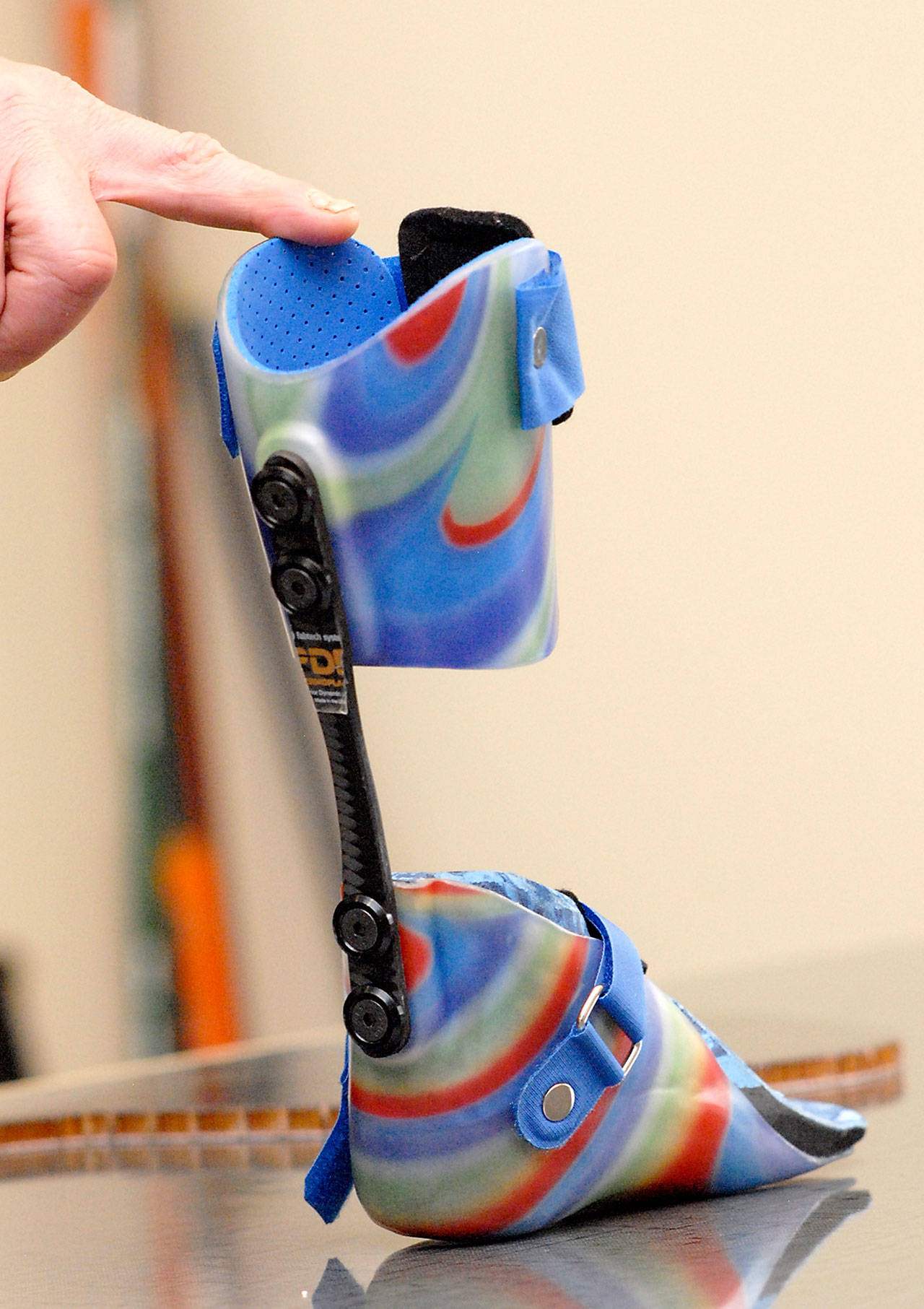
A carbon fiber spring manufactured at the Composite Recycling Technology Center in Port Angeles is the backbone of a orthoic device on display. (Keith Thorpe/Peninsula Daily News)
