By Gillian Flaccus
The Associated Press
PORTLAND, Ore. — A fiery oil train derailment in Oregon’s scenic Columbia River Gorge drew immediate reaction from environmentalists who said oil should not be transported by rail, particularly along a river that is a hub of recreation and commerce.
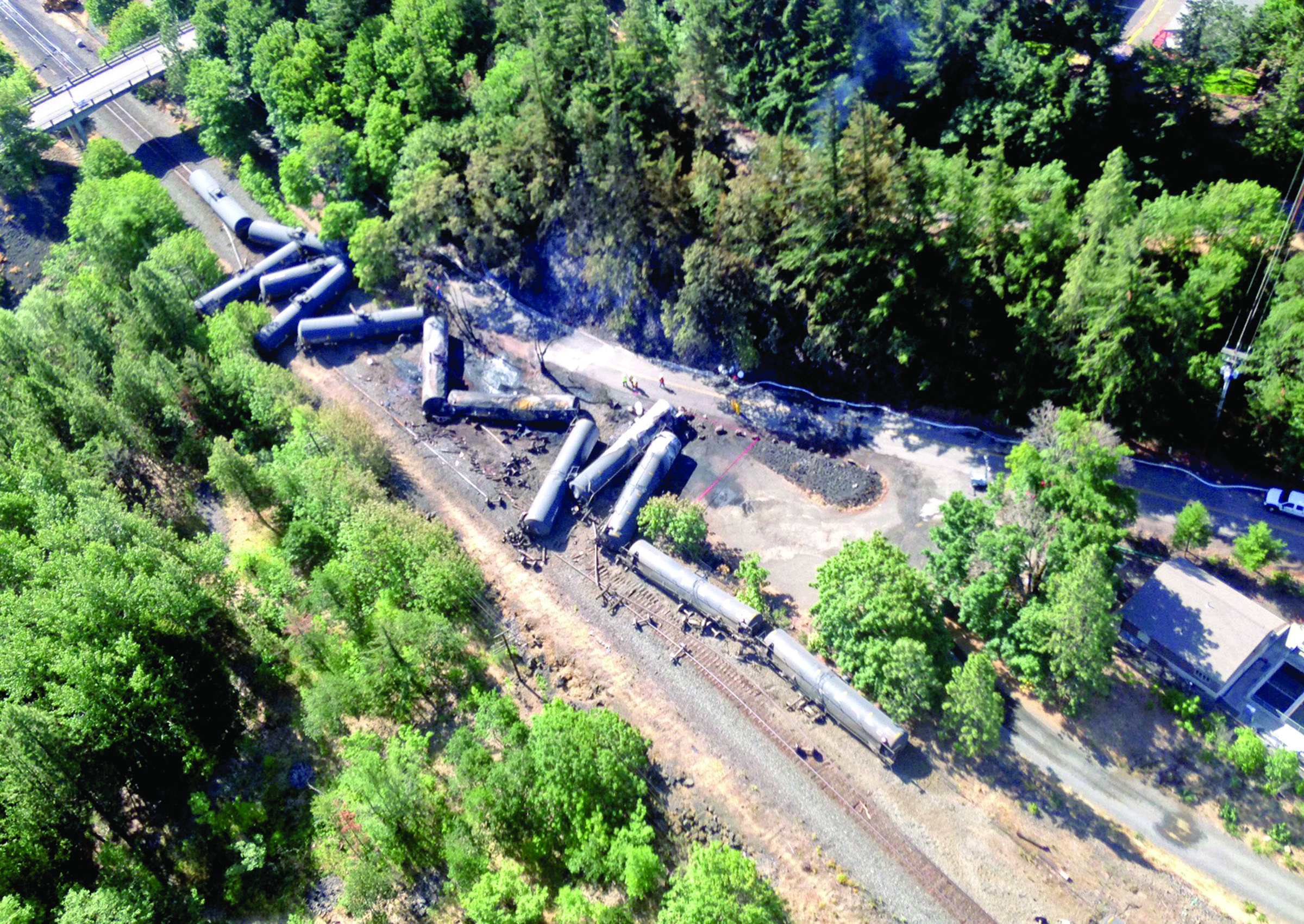
At least 11 cars derailed Friday in the 96-car Union Pacific train, and the company said several caught fire.
The crash released oil alongside tracks that parallel the Columbia River and sent a plume of black smoke high into the sky that spurred evacuations and road closures.
No injuries were reported.
All the cars were carrying Bakken oil, a type of oil that is more flammable than other varieties because it has a higher gas content and vapor pressure and lower flash point.
“Moving oil by rail constantly puts our communities and environment at risk,” said Jared Margolis, an attorney at the Center for Biological Diversity in Eugene, Oregon.
It wasn’t immediately clear if oil had seeped into the river or what had caused the derailment.
Traveling slowly
Aaron Hunt, a spokesman for the railroad, did not know how fast the train was traveling at the time, but witnesses said it was going slowly as it passed the town of Mosier, Ore., about 70 miles east of Portland.
Response teams were using a drone to assess the damage, said Katherine Santini, a spokeswoman with the U.S. Forest Service.
Crews were continuing to suppress the fire, which they expected to do overnight.
Gov. Kate Brown activated additional state resources including water tenders and the coordination efforts of the Oregon State Fire Marshal to assist firefighters at the scene.
Evacuated area
Officials in Mosier closed about 23 miles of Interstate 84 and evacuated the area immediately around the spill, including 50 mobile homes and 200 schoolchildren who were picked up by their parents.
Residents in Mosier were issued notices to boil their water until further notice due to a loss of water pressure, potentially allowing harmful bacteria to get into the water supply.
Silas Bleakley was working at his restaurant in Mosier when the train derailed.
“You could feel it through the ground. It was more of a feeling than a noise,” he told The Associated Press as smoke billowed from the tankers.
Bleakley said he went outside, saw the smoke, got in his truck and drove about 2,000 feet to a bridge that crosses the railroad tracks.
There, he said, he saw tanker cars “accordioned” across the tracks.
Another witness, Brian Shurton, was watching the train as it passed by the town when he heard a tremendous noise.
“All of a sudden, I heard ‘Bang! Bang! Bang!’ like dominoes,” he told AP.
He also drove to the overpass and saw the cars flipped over before a fire started and he called 9-1-1.
“The train wasn’t going very fast. It would have been worse if it had been faster,” said Shurton, who runs a wind surfing business in nearby Hood River.
Matt Lehner, a spokesman from the Federal Railroad Administration, said a team of investigators had arrived at the scene from Vancouver, Wash.
Union Pacific said 11 cars had derailed, but a spokesman from the Oregon Department of Forestry, which helped extinguish the blaze, said 12 cars had been involved. The discrepancy could not immediately be resolved.
Including Friday’s accident, at least 26 oil trains have been involved in major fires or derailments during the past decade in the U.S. and Canada, according to AP analysis of accident records from the two countries.
The worst was a 2013 derailment that killed 47 people in Lac-Mégantic, Quebec. Damage from that accident has been estimated at $1.2 billion or higher.
At least 12 of the oil trains that derailed over the past decade were carrying crude from the Northern Plains’ Bakken region — fuel that is known for being highly volatile. Of those, eight resulted in fires.
Combustibles
Since last spring, North Dakota regulators have required companies to treat oil before it’s shipped by rail to make it less combustible.
Reducing the explosiveness of the crude moved by rail was not supposed to be a cure-all to prevent accidents. Department of Transportation rules imposed last year require companies to use stronger tank cars that are better able to withstand derailments.
But tens of thousands of outdated tank cars that are prone to split open during accidents remain in use.
It’s expected to take years for them to be retrofitted or replaced.
Hunt, the Union Pacific spokesman, did not respond to questions about whether the Bakken oil in Friday’s derailment had been treated to reduce volatility. It also wasn’t clear if the tank cars in the accident had been retrofitted under the new rules.
