
EDITOR’S NOTE: This report has been corrected to attribute some quotes to Christopher Burns, natural resources technician with the Jamestown S’Klallam tribe.
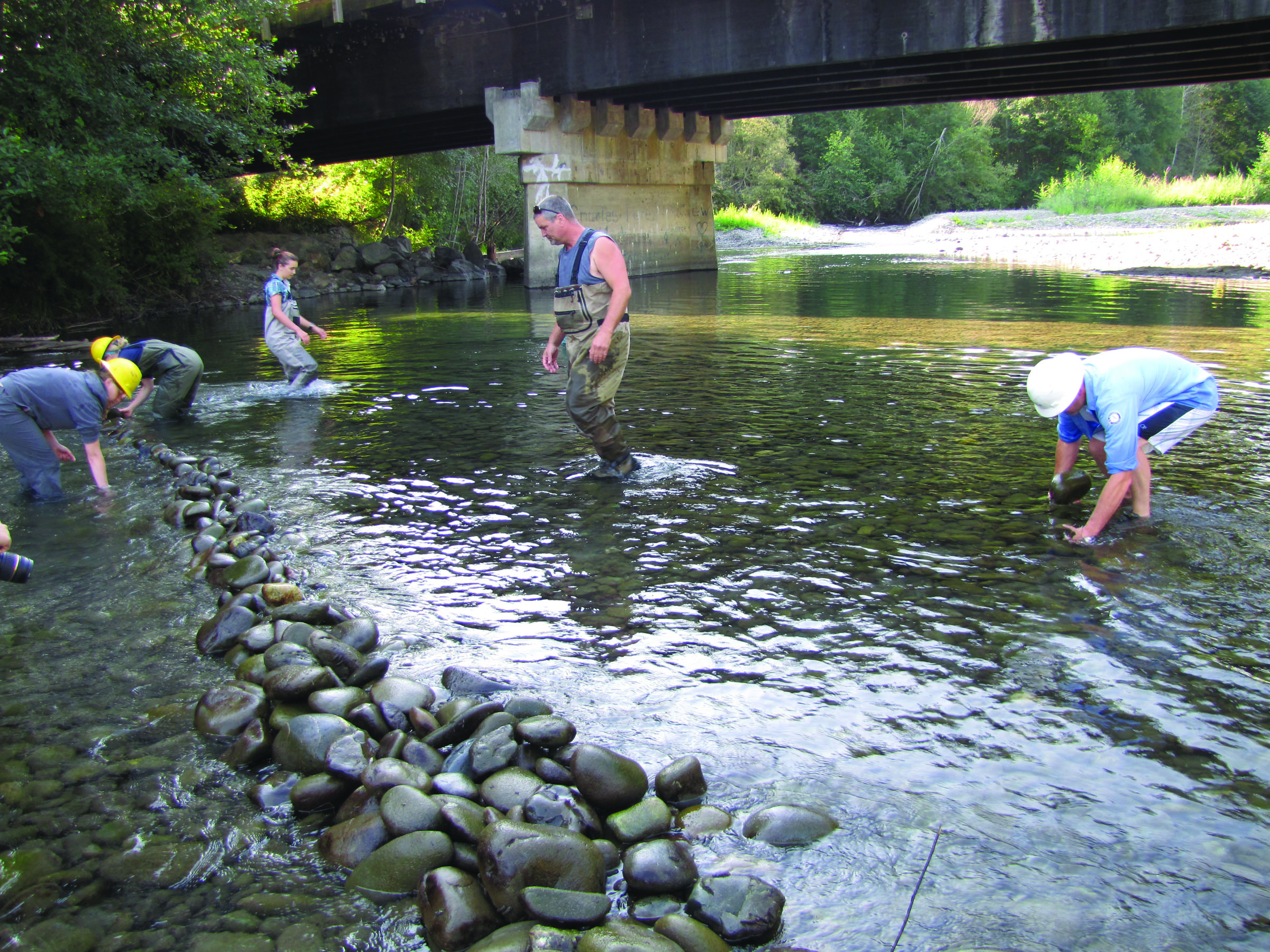
SEQUIM — An industrious crew of 18 young adults worked last week to raise water levels in areas of the Dungeness River, building stone diversion dams and clearing channels to allow salmon to reach their spawning grounds.
An emergency state grant paid for equipment and crews to ease upriver travel for the salmon, including two crews from the Washington Conservation Corps.
The water in the Dungeness River is at a record low just as masses of pink salmon and chinook are expected to enter the river.
The Jamestown S’Klallam tribe and state Fish and Wildlife are working to create channels of deeper water to allow the fish passage.
The state Department of Ecology provided a $74,430 grant to the Jamestown S’Klallam for the work, the state announced Monday.
“It’s pretty exciting news. We will be able to purchase some equipment to do this work on the river,” said Scott Chitwood, natural resources director for the tribe.
Flows in the Dungeness River are currently 35 percent of normal, Ecology said.
The flow as measured Saturday by the U.S. Geological Survey was 110 cubic feet per second (cfs), lower than the record set in 2009 when the river dropped to 130 cfs.
While the river has never been lower, the preseason prediction was for 1.3 million pink salmon to return to the river in a run that would peak this month.
Mike Gross, state Department of Fish and Wildlife biologist, said those numbers may not be reached. Still, large numbers are expected; Gross mentioned at least 200,000.
The early forecast “is the one we were operating with last winter,” Chitwood said.
“We are trying to prepare for that many fish . . . there may not be that many, but we don’t know yet.
“We’ll know by the end of the month how accurate the forecast was,” he said.
“The idea we’ve been formulating for several months is that these returning adult salmon will need assistance to get across shallow riffles,” he said, adding that work began a couple of weeks ago.
Returning chinook are a special concern.
Only about 300 are expected this year, but the massive fish are struggling in the low water level, said Aaron Brooks, fisheries biologist with the Jamestown S’Klallam.
“A few more years like this, and they may be gone,” Christopher Burns, natural resources technician with the Jamestown S’Klallam tribe, said.
The crews are narrowing the flow so it’s deeper in some areas. They place sand bags on some channels and on others are using devices that create a bladder on both sides of the channel, Chitwood said.
Other devices also can help direct river flow.
“We’ve been monitoring 12 to 14 locations in the lower 11 miles of river,” Chitwood said.
“As the flows continue to drop, we will prioritize which sites need the most attention.”
On Tuesday, the river improvement team used river stones to create a diversion to deepen a natural channel where pink salmon were swimming upstream five at a time.
The stone diversion dam shifted water from very shallow riffles, which was not navigable by the fish.
Each stone was taken from the channel to further deepen it as the river level increased on that portion of the river.
Each of the nine primary diversion dams and channels created by the team was permitted through the state and built in a manner that winter floods would remove it naturally, and is marked by a sign so well-meaning members of the public do not destroy them.
Some temporary plastic diversion dams were available for places where the stone dams are impractical and removed at the end of the salmon runs.
Brooks said the low water level isn’t just preventing fish from getting through shallow areas; it also is warming the water.
North Olympic Peninsula rivers aren’t running too warm for fish — but temperatures are higher than usual.
Biologist become concerned at about 68 degrees, Gross said, “because it could escalate into something . . . 70- to 72-degree water along with other stressors can cause pre-spawning deaths.”
Low water levels also increase predation, Burns said.
“The eagles and otter are having a heyday,” he said.
He said the team was also finding evidence of illegal fishing on the banks, such as discarded fishing gear and fish blood on the rocks.
“It’s a $5,000 fine for messing with chinook,” he said.
Ecology also has allocated emergency funding to two other drought-relief projects.
The Stevens County Public Utility District will receive $47,000 to help drill a new well to replace the failing main production well of the Riverside Water System and provide reliable drinking water to 385 residents.
The Kennewick Irrigation District will receive $28,872 to help increase water conservation by 23,000 customers in Kennewick, Richland, West Richland and incorporated Benton County.
The state Legislature approved $16 million for use over the next two years to help relieve drought hardships statewide, Ecology said.
Through the grant program, public entities such as cities, public utilities and irrigation districts can get help paying for developing alternative water supplies or deepening existing groundwater wells.
_________
Reporter Arwyn Rice can be reached at 360-452-2345, ext. 5070, or at arwyn.rice@peninsuladailynews.com.
Executive Editor Leah Leach can be reached at 360-417-3531 or at lleach@peninsuladailynews.com.
