
Jamestown S’Klallam Tribe/Northwest Indian Fisheries Commission
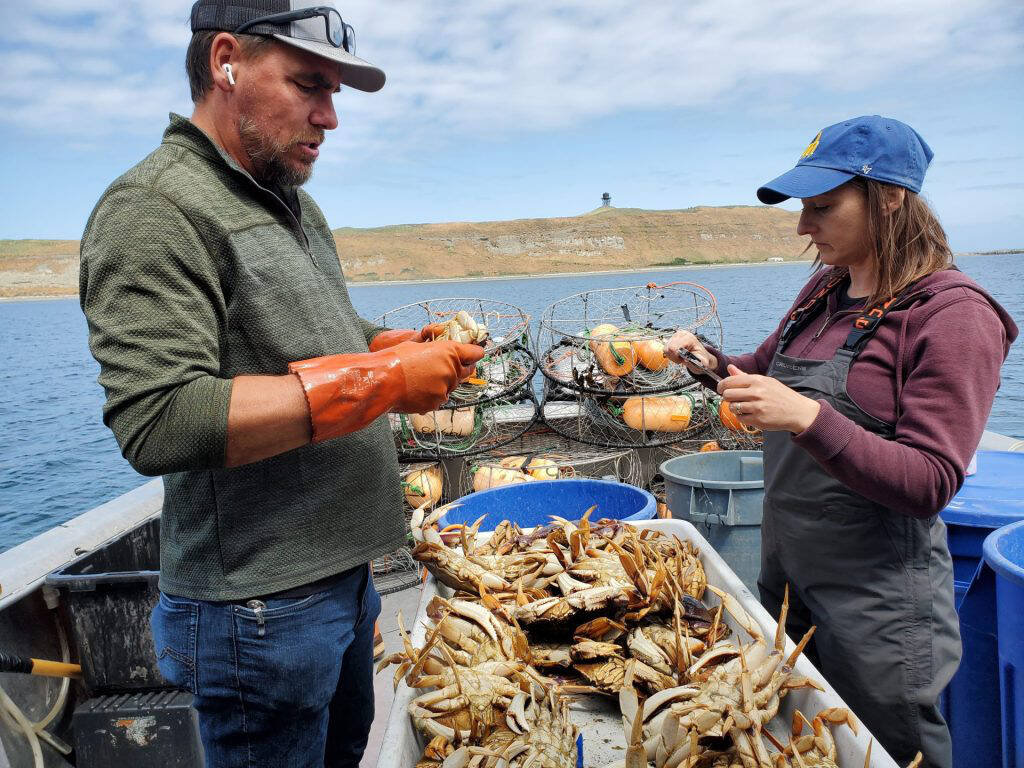
Jamestown S’Klallam tribal fisherman Josh Chapman and Jamestown S’Klallam Tribe shellfish manager Liz Tobin measure Dungeness crab samples as part of the genetics project.

Jamestown S’Klallam Tribe/Northwest Indian Fisheries Commission Jamestown S’Klallam tribal fisherman Josh Chapman and Jamestown S’Klallam Tribe shellfish manager Liz Tobin measure Dungeness crab samples as part of the genetics project.

Crab DNA study examines possible distinct populations

Jamestown S’Klallam Tribe partners are considering genetics

  • By Tiffany Royal Northwest Indian Fisheries Commission
  • Wednesday, January 24, 2024 1:30am
  • NewsClallam County

BLYN — The Jamestown S’Klallam Tribe is working with a diverse group of partners to learn more about the population structure of Puget Sound’s Dungeness crab by studying the DNA of both larvae and adults.

“The main question our team is looking to answer is whether Dungeness crab in the region belong to a single large population or are there multiple genetically distinct populations?” said Liz Tobin, the tribe’s shellfish program manager.

Biologists have been working with tribal and non-tribal commercial crab fishermen to collect genetic material from crab larvae and adults from 11 management areas throughout Puget Sound this year.

After genetic analysis is completed by Jay Dimond, a research assistant professor at Western Washington University, tribal and state co-managers and members of the shellfish industry will evaluate the results to determine if the population’s genetics vary throughout the region and how that aligns with the current Dungeness crab management regions and boundaries.

“Genetic diversity is a species’ best defense against environmental change, so our goal with this research is to provide fishery managers with the information needed to maintain this diversity,” Dimond said.

“Genetic data can also provide us with information about where crab larvae are coming from and where they are going. Some populations may be self-seeding, while others may be seeded by larvae from distant sources.”

This work also can help scientists understand fluctuations or declines in crab populations that may be explained by natural factors such as larval supply, he said.

In the end, the goal is to maximize harvest opportunities while ensuring the long-term sustainability of the resource.

The tribes and state have been conducting surveys and test fisheries to get an idea of how much crab is out there and observe seasonal molting patterns.

A region-wide light trap project since 2018 also has helped scientists track when and where crab larvae are present across the inland waters of Washington and British Columbia.

So far, more larvae have been found in North Sound and the Strait of Juan de Fuca, while fewer crab have been showing up in South Sound and Hood Canal.

“This project is a great demonstration of multi-partner collaboration across the region,” said Emily Buckner, program coordinator for the Pacific Northwest Crab Research Group (PCRG).

“Between the project leads, technical reviewers and data collectors, 19 unique partners have contributed to this effort via the coordination of the crab research group.”

Funded by a National Oceanic and Atmospheric Administration Saltonstall-Kennedy grant, the principal researchers on the project are Western Washington University, Jamestown S’Klallam Tribe, Puget Sound Restoration Fund/PCRG, Swinomish Indian Tribal Community and Washington Department of Fish and Wildlife.

Additional partners include other state departments and tribes, including the Port Gamble S’Klallam Tribe.

________

This story was originally featured in the Northwest Indian Fisheries Commission’s Northwest Treaty Tribes and was used by permission. See nwtreatytribes.org for more information.
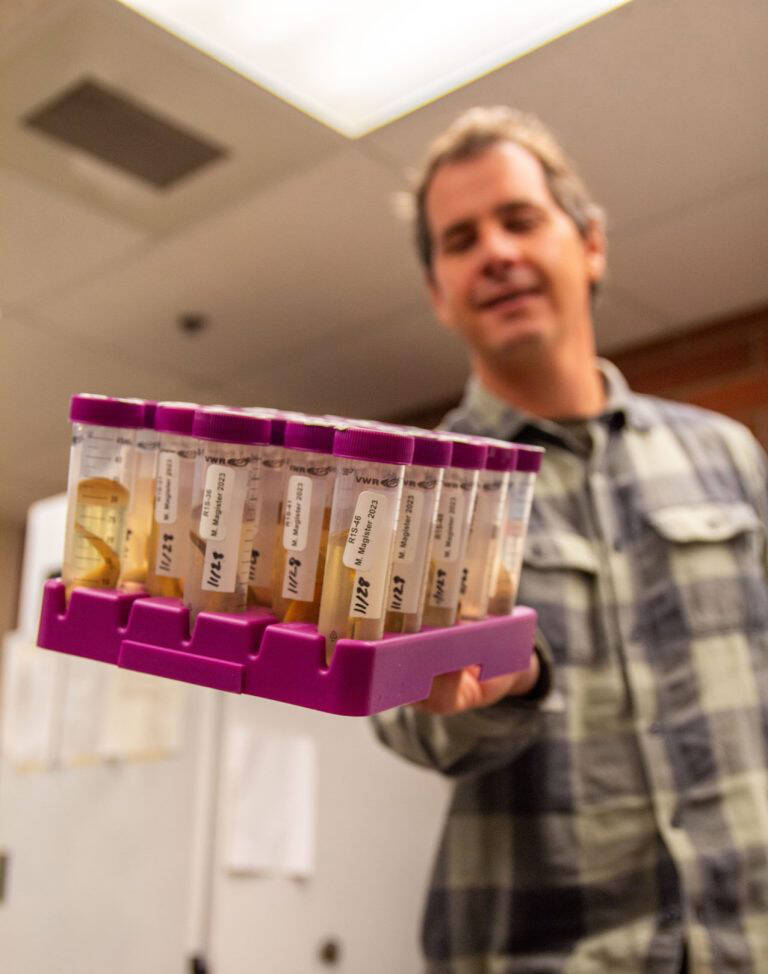
Jay Dimond, Western Washington University research assistant professor, inspects samples of Dungeness crab that have been collected for DNA testing. (Tiffany Royal/Northwest Indian Fisheries Commission)

Jay Dimond, Western Washington University research assistant professor, inspects samples of Dungeness crab that have been collected for DNA testing. (Tiffany Royal/Northwest Indian Fisheries Commission)

More in News

Sue Long, left, Vicki Bennett and Frank Handler, all from Port Townsend, volunteer at the Martin Luther King Day of Service beach restoration on Monday at Fort Worden State Park. The activity took place on Knapp Circle near the Point Wilson Lighthouse. Sixty-four volunteers participated in the removal of non-native beach grasses. (Steve Mullensky/for Peninsula Daily News)
Work party

Sue Long, left, Vicki Bennett and Frank Handler, all from Port Townsend,… Continue reading

Portion of bridge to be replaced

Tribe: Wooden truss at railroad park deteriorating

Kingsya Omega, left, and Ben Wilson settle into a hand-holding exercise. (Aliko Weste)
Process undermines ‘Black brute’ narrative

Port Townsend company’s second film shot in Hawaii

Jefferson PUD to replace water main in Coyle

Jefferson PUD commissioners awarded a $1.3 million construction contract… Continue reading

Scott Mauk.
Chimacum superintendent receives national award

Chimacum School District Superintendent Scott Mauk has received the National… Continue reading

Hood Canal Coordinating Council meeting canceled

The annual meeting of the Hood Canal Coordinating Council, scheduled… Continue reading

Bruce Murray, left, and Ralph Parsons hang a cloth exhibition in the rotunda of the old Clallam County Courthouse on Friday in Port Angeles. The North Olympic History Center exhibit tells the story of the post office past and present across Clallam County. The display will be open until early February, when it will be relocated to the Sequim City Hall followed by stops on the West End. The project was made possible due to a grant from the Clallam County Heritage Advisory Board. (Dave Logan/for Peninsula Daily News)
Post office past and present

Bruce Murray, left, and Ralph Parsons hang a cloth exhibition in the… Continue reading

This agave grew from the size of a baseball in the 1990s to the height of Isobel Johnston’s roof in 2020. She saw it bloom in 2023. Following her death last year, Clallam County Fire District 3 commissioners, who purchased the property on Fifth Avenue in 2015, agreed to sell it to support the building of a new Carlsborg fire station. (Matthew Nash/Olympic Peninsula News Group file)
Fire district to sell property known for its Sequim agave plant

Sale proceeds may support new Carlsborg station project

As part of Olympic Theatre Arts’ energy renovation upgrade project, new lighting has been installed, including on the Elaine and Robert Caldwell Main Stage that allows for new and improved effects. (Olympic Theatre Arts)
Olympic Theatre Arts remodels its building

New roof, LED lights, HVAC throughout

Weekly flight operations scheduled

Field carrier landing practice operations will be conducted for aircraft… Continue reading

Workers from Van Ness Construction in Port Hadlock, one holding a grade rod with a laser pointer, left, and another driving the backhoe, scrape dirt for a new sidewalk of civic improvements at Walker and Washington streets in Port Townsend on Thursday. The sidewalks will be poured in early February and extend down the hill on Washington Street and along Walker Street next to the pickle ball courts. (Steve Mullensky/for Peninsula Daily News)
Sidewalk setup

Workers from Van Ness Construction in Port Hadlock, one holding a grade… Continue reading