
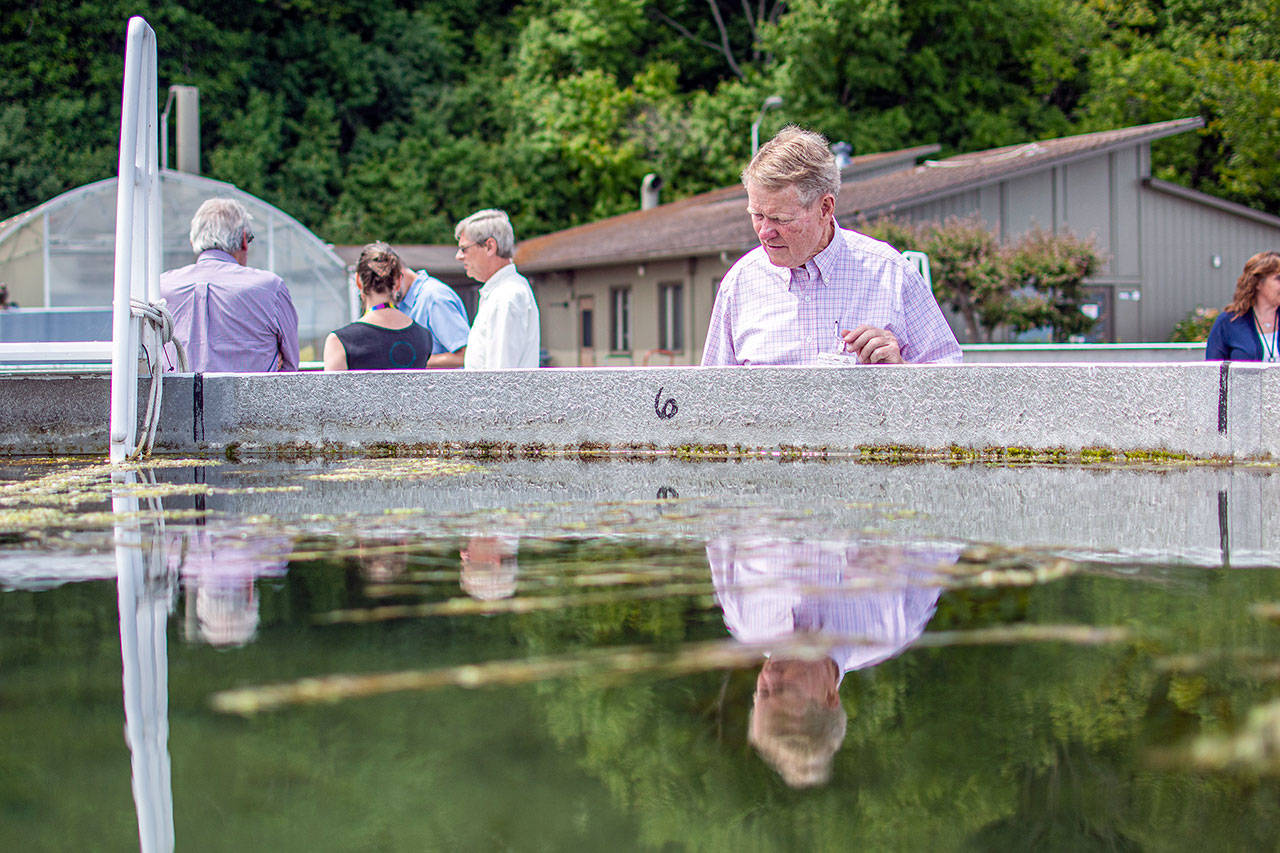
SEQUIM — Officials from Clallam County and the city of Sequim toured the Pacific Northwest National Laboratory’s Marine Sciences Laboratory in Sequim recently, learning about the facility’s research on climate change.
During presentations at the laboratory Wednesday, part of the county’s series of events focusing on the impacts of climate change, officials learned about a study in Grays Harbor County on how forests respond to increasing amounts of salt water, what happens to eelgrass as temperatures rise and about how the lab hopes to work with local businesses and organizations.
Genevra Harker-Klimes, division director of the Coastal Sciences Division, told county commissioners, City Council members and other officials after a tour of the facility that though priorities shift depending on the current administration, scientists at the facility are still studying climate change.
“While we’re trying to do a lot of the same research, we can no longer call it climate change research,” she said. “We can look at coastal resilience and adaptation. A lot of the work today has those titles instead.”
Earth scientist Nick Ward told officials about work being conducted in Grays Harbor County that examines the effects of salt water on trees.
He called Beaver Creek, a creek between Westport and Aberdeen, an “extreme” example of what happens as sea levels rise. In 2014, a culvert was knocked out to improve access for spawning salmon, but that also reintroduced tidal flow into the floodplain.
“We now get every month or so these floods of seawater where there are 80-year-old trees growing,” he said. “We are seeing these guys dying quick.”
Ward, who studies greenhouse gasses, said the death of the trees puts the carbon emissions and carbon sequestration in that watershed out of balance.
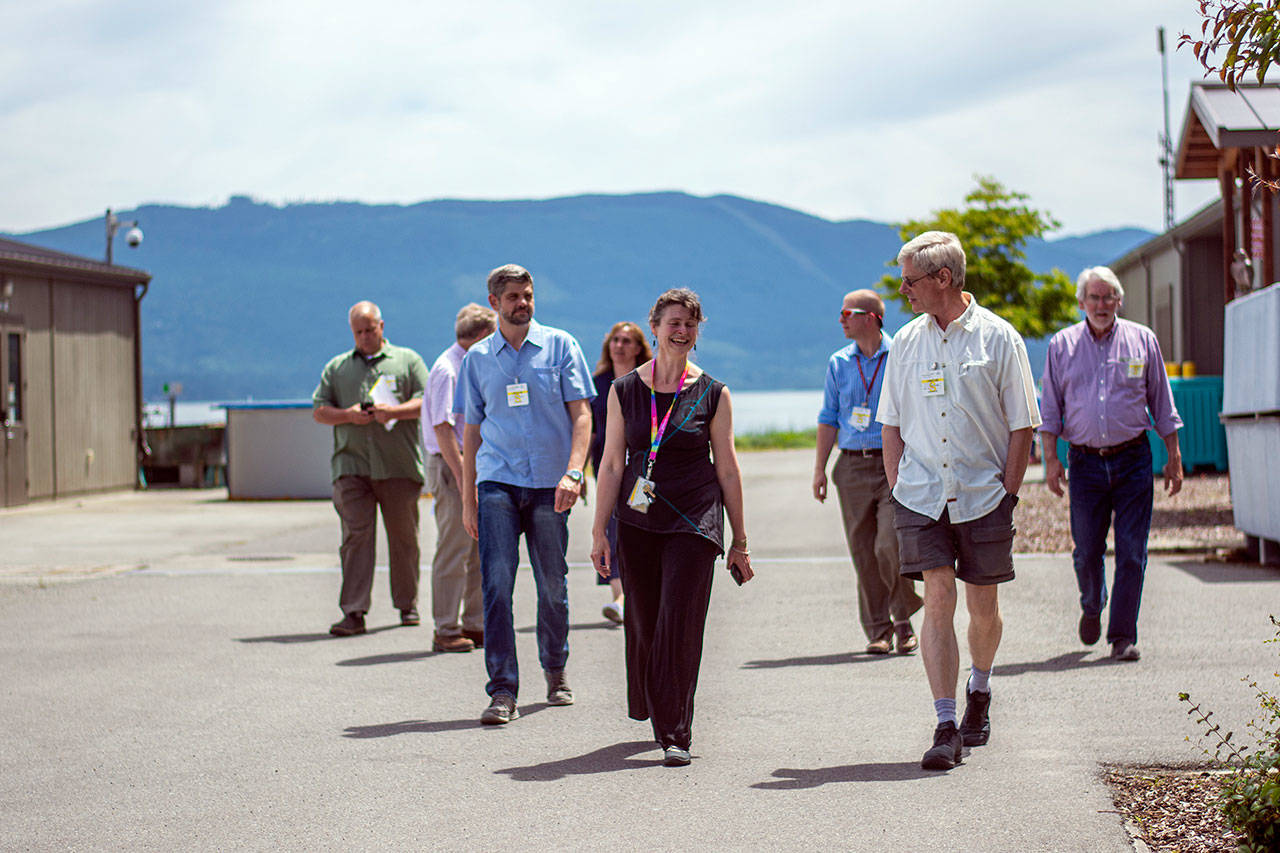
Genevra Harker-Klimes, center, division director of the Pacific Northwest National Laboratory’s Marine Sciences Laboratory, leads a tour through the Sequim facility. (Jesse Major/Peninsula Daily News)
“This freshwater wetland, the upland forest and the river are in balance,” he said. “The forest takes up a bunch of methane, the river and the wetland put out a bunch, and it equals out. These floods tip it over the scale.”
He said a model shows that system will not reach equilibrium for about 15 years.
Ward said he and other scientists are trying to better understand why this equilibrium seems to exist around the world and how it relates to climate change.
“We’re now getting to the point where our quantification of CO2 emissions from aquatic systems is almost balancing the terrestrial landscape,” he said. “Really, we’re trying to understand why that is and how that will change with a change of climate.”
Earth Scientist Kate Buenau told officials about eelgrass, which scientists at the facility have been studying for more than 25 years.
“If you look at all the major plant ecosystems in the world, sea grass … are the second greatest primary producers of carbon after mangrove forests,” she said.
Eelgrass is protected on federal and state levels and it provides habitat for many shellfish and smaller sea critters, she said. The state has a “no net loss” policy that prohibits projects from reducing the amount of eelgrass.
She said there are a number of things that affect eelgrass growth, such as amount of light, temperature of water, pollution and heat outside of water.
She told officials that during the 2015 drought Canada geese began eating more eelgrass than they typically would because they apparently had fewer food sources on land that summer.
This led to the destruction of an eelgrass bed the facility had been monitoring for many years.
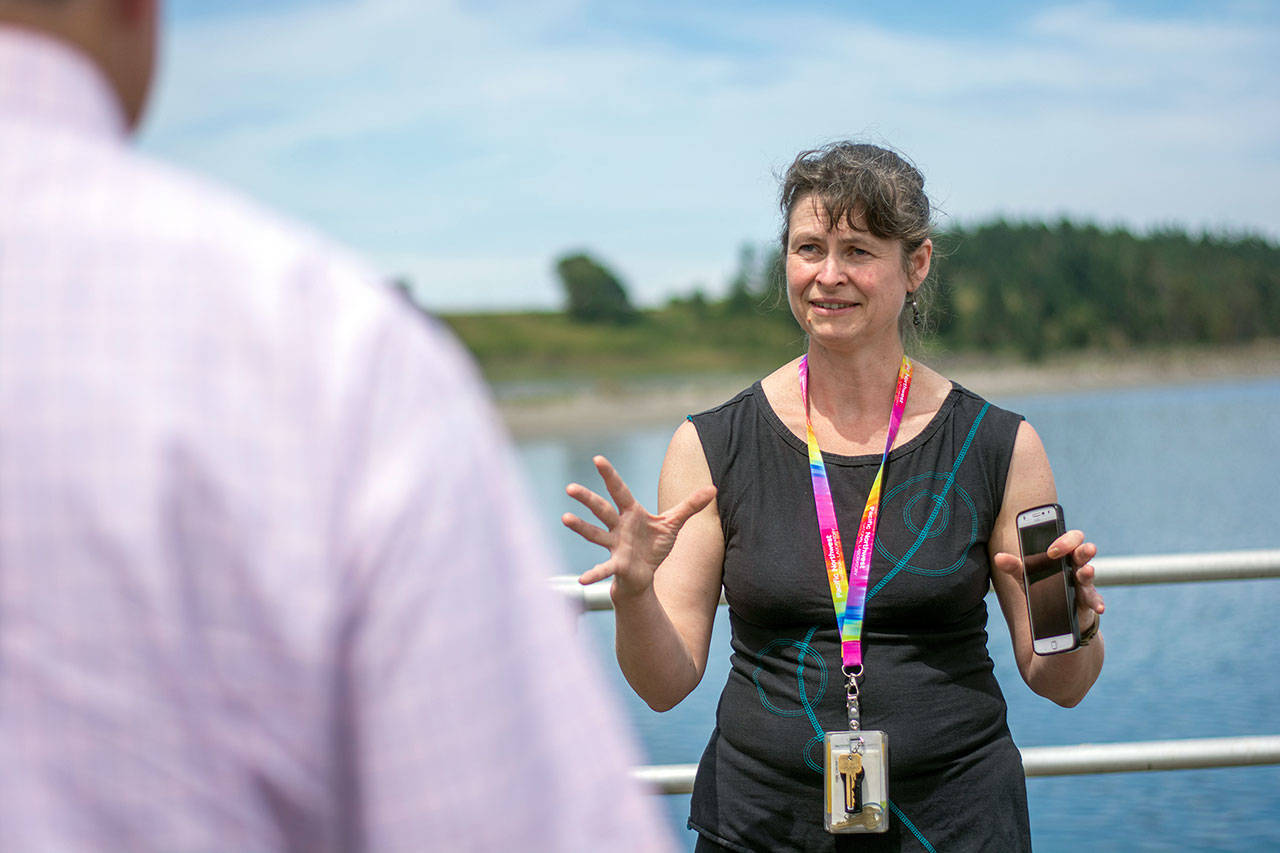
Genevra Harker-Klimes, division director of the Pacific Northwest National Laboratory’s Marine Sciences Laboratory, leads a tour through the Sequim facility. (Jesse Major/Peninsula Daily News)
“We can’t stop the ocean from warming, but there might be things locally that can be done to reduce other stresses so that the climate stresses are not overwhelming,” she said. “Water quality especially is a focus for that research.”
Biologist Scott Edmundson, told the officials about how the lab hopes to partner with local agencies and companies on projects to reduce carbon emissions.
He said there have been discussions with McKinley Paper Co., which is working to reopen the mill on Ediz Hook by the end of the year.
“They are really interested in their environmental footprint and having a positive environmental externality,” Edmundson said.
He said McKinley will be focused on recycled materials, but a large fraction of the material the company will truck in will not be usable.
“The project is really looking at can we apply PNNL expertise and algal cultivation expertise and technology,” he said. “If we can pull this all together we would get more jobs, more industry, renewable fuels, clean water and be able to recycle carbon.”
Edmundson said McKinley isn’t the only local organization seeking PNNL’s expertise.
The Jamestown S’Klallam Tribe is interested in growing algae to help with oyster cultivation, he said.
“They would love to boost their algal production capabilities because they have a booming business in oyster cultivation,” he said. “There’s massive potential.”
________
Reporter Jesse Major can be reached at 360-452-2345, ext. 56250, or at jmajor@peninsuladailynews.com.
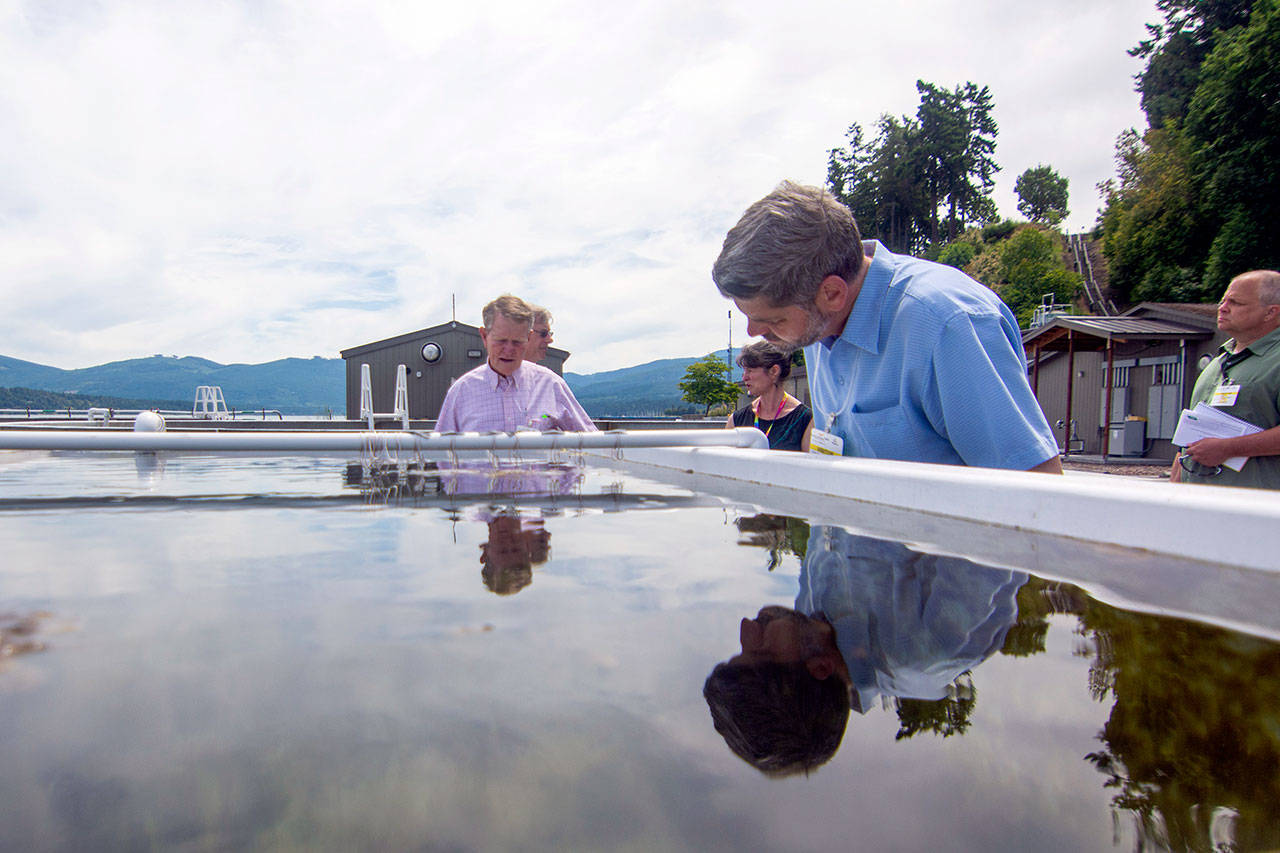
Clallam County Commissioner Mark Ozias inspects eelgrass growing at the Pacific Northwest National Laboratory’s Marine Sciences Laboratory in Sequim. (Jesse Major/Peninsula Daily News)
