
CORRECTION — Tom Berg’s age and occupation after his service in the Navy has been corrected, as well as information about those who died on the USS Arizona and USS Tennessee during the attack on Pearl Harbor.
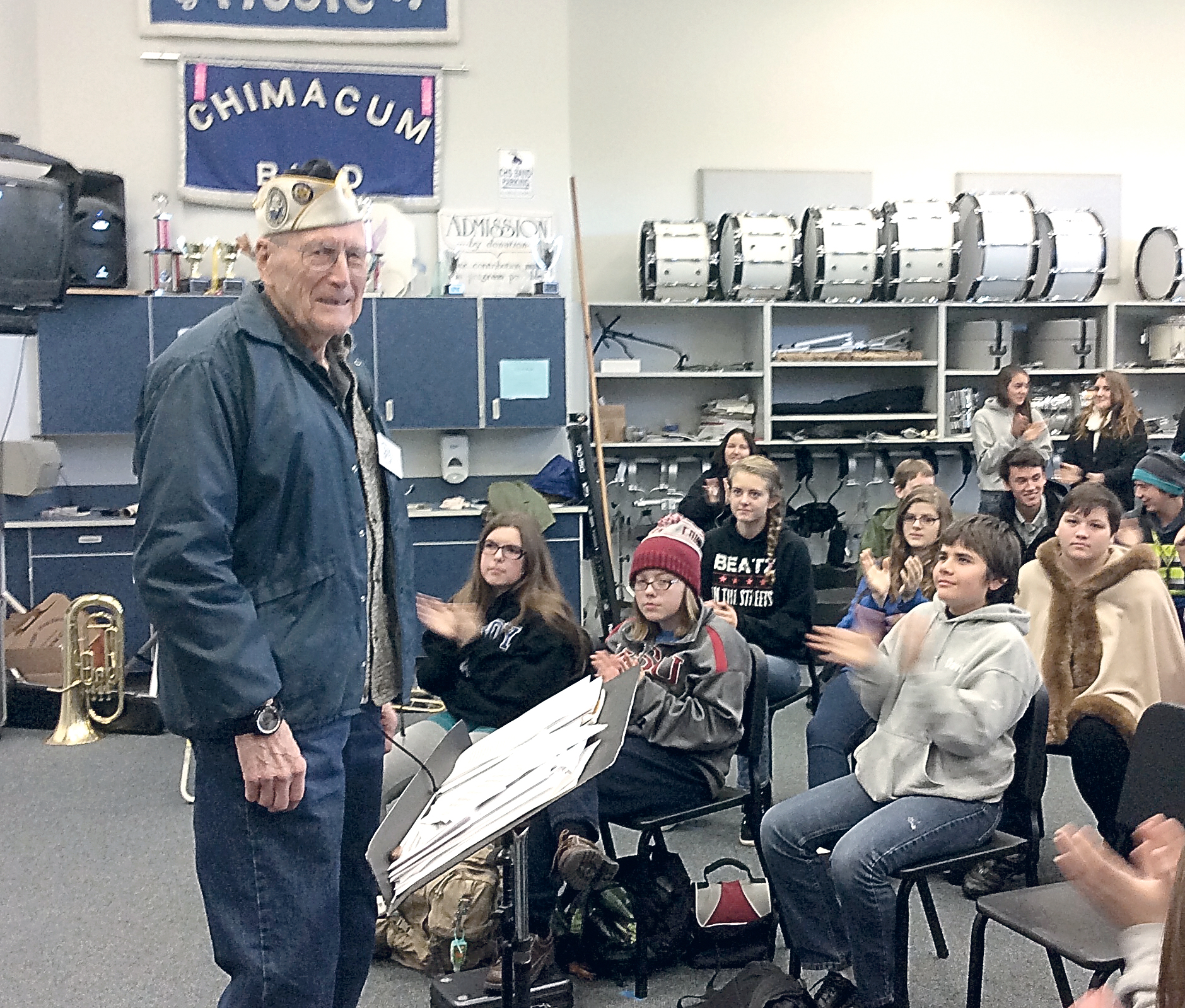
CHIMACUM — As preparation for its appearance in Hawaii’s Pearl Harbor Day Parade, members of the Chimacum High School Marching Band heard a presentation from a Port Townsend man who survived the attack.
Most of the 62 students who are making the trip next month were on hand Wednesday as Tom Berg, 92, who was a crew member on the USS Tennessee on Dec. 7, 1941, offered firsthand knowledge about the Japanese attack that prompted the U.S. entry into World War II.
Band director Garth Gourley said students are excited about going to Honolulu, but he doubted they understand the significance.
“I don’t think the kids are fully prepared for what they are about to see,” he said.
“This was an event that completely changed America, and the visit today gives kids a personal connection more than what they may have read in a book or heard in history class.”
Berg, an Aberdeen native who moved to Jefferson County in 1986, wore his Tennessee cap as he spoke for nearly an hour about his path to Pearl Harbor, the attack and the trip back home.
He enlisted in 1940 when he was 18, celebrating his birthday in July after graduating from high school, and requested assignment to the USS Arizona.
The Arizona exploded and sank in the attack. Of the 1,512 aboard, 1,177 died. The wreck still lies at the bottom of Pearl Harbor and the USS Arizona Memorial straddles the ship’s hull.
“I wanted to be on the Arizona because I knew someone who was on that ship, but they said there was no room and assigned me to the Tennessee,” Berg said.
“If I had gotten onto the Arizona, I’d still be there.”
Five people died on the Tennessee, which was moored near the Arizona during the attack. The ship was repaired and modernized.
Berg said his initial assignment was as a gunner, but he found that boring “because we’d go up on a drill, sit there and do nothing and talk to the guy next to you,” so he requested reassignment to the boiler room.
On the day of the attack, a Sunday, the crew was preparing for an inspection the next day when he saw an airplane with the large red disc of the flag of Japan on its wings diving toward land.
At the time, he thought the training exercises had become more realistic by painting the planes to appear Japanese.
A few minutes later, a crewman yelled a warning of the attack.
Berg and the other crewmen didn’t believe him until an explosion knocked them off their seats.
After the attack, the ship’s deck was covered with spent shells stacked several inches high.
A few days later, when the Arizona was resting at the bottom with only its mast above the water, the bodies began to float up, Berg said.
“At first, you could see [only] their backs since their heads and legs were still under water,” Berg said.
“They fished them out and took them to a big swimming pool and stored them there for a while.”
As devastating as the attack was, it could have been much worse, Berg said.
“There were several large oil storage tanks nearby which the Japanese did not bomb,” he said.
“If they had, it would have caused a huge oil spill.
“We are lucky that they only had one thing in mind.”
Among Berg’s few possessions was his violin.
“I’d been playing since I was 8 years old, and I played to relax,” he said.
“I’d go into a storage room where there was lots of metal and play. The sound would come back. It sounded like I was playing with an orchestra.”
Since the violin was stored below the water line, it was not damaged in the attack.
Berg plays that same instrument as a member of the Port Townsend Community Orchestra.
After serving in the Navy for six years, Berg earned a bachelor’s degree in mechanical engineering. He worked as a professional mechanical engineer for 16 years in the Bremerton shipyard and for 12 years at Naval Torpedo Station, Keyport, before retiring in 1977.
He travels to Pearl Harbor each year for the parade.
He told the students to stay out of the souvenir shops and spend as much time in the museum as possible “so you can learn why the Japanese were mad at us.”
The band raised the $70,000 needed to subsidize the trip with a series of student work programs, concerts and other fundraisers that subsidized every student who wanted to make the trip, Gourley said.
Chimacum School is the only one in the state to send a band to the commemorative parade.
The entourage will leave Dec. 3 and return Dec. 8.
The students will rehearse intensively in the time leading up to departure, Gourley said.
“We’ve learned our parade piece and are ready to go outside and try it out,” he added.
At the parade, the band will play four selections: “Sousa!,” “America the Beautiful,” “Requiem for a Soldier” and “God Bless America,” which it will perform in conjunction with the U.S. Marine Corps Forces Pacific Band.
________
Jefferson County Editor Charlie Bermant can be reached at 360-385-2335 or cbermant@peninsuladailynews.com.
