
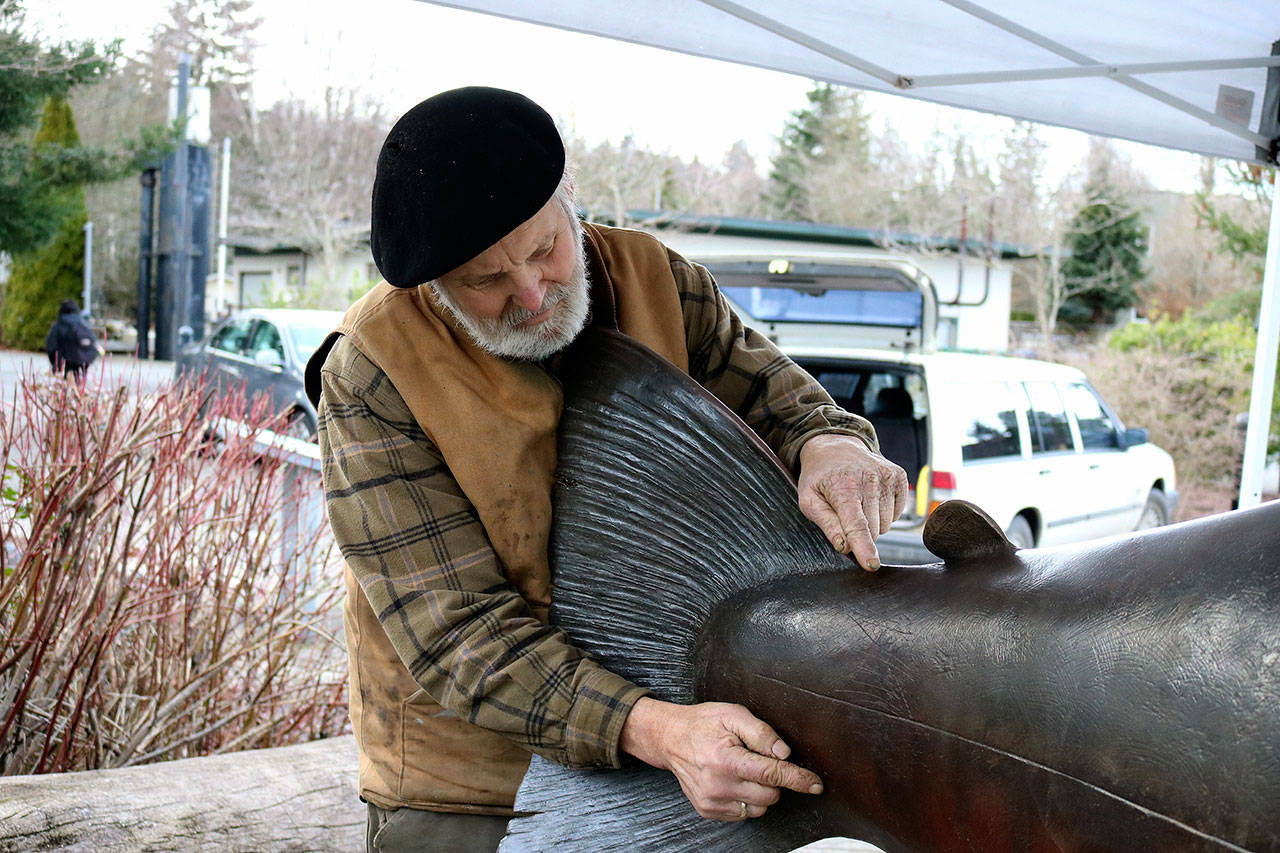
CHIMACUM — Tom Jay was a different kind of leader. He worked with multiple mediums and stretched across boundaries to educate, celebrate and restore Jefferson County watersheds.
He was a bronze sculptor, a published author and an environmental advocate.
A co-founder of Wild Olympic Salmon with his wife, Sara Johani, Jay died Nov. 10 at age 76.
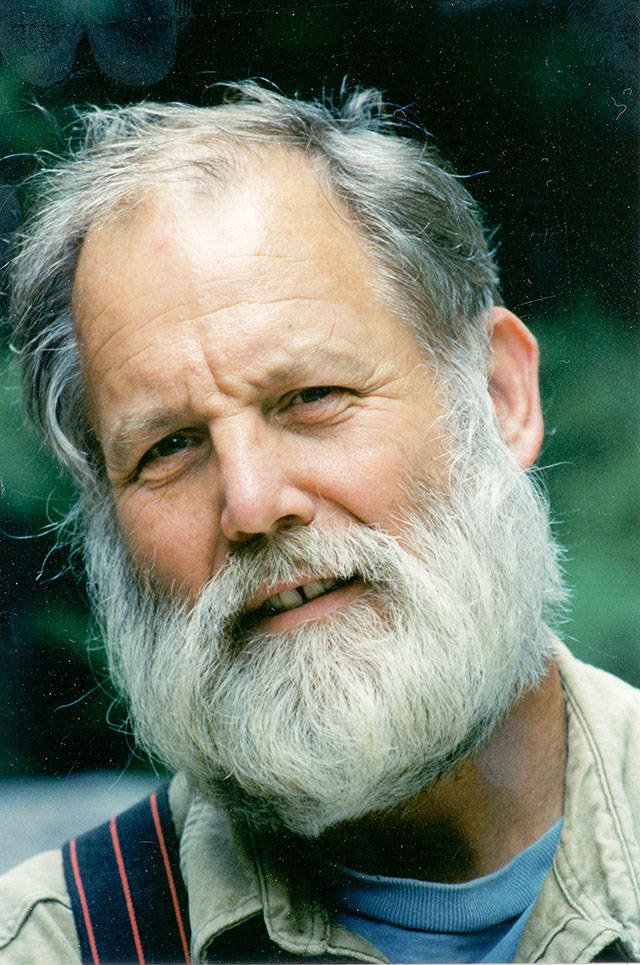
Tom Jay
Hundreds of people attended his celebration of life ceremony on Tuesday at Finnriver Farm & Cidery.
“He saw salmon as kind of a literal and metaphorical weaver of both the community and the ecosystem locally,” said Dru Jay, Tom and Sara’s son.
Tom grew up in many different places throughout the country, but once he settled in the Chimacum Valley, he never budged, Dru said.
“He put down roots, and he didn’t pull them up,” said Dru, a 1998 Chimacum High School graduate who now works in Montreal, Quebec, Canada as a writer.
Tom went to Pomona College in Claremont, Calif., a private liberal arts school, and finished his bachelor’s degree at Seattle University, where he built the school’s first bronze casting facility. He went on to earn a master of fine arts degree from the University of Washington in 1969, and then established Riverdog Fine Arts Foundry in Chimacum.
“When he first heard the sound of the furnace and saw the bronze being melted, he had a revelation,” Dru said. “He knew what he was going to do with his life.”
Tom ran a commercial foundry and cast the work of other artists. During recessions, Dru said his father would take on other jobs, such as welding wood-burning stoves and selling them.
In the late 1980s, the original foundry burned down. The operation moved briefly to Fort Worden while a new one was constructed.
“There was a big community mobilization,” Dru said. “A lot of different artists and people from the community really stepped up, and they held a huge art auction at the [Jefferson County] fairgrounds. They even got an old farm auction guy to come up and do the auction.”
Many people wanted to watch when the foundry was active, Dru said.
“The pours would be this big community effort,” he said. “People would just gather to see it.
“It’s like watching alchemy in action. It’s like nothing you’ve ever seen.”
So was the impact Tom had on the environment.
Wild Olympic Salmon is the predecessor of the North Olympic Salmon Coalition, whose executive director, Rebecca Benjamin, recalled the passion with which Tom served.
“He was so dedicated to this community, to the salmon,” she said. “His commitment to salmon was from the heart.
“A lot of people gained inspiration from Tom and Sara. Those two walked hand-in-hand throughout their marriage and their life.”
Wild Olympic Salmon was known for its restoration work, Benjamin said.
“They were trying to reconnect the non-native people with the importance of salmon history and salmon culture,” she said. “He really built the foundation of where we’re all working from today in terms of salmon recovery and community celebration.”
One of the lasting projects was a game called Dragon Tracking, a form of geocaching before global-positioning system coordinates were readily accessible.
Tom used bronze and cast pieces he called dragon footprints, and they were placed in about a dozen locations throughout the county, from the top of Mount Walker to upper Snow Creek, and from the Dosewallips River to Lake Leland and beyond.
“He created these trading cards and workbooks,” said Lela Hilton, the executive director of the national Clemente Course in the Humanities, which is taught at Fort Worden. “It was like a treasure hunt.
“There was an illustrated book with clues and cards, usually in rhymes referring to local flora, fauna and geology, and you’d have to figure it out.”
It brought families together 25 years ago, Hilton said, because they would spend a whole year hiking and trying to explore to find the dragon tracks.
Al Latham, Bruce Marston, Cheri Scalf and others met Tom through Wild Olympic Salmon.
Many of them worked to restore summer chum to Chimacum Creek.
“He worked with landowners who probably weren’t very receptive, but he was able to be non-judgmental about other people’s views, and he could work with anybody,” said Latham, who knew Tom for about 40 years.
“People flocked to be around him. He had a subtle charisma, a very humble guy who was always fun to be with, and he always had some interesting perspective on the world to share.”
Latham said the two of them were in the woods one day, scoping out a project in the rain.
“He weighed a lot more than I did, and I just remember going through this wet, mucky soil,” Latham said. “I was walking on top of it, and I turned around and Tom was making post holes with every step. He just shrugged his shoulders and laughed.”
Marston said he joined Tom to bring back summer chum at Chimacum Creek, where they were no longer running. They believed their closest relatives were in Salmon Creek due to a 15 percent stray factor, so they created a hatchery to enhance the run at Salmon Creek and reintroduced the eggs to Chimacum Creek.
“Ultimately, we did it very successfully,” he said.
Scalf, who joined Tom in October as a winner of the Eleanor Stopps Environmental Leadership Award, works today as a scientific technician for the state Department of Fish and Wildlife.
But when she met him, she was staying home with her kids, having most recently worked as a nurse.
“I answered a newspaper article that said if you’re interested, call Tom Jay,” Scalf said. “I got up the courage to call him because it was my watershed, my community, and I had been primed by that dragon tracking game to think about my watershed and my community.”
Tom told a group they could each take a day to be responsible for salmon eggs as they worked to restore the run to Chimacum Creek.
“Very casually, I signed up for a day,” Scalf said. “From then on, I was hooked.”
Just last month, Scalf said Tom was counting the chum as they returned to spawn.
“Even when he couldn’t do it himself, he would stand on the bank and walk them through it,” she said.
“He was working and teaching and creating, right up until the very end.”
________
Jefferson County Managing Editor Brian McLean can be reached at 360-385-2335, ext. 6, or at bmclean@peninsuladailynews.com.
