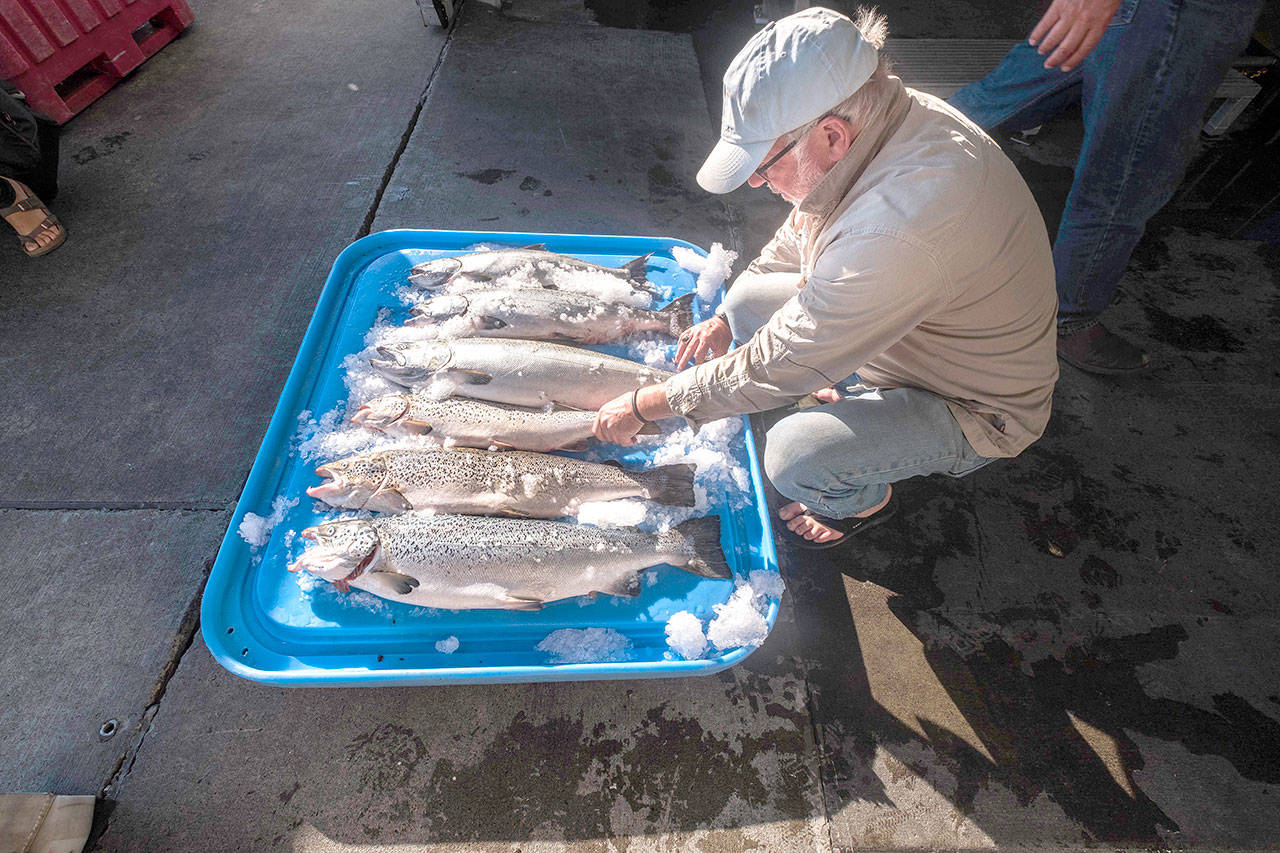
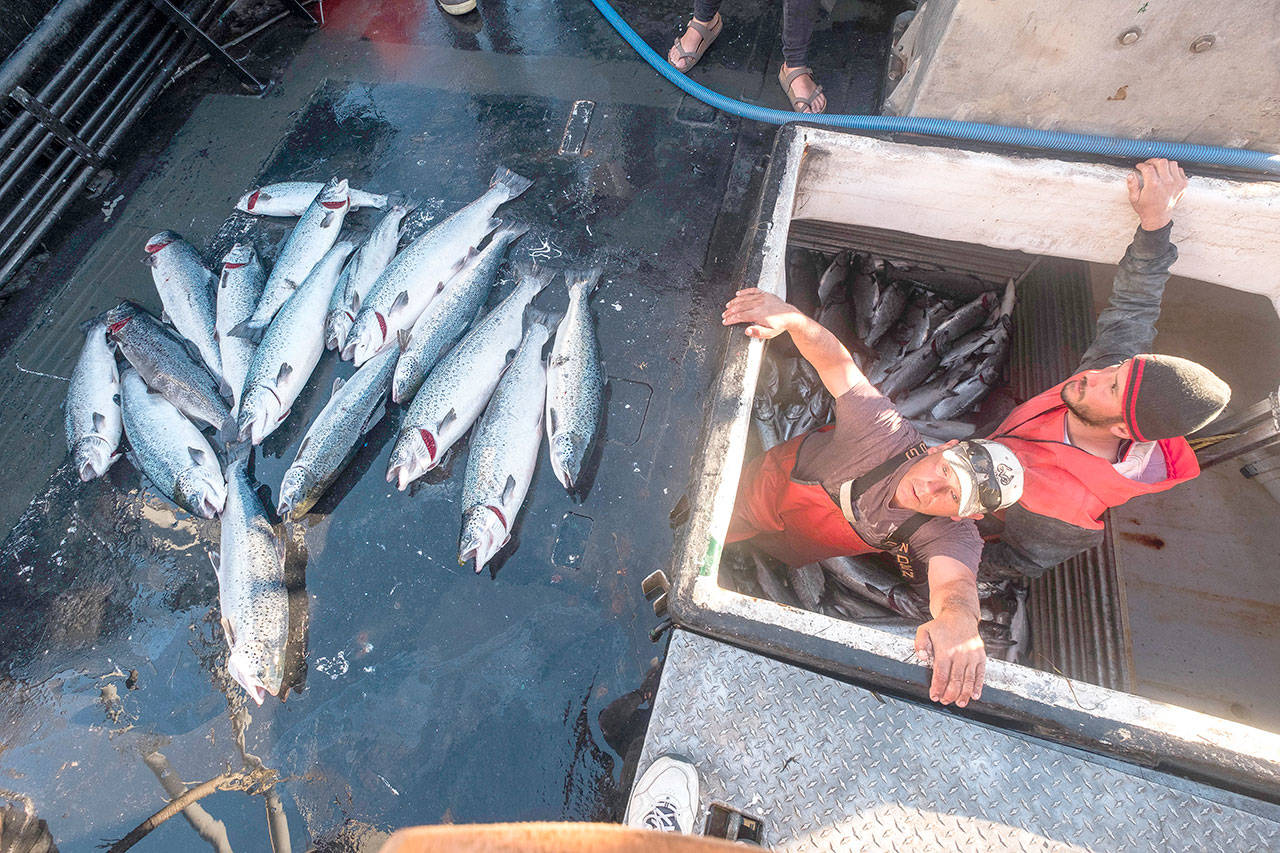
PORT ANGELES — A marine net pen holding 305,000 farmed Atlantic salmon that collapsed in Skagit County recently, releasing thousands of fish into Puget Sound, has renewed concerns that a new proposed salmon farm could harm wild salmon stock and cause other environmental damage.
The release at Cooke Aquaculture’s facility at its farm off Cypress Island in Skagit County comes as the company is proposing an expanded commercial facility in the Strait of Juan de Fuca near Port Angeles.
Canada-based Cooke, which operates five salmon farms in Washington state that it acquired last year, would build 14 floating circular net pens about 1½ miles offshore.
It would move current operations from Port Angeles Harbor, cutting down the number of pens but making them slightly larger and moving them apart, according to general manager Innes Weir in April.
The project is in the permitting phase. A county hearing examiner hearing on the project is planned Sept. 7.
The Sierra Club North Olympic Group will host a public forum, “Stop Atlantic Salmon Net Pens Infecting the Strait,” from 6 p.m. to 8 p.m. Tuesday at the Sequim Transit Center, 190 W. Cedar St. Kurt Beardslee, executive director of the Wild Fish Conservancy, and Chris Wilke, executive director of Puget Soundkeeper Alliance, will speak.
Cooke bought Icicle Seafoods, which operated the Port Angeles Atlantic salmon farm, in 2016.
Critics say the recent fish escape highlights potential risks of open-sea fish farming. They worry about water pollution from fish feed and the potential for farmed fish to spread diseases and parasites to wild fish.
“These are open net pens. They’re not isolated from surrounding environment,” said Wilke of the Puget Soundkeeper Alliance, which opposes the project.
Ron Warren, who heads the state Department of Fish and Wildlife’s fish program, said there’s no evidence the escaped fish pose a threat to native fish populations, either through disease or crossbreeding with Pacific salmon.
Still, he said, the state wants to protect native fish species and has urged anglers to catch as many escaped salmon, some up to 10 pounds, as possible.
Washington has the largest marine finfish aquaculture industry in the U.S., with farms producing about 17 million pounds of Atlantic salmon each year, according to the state.
While salmon farms have operated for more than 30 years in Washington, they still remain controversial in the Pacific Northwest, where wild salmon reigns supreme.
Alaska has banned commercial finfish aquaculture. Several counties in Washington such as Whatcom County have moved to limit commercial finfish aquaculture. After much controversy, Jefferson County allows finfish aquaculture with restrictions.
Cooke blamed high tides and currents coinciding with Monday’s solar eclipse for the failure over the weekend at its farm off Cypress Island.
“The ongoing tides were a huge challenge,” said Nell Halse, a Cooke spokeswoman.
She said the company called in experts last month to stabilize the salmon farm during high tides, though no fish escaped then.
“We put our best expertise to stabilizing this farm and we had no reason to believe that it would have collapsed on Sunday.”
Critics weren’t buying that reasoning, noting that tides weren’t higher than unusual over the weekend.
“They’re trying to imply that this was some unnatural natural event. This was absolute negligence on their part,” said Beardslee. Fish farms “are polluting every single day a massive amount of phosphorous and nitrogen into the waters that we’re trying to clean up.”
Halse said Cooke had applied for permits to upgrade the net pens at Cypress Island to its level of standards. It also plans to make investments in operations across the state.
“This disaster could have devastating effects and could potentially decimate this year’s run of chinook salmon,” said Merle Jefferson, natural resource director for the Lummi Nation. He worried that the escaped salmon will eat juvenile salmon.
The Lummi Nation has been so concerned about the fish escapes that tribal anglers have been trying to catch the Atlantic salmon before they enter local rivers. The tribe declared a state of emergency Thursday, saying the fish spill needs to be addressed immediately. Tribal officials are worried that farmed salmon will eat native fish or disturb its spawning grounds.
But Michael Rust, science adviser with the National Oceanic and Atmospheric Administration’s aquaculture office, said farmed salmon tend to be domesticated, raised on feed and not used to catching fish or escaping predators. Farmed salmon are more likely to be prey than predator, he said.
He and others note that science and technology advances have improved fish farming practices in the U.S. over the decades and aquaculture operations must meet strict regulations.
Jill Rolland, who directs the U.S. Geological Survey’s Western Fisheries Research Center in Seattle, said she’s not concerned that the escaped fish have any pathogens that will spread to wild fish.
“We have a very strong regulatory environment to ensure that these fish are under veterinary care,” she said.