
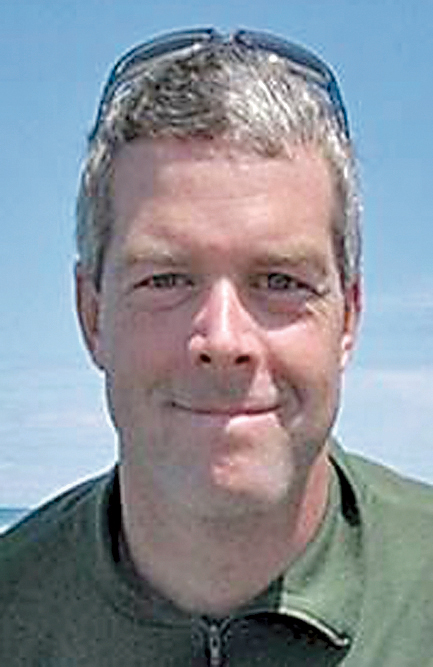
SEQUIM — North Olympic Peninsula communities need to make choices about how to deal with a rising tide, said a coastal hazards specialist.
Sea level is expected to rise, according to a climate change study recently completed by Washington Sea Grant, an extension of the University of Washington, said Ian Miller of Washington Sea Grant during a seminar about the study last week in Sequim.
Port Townsend faces the possibility of more flooding by 2030, while Port Angeles and Neah Bay are so far keeping pace with sea level rises due to plate tectonics.
But both Neah Bay and Port Angeles could begin experiencing an increase in sea levels within the next 85 years.
“What approaches can we take to adapt to sea level rise on the North Olympic Peninsula?” Miller asked.
Ninety-six people attended the seminar, which was held Thursday evening at the Dungeness River Audubon Center.
Much of rising sea levels globally can be attributed to an increase in the amount of heat stored in the oceans, which causes the water to expand, and the addition of new water volume to the oceans as land-grounded ice in Greenland and Antarctica melts, Miller said.
Options for adapting
Locally, there “are a variety of options for adapting to sea level rise on the North Olympic Peninsula,” he said.
One option may be to limit the use of coastal armoring along coastlines.
According to the National Oceanic and Atmospheric Administration, coastal armoring — also referred to as hard armoring — is the erection of seawalls, bulkheads and revetments along the coast, intended to prevent wave erosion and to protect and stabilize the land it supports.
Such infrastructure “intuitively seems like [it] would do a better job of holding back rising seas, but what we find are two things,” Miller said.
“One is that if you do that, you essentially lose the intertidal zone, which [has] ecological, recreation and aesthetic downsides.”
The second reason relies on research “suggesting that over the long term, you would expect that hard armoring strategy would cost more,” Miller said.
“If you try to take a soft shoreline approach, it actually has the possibility of adapting to rising sea levels or modifying in a less expensive manner than hard armoring.”
When it comes to vulnerable infrastructure, “you have three options for sea level rise,” Miller said.
“You can either try to protect it, you can try to adapt it . . . or you can try to move it.”
Using projections from the climate change study, “we can go in advance and try to identify which of these strategies might be applicable for different sorts of infrastructure,” Miller said.
Upon identification, local communities will need to make long-term plans to deal with the projected changes, he said.
Fresh water wells
That will include the relocation of freshwater wells used by area residents along the coast.
“Start thinking about saltwater intrusion in the water supply,” Miller said.
“Some communities draw their water from wells that are relatively near the shoreline. Other places in the country have experienced increasing salt in their water supply. Nobody likes that . . . so starting to think about this for this area” is an important step.
Flooding potential
The study suggests that “eustatic” sea level — the level of the sea irrespective of a change of land elevation due to tectonic events — has risen at a rate of 3 inches to 4 inches per century since about 1940.
However, the land is also moving at different rates in the different communities on the Olympic Peninsula due to the Juan de Fuca Plate subsiding beneath the North American Plate, causing the land to rise.
Because of the rising land mass, the study also considered the “relative” sea level, which is the level of the sea in relation to the land, Miller said.
In Neah Bay, the rising land has caused the relative sea level to decline there at a rate of about 7 inches per century.
In Port Townsend, the land appears to be subsiding faster than the rising eustatic rate at about 6 inches per century, Miller said.
Flooding in PA
The study suggests that as sea levels rise, there is a reasonable chance for a noticeable flooding increase in downtown Port Townsend during winter storm events by 2030.
In Port Angeles, the land is rising but at a slower rate than in Neah Bay, keeping the sea level steady over time.
However, that is expected to change over the next 85 years, with sea levels creeping up in the Port Angeles area, Miller said.
In the coming decades, Port Angeles will begin to experience additional flooding issues along portions of Ediz Hook, including the roadway, he said.
By 2050, “there are a few areas in the downtown area” of Port Angeles and near Ennis Creek “that emerge as potentially vulnerable” to flooding, he added.
“That might be something to start thinking about and planning for as we move into the decades,” he said.
By 2100, the study suggests that “we would get some significant acceleration of sea level rise rates” that could potentially impact U.S. Coast Guard Air Station/Sector Field Office Port Angeles, Miller added.
________
Sequim-Dungeness Valley Editor Chris McDaniel can be reached at 360-681-2390, ext. 5052, or cmcdaniel@peninsuladailynews.com.
