
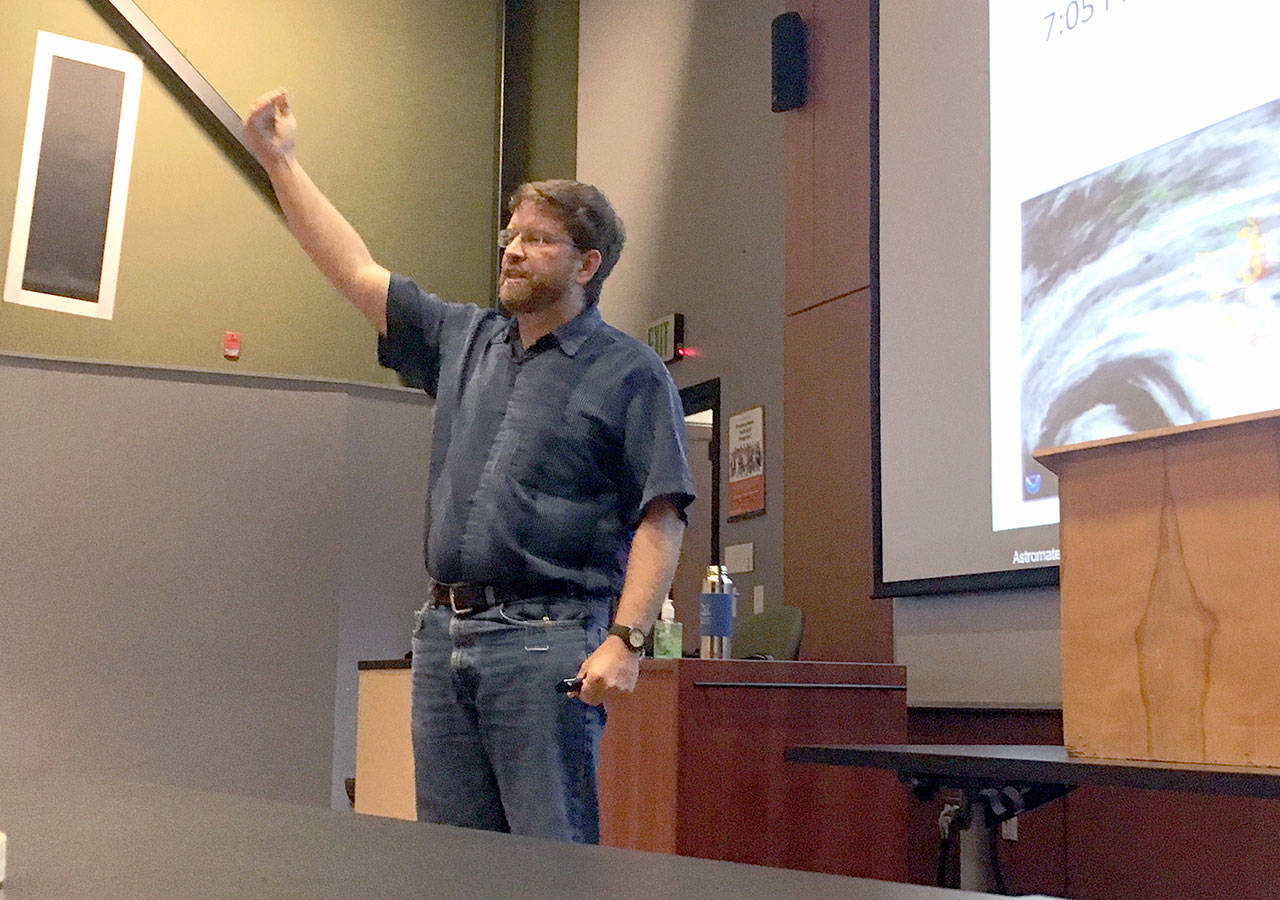
PORT ANGELES — There was something different about the meteorites that fell into the Olympic Coast National Marine Sanctuary on March 7, a NASA scientist suspects.
Cosmic Dust Curator Marc Fries told a Port Angeles audience that the massive space rock that exploded in a supersonic fireball with pieces plunging into the Pacific Ocean was probably “mechanically tough” because of the way it broke apart.
“Weird fall,” Fries said. “Big fall. Fragmented in an unusual pattern.”
Thanks to a potentially-groundbreaking discovery on the exploration vessel Nautilus, Fries will test his hypothesis in a lab at NASA’s Johnson Space Center.
“We did find some small stuff that I believe are fragments of a meteorite,” Fries said in a presentation at Peninsula College on Thursday.
Using a pair of underwater robots, the Nautilus crew on Monday traversed a section of the sanctuary sea floor where Fries believes the largest of the meteorite fragments landed.
Fries used NOAA (National Oceanic and Atmospheric Administration) weather radar from March 7 that painted the column of falling rock fragments and a computer model to predict that larger meteorites landed about 15.5 miles off the Quinault Reservation in about 330 feet of water.
While no large pieces were found in the soft, thick mud, sediment samples from the seafloor revealed two suspected meteorites about four millimeters across with tiny droplets of suspected fusion crust that formed when the meteoroid slammed into the atmosphere at 7:05 p.m. March 7.
“I think this may well be a meteorite — a little one,” Fries said while displaying a slide of one of the samples.
“We’re going to saw this thing open, look into the interior, and we’ll be able to tell from bulk chemistry mineralogical and isotopic analyses of this whether this is just something from the sea floor, or whether it came from meteorites.”
Fries said it would take a “few weeks” to determine if the samples are from space.
If the material is confirmed to be meteoric, Fries and the Nautilus crew will have been the first to find space rock that crashed into an ocean. The material will be kept at the Smithsonian Institution.
The fireball that produced a shock wave and lit the skies above Grays Harbor County on March 7 was the largest meteor reported over the U.S. since weather radar went online in the 1990s, Fries said.
“This is easily the largest, most massive meteorite fall of all of the ones that I’ve showed you,” Fries told a crowd of nearly 100 in Keegan Hall.
“Since radar data has been collecting data, nothing’s come close to the total mass of this one.”
Fries estimated that two tons of meteorites fell into the sanctuary and sank into the soft seafloor four months ago.
The Nautilus was already scheduled to be in the sanctuary when the eight-hour survey took place Monday.
Olympic Coast National Marine Sanctuary Research Coordinator Jenny Waddell had reached out to cosmic scientists to pitch a meteorite survey on the Nautilus, sanctuary Education and Outreach Coordinator Jacqueline Laverdure said.
The Nautilus is operated by the nonprofit Ocean Exploration Trust. Its underwater surveys are shown in real time at www.nautiluslive.org.
Fries formed a hypothesis that the March 7 meteorite was mechanically tough because of the high number of large fragments that survived the fireball relative to the number of small fragments that appeared on Doppler radar.
After the fireball, it takes about 10 minutes for meteorites to fall about 20 kilometers (65,617 feet) to the ground or into a body of water. The smaller the fragment, the more susceptible it is to the wind.
“The largest thing to show up on radar was 4.4 kilograms (9.7 pounds),” Fries said.
“There’s probably larger ones in the water as well. Almost certainly.”
Fries passed around a small ordinary chondrite, the most common type of meteorite. Ordinary chondrites formed when the inner solar system was a disc of particles and cosmic dust about 4.5 billion years ago, Fries said.
In February 2013, an estimated 1,200 Russians were injured by a shock wave caused by the Chelyabinsk meteor. Most of those injuries were from flying glass.
“(If) a meteorite hits a building, it just goes through it like it’s butter,” Fries said.
While up to 20 meteorite falls are discovered around the world every year, there have been no reported deaths from meteorite falls.
An Alabama woman was injured in 1954 when a meteorite smashed into her radio, bounced around her living room and struck her on the hip.
“If it would have hit her directly, it would have killed her,” Fries said.
A boy in Africa was not injured when he heard the sound of falling debris, looked up and was hit by a fingernail-sized meteorite that had caromed off a tree, Fries said.
“As far as we know, no one’s ever been hit and killed by one,” Fries said.
Fries encouraged audience members to use available technology to hunt for meteorites online.
Fireball sightings are available on You Tube and the American Meteor Society website, www.amsmeteors.org.
Once you know when and where a meteor occurred, pull the corresponding NOAA NEXRAD radar images to look for signs of falling rocks, Fries suggested.
The 90-minute presentation was part of Peninsula College’s monthly STEMinar science lecture series. It was co-hosted by NOAA’s Olympic Coast National Marine Sanctuary.
________
Reporter Rob Ollikainen can be reached at 360-452-2345, ext. 56450, or at rollikainen@peninsuladailynews.com.
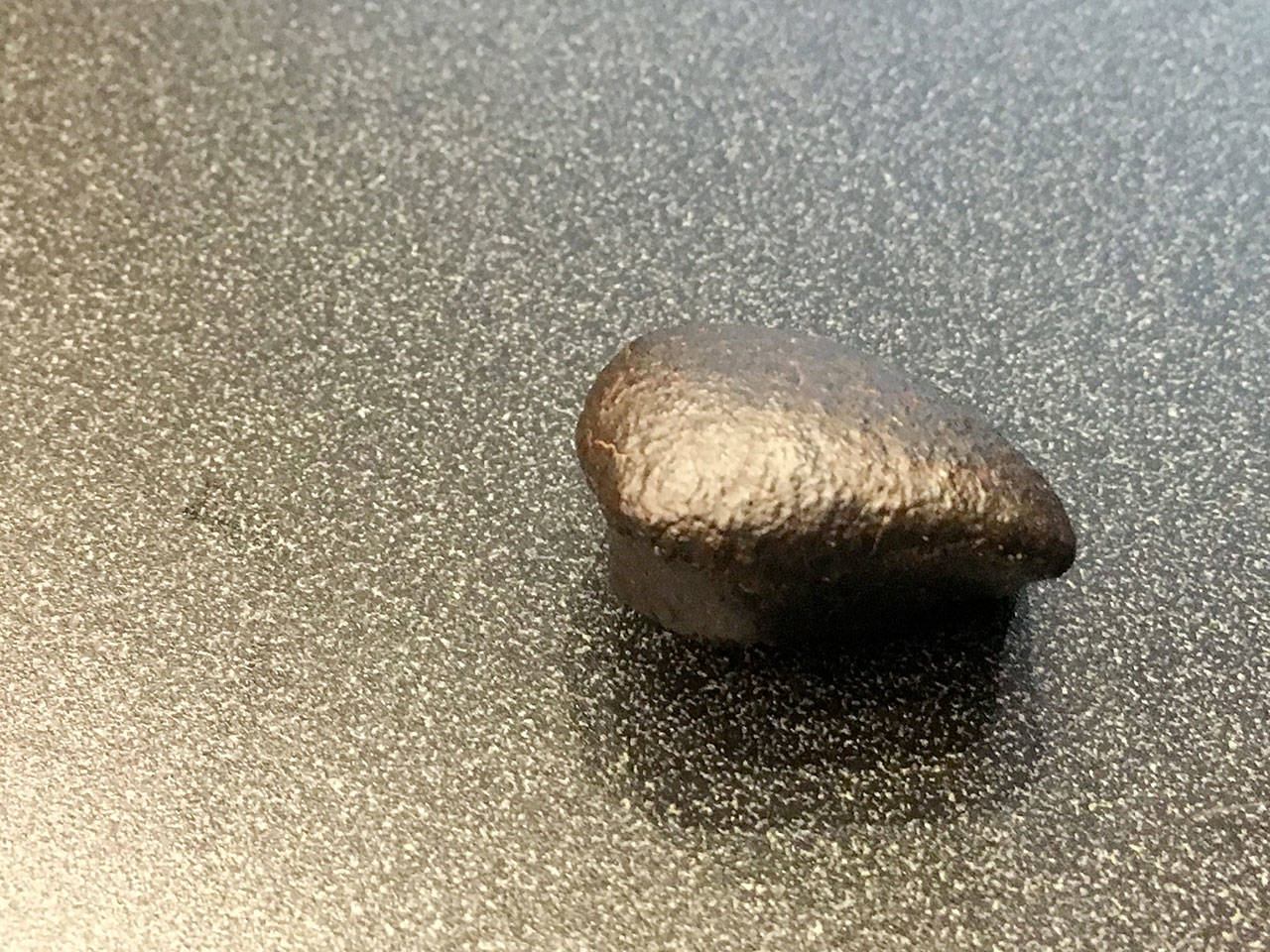
An ordinary chondrite meteorite is shown. Scientists believe meteorites were formed during the birth of the inner solar system about 4.5 billion years ago. (Rob Ollikainen/Peninsula Daily News)
